







Question: Activity 2 - What is a function? Part 1 - The definition of a function A function is a correspondence, or, rule between inputs and
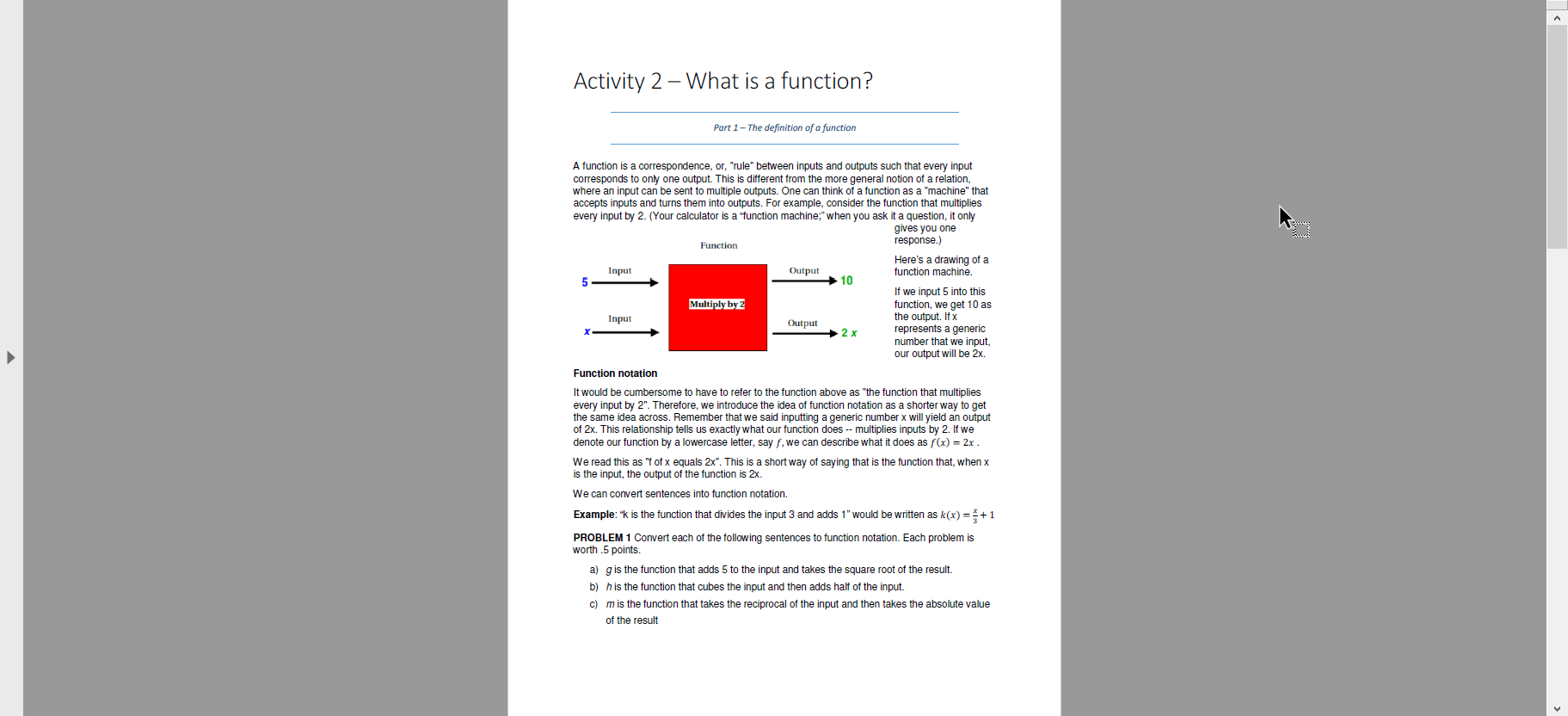
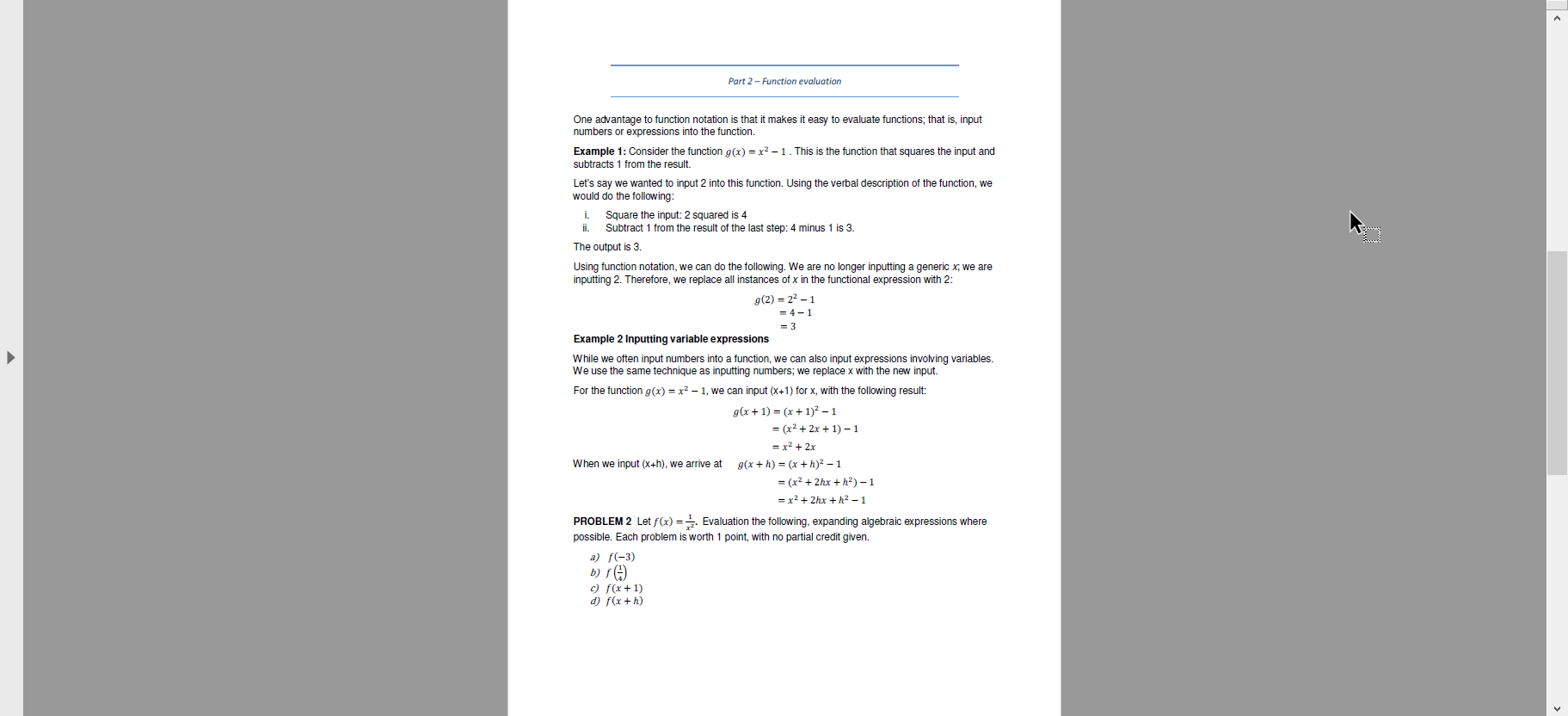
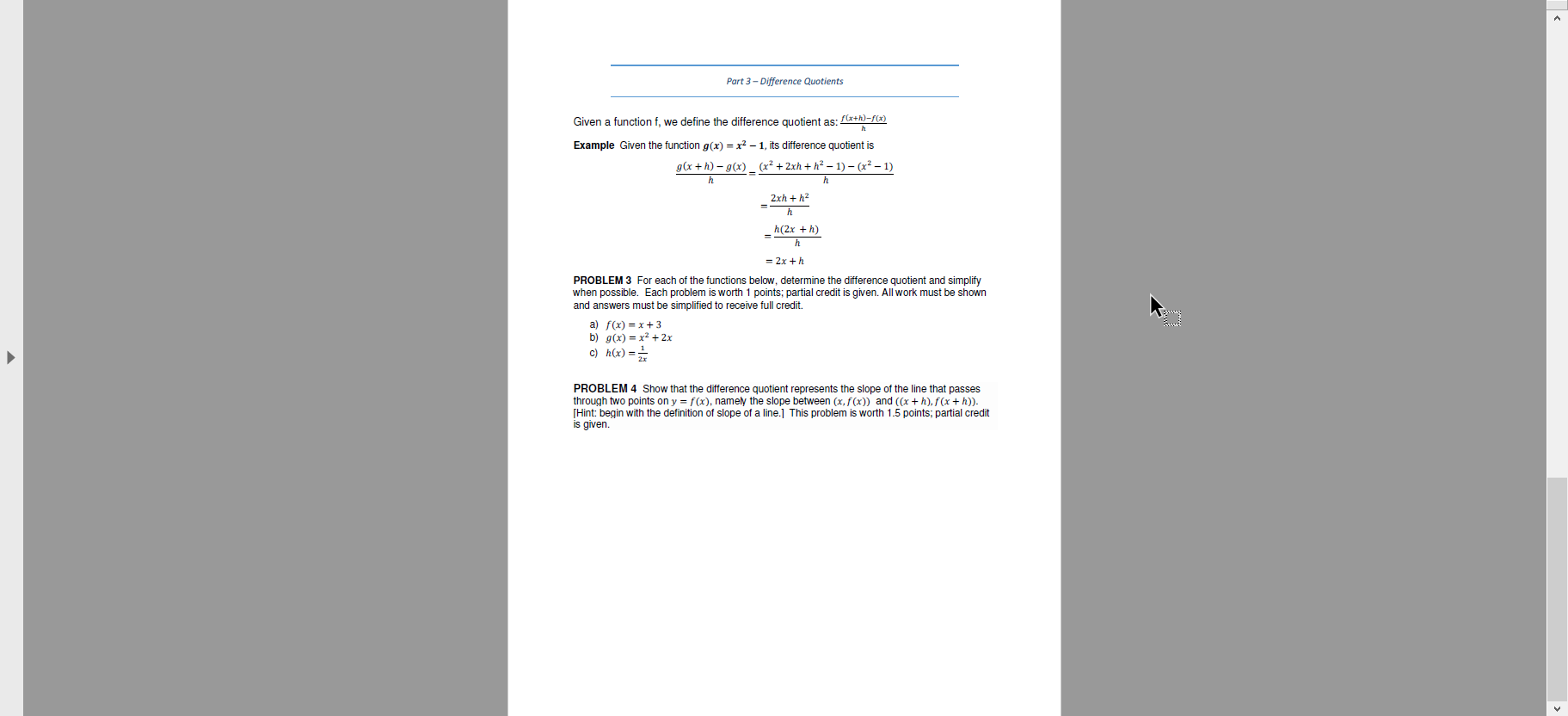
Activity 2 - What is a function? Part 1 - The definition of a function A function is a correspondence, or, "rule" between inputs and outputs such that every input corresponds to only one output. This is different from the more general notion of a relation, where an input can be sent to multiple outputs. One can think of a function as a "machine" that accepts inputs and turns them into outputs. For example, consider the function that multiplies every input by 2. (Your calculator is a "function machine;" when you ask it a question, it only gives you one Function response. Here's a drawing of a Input Output function machine 5 10 If we input 5 into this Multiply by 2 function, we get 10 as Input Output the output. If x 2 X represents a generic number that we input our output will be 2x. Function notation It would be cumbersome to have to refer to the function above as "the function that multiplies every input by 2". Therefore, we introduce the idea of function notation as a shorter way to get the same idea across. Remember that we said inputting a generic number x will yield an output of 2x. This relationship tells us exactly what our function does -- multiplies inputs by 2. If we denote our function by a lowercase letter, say f, we can describe what it does as f(x) = 2x . We read this as "f of x equals 2x". This is a short way of saying that is the function that, when x is the input, the output of the function is 2x. We can convert sentences into function notation. Example: "k is the function that divides the input 3 and adds 1" would be written as k(x) = # + 1 PROBLEM 1 Convert each of the following sentences to function notation. Each problem is worth .5 points. a) g is the function that adds 5 to the input and takes the square root of the result. b) h is the function that cubes the input and then adds half of the input. c) m is the function that takes the reciprocal of the input and then takes the absolute value of the resultPart 2 - Function evaluation One advantage to function notation is that it makes it easy to evaluate functions; that is, input numbers or expressions into the function. Example 1: Consider the function g(x) = x2 - 1 . This is the function that squares the input and subtracts 1 from the result. Let's say we wanted to input 2 into this function. Using the verbal description of the function, we would do the following: Square the input: 2 squared is 4 ii. Subtract 1 from the result of the last step: 4 minus 1 is 3. The output is 3. Using function notation, we can do the following. We are no longer inputting a generic x, we are inputting 2. Therefore, we replace all instances of x in the functional expression with 2: g(2) = 22 - 1 =4-1 = 3 Example 2 Inputting variable expressions While we often input numbers into a function, we can also input expressions involving variables. We use the same technique as inputting numbers; we replace x with the new input. For the function g(x) = x2 - 1, we can input (x+1) for x, with the following result: g(x + 1) = (x +1)2 -1 = (x2+ 2x + 1) - 1 = x2 + 2x When we input (x+h), we arrive at g(x+ h) = (x + h)? -1 = (x2 + 2hx + h2)-1 = x2 + 2hx + h2 -1 PROBLEM 2 Let f(x) = =. Evaluation the following, expanding algebraic expressions where possible. Each problem is worth 1 point, with no partial credit given. a) f(-3) b) f () c) f(x + 1) d) f ( x + h )Part 3 - Difference Quotients Given a function f, we define the difference quotient as: /(x+h)-f(x) Example Given the function g(x) = x2 - 1, its difference quotient is g ( x + h) - g(x) _ (x2 + 2xh+ h2 -1) - (x2 -1) 2xh + h2 h h(2x + h) = 2x + h PROBLEM 3 For each of the functions below, determine the difference quotient and simplify when possible. Each problem is worth 1 points; partial credit is given. All work must be shown and answers must be simplified to receive full credit. a) f(x) = x+3 b) g(x) = x2+2x c) h(x)= PROBLEM 4 Show that the difference quotient represents the slope of the line that passes through two points on y = f(x), namely the slope between (x, f(x)) and ((x + h), f(x + h)). [Hint: begin with the definition of slope of a line.] This problem is worth 1.5 points; partial credit is given
Step by Step Solution
There are 3 Steps involved in it

Get step-by-step solutions from verified subject matter experts
 Study Help