







Question: Activity 3: Place your b strip on the lab table. Place your t strip on top of the b strip (as you did in
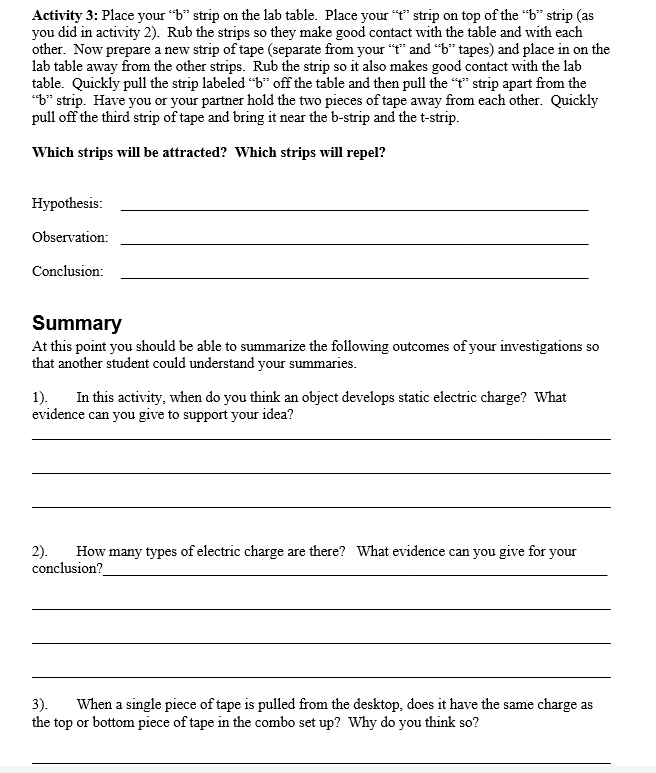
Activity 3: Place your "b" strip on the lab table. Place your "t" strip on top of the "b" strip (as you did in activity 2). Rub the strips so they make good contact with the table and with each other. Now prepare a new strip of tape (separate from your "t" and "b" tapes) and place in on the lab table away from the other strips. Rub the strip so it also makes good contact with the lab table. Quickly pull the strip labeled "b" off the table and then pull the "t" strip apart from the "b" strip. Have you or your partner hold the two pieces of tape away from each other. Quickly pull off the third strip of tape and bring it near the b-strip and the t-strip. Which strips will be attracted? Which strips will repel? Hypothesis: Observation: Conclusion: Summary At this point you should be able to summarize the following outcomes of your investigations so that another student could understand your summaries. 1). In this activity, when do you think an object develops static electric charge? What evidence can you give to support your idea? 2). How many types of electric charge are there? What evidence can you give for your conclusion? 3). When a single piece of tape is pulled from the desktop, does it have the same charge as the top or bottom piece of tape in the combo set up? Why do you think so?
Step by Step Solution
There are 3 Steps involved in it
It looks like youve participated in a science activity related to static electricity Based on the description provided the activity involves rubbing s... View full answer

Get step-by-step solutions from verified subject matter experts
 Study Help