







Question: Activity 4 . 1 . 4 . Suppose that an object moving along a straight line path has its velocity v ( in meters per
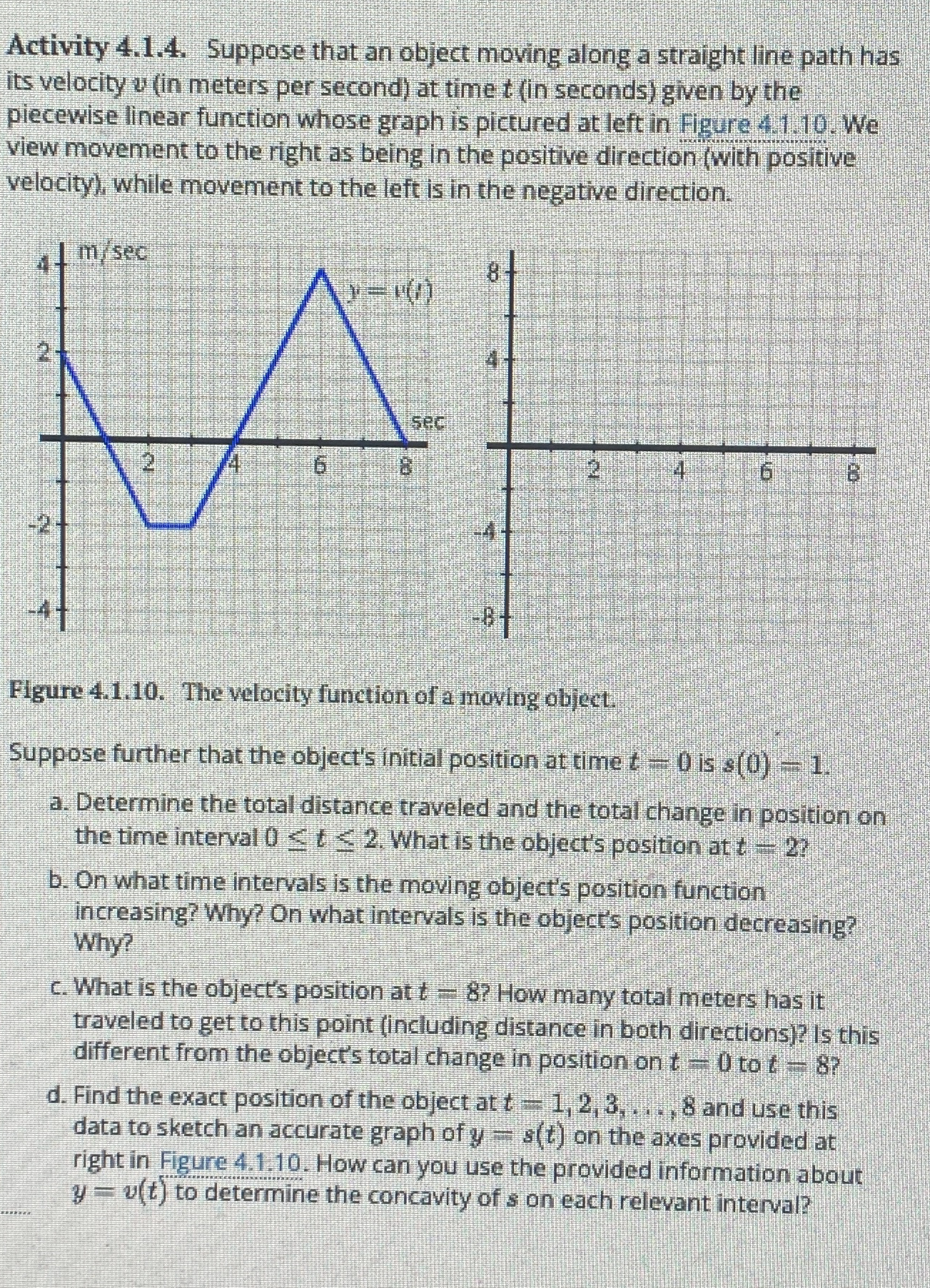
Activity Suppose that an object moving along a straight line path has its velocity in meters per second at time in seconds given by the piecewise linear function whose graph is pictured at left in Figure We view movement to the right as being in the positive direction with positive velocity while movement to the left is in the negative direction.
Figure The velocity function of a moving object.
Suppose further that the object's initial position at time is
a Determine the total distance traveled and the total change in position on the time interval What is the object's position at
b On what time intervals is the moving object's position function increasing? Why? On what intervals is the objects position decreasing? Why?
c What is the object's position at How many total meters has it traveled to get to this point including distance in both directions Is this different from the object's total change in position on to
d Find the exact position of the object at dots, and use this data to sketch an accurate graph of on the axes provided at right in Figure How can you use the provided information about to determine the concavity of on each relevant interval?
Step by Step Solution
There are 3 Steps involved in it
1 Expert Approved Answer
Step: 1 Unlock

Question Has Been Solved by an Expert!
Get step-by-step solutions from verified subject matter experts
Step: 2 Unlock
Step: 3 Unlock
 Study Help