







Question: Activity Cost Pool Activity Base Activity Rate Activity Usage Desks Cabinets Parts receipts Number of parts $ 2.00 per part 2,400 parts 1,700 parts Machining
| Activity Cost Pool | Activity Base | Activity Rate | Activity Usage | |||||||
| Desks | Cabinets | |||||||||
| Parts receipts | Number of parts | $ | 2.00 | per part | 2,400 | parts | 1,700 | parts | ||
| Machining | Machine-hours | $ | 12.00 | per machine-hour | 245 | machine-hours | 360 | machine-hours | ||
| Assembly | Units produced | $ | 2.00 | per unit | 1,200 | units | 1,700 | units | ||
| Quality control | Units tested | $ | 3.00 | per unit | 120 | units | 1,600 | units | ||
| Direct materials | $ | 6,000 | $ | 3,400 | ||||||
| Direct labour | $ | 14,400 | $ | 14,400 | ||||||
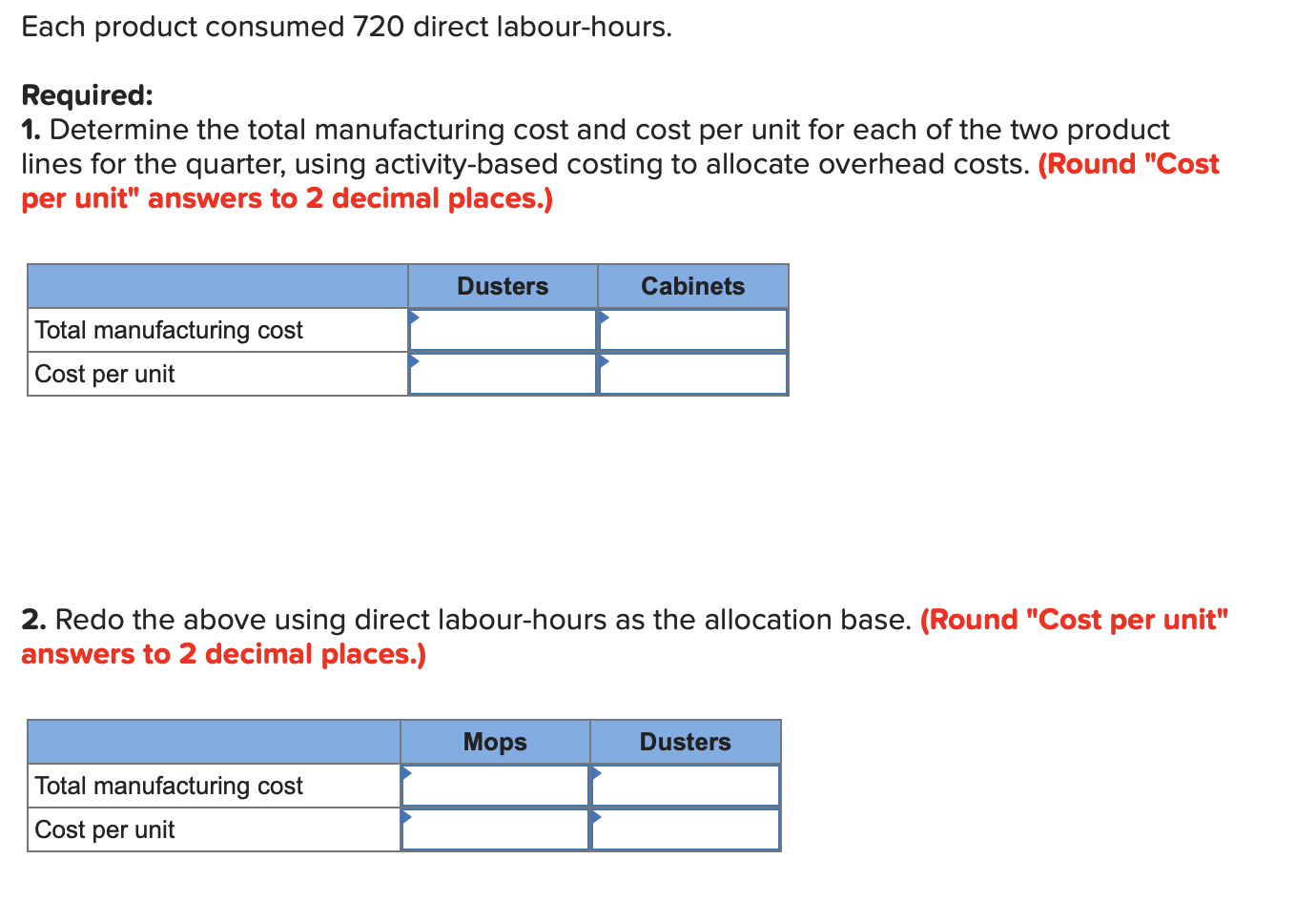 Please fill in the empty boxes
Each product consumed 720 direct labour-hours. Required: 1. Determine the total manufacturing cost and cost per unit for each of the two product lines for the quarter, using activity-based costing to allocate overhead costs. (Round "Cost per unit" answers to 2 decimal places.) Dusters Cabinets Total manufacturing cost Cost per unit 2. Redo the above using direct labour-hours as the allocation base. (Round "Cost per unit" answers to 2 decimal places.) Mops Dusters Total manufacturing cost Cost per unit
Step by Step Solution
There are 3 Steps involved in it
1 Expert Approved Answer
Step: 1 Unlock

Question Has Been Solved by an Expert!
Get step-by-step solutions from verified subject matter experts
Step: 2 Unlock
Step: 3 Unlock
 Study Help