







Question: Activity Hawk Diving There are many situations where motion is non-uniform, really anytime an object deviates from a straight line or changes speed. Because
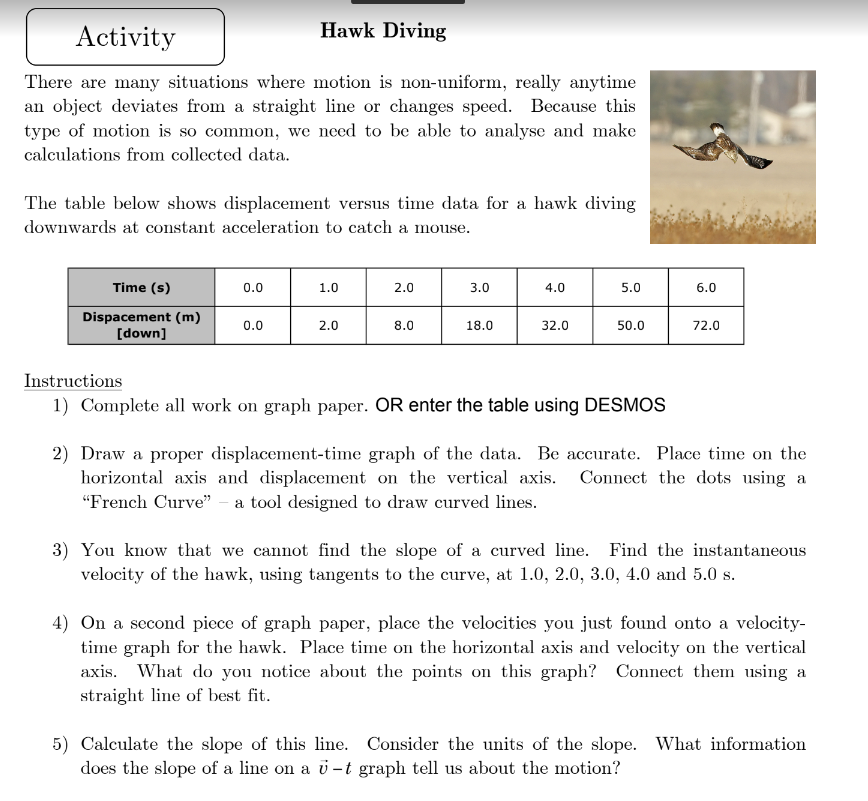
Activity Hawk Diving There are many situations where motion is non-uniform, really anytime an object deviates from a straight line or changes speed. Because this type of motion is so common, we need to be able to analyse and make calculations from collected data. The table below shows displacement versus time data for a hawk diving downwards at constant acceleration to catch a mouse. Time (s) Dispacement (m) [down] 0.0 1.0 2.0 3.0 4.0 5.0 6.0 0.0 2.0 8.0 18.0 32.0 50.0 72.0 Instructions 1) Complete all work on graph paper. OR enter the table using DESMOS 2) Draw a proper displacement-time graph of the data. Be accurate. Place time on the horizontal axis and displacement on the vertical axis. Connect the dots using a "French Curve" - a tool designed to draw curved lines. 3) You know that we cannot find the slope of a curved line. Find the instantaneous velocity of the hawk, using tangents to the curve, at 1.0, 2.0, 3.0, 4.0 and 5.0 s. 4) On a second piece of graph paper, place the velocities you just found onto a velocity- time graph for the hawk. Place time on the horizontal axis and velocity on the vertical axis. What do you notice about the points on this graph? Connect them using a straight line of best fit. 5) Calculate the slope of this line. Consider the units of the slope. What information does the slope of a line on a -t graph tell us about the motion?
Step by Step Solution
There are 3 Steps involved in it

Get step-by-step solutions from verified subject matter experts
 Study Help