







Question: Adaptive Expectations, Rational Expectations, Optimal Forecast, January Effect CONCEPTS IN THIS CASE: adaptive expectations rational expectations optimal forecast unexploited profit opportunity random walk January effect
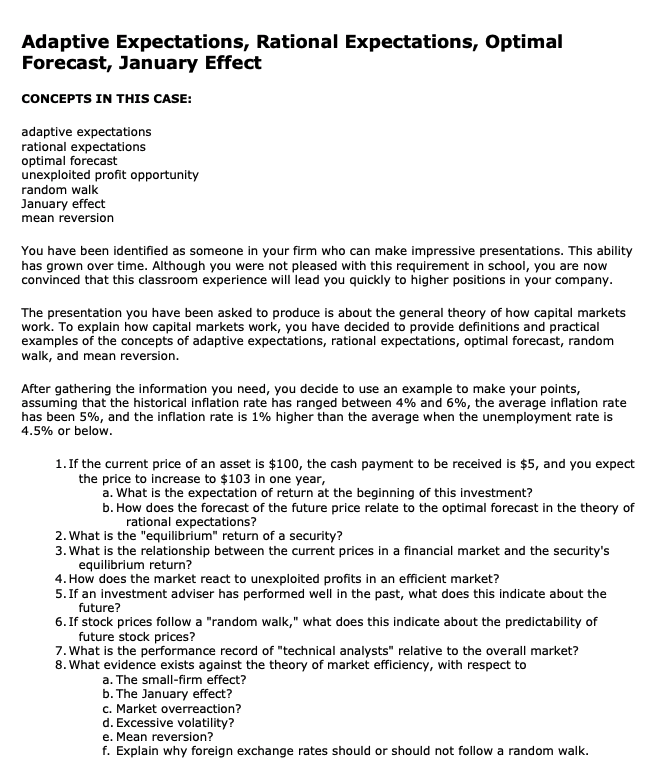
Adaptive Expectations, Rational Expectations, Optimal Forecast, January Effect CONCEPTS IN THIS CASE: adaptive expectations rational expectations optimal forecast unexploited profit opportunity random walk January effect mean reversion You have been identified as someone in your firm who can make impressive presentations. This ability has grown over time. Although you were not pleased with this requirement in school, you are novw convinced that this classroom experience will lead you quickly to higher positions in your company The presentation you have been asked to produce is about the general theory of how capital markets work. To explain how capital markets work, you have decided to provide definitions and practical examples of the concepts of adaptive expectations, rational expectations, optimal forecast, random walk, and mean reversion After gathering the information you need, you decide to use an example to make your points assuming that the historical inflation rate has ranged between 496 and 696, the average inflation rate has been 596, and the inflation rate is 1% higher than the average when the unemployment rate is 4.5% or below 1.If the current price of an asset is $100, the cash payment to be received is $5, and you expect the price to increase to $103 in one year a. What is the expectation of return at the beginning of this investment? b. How does the forecast of the future price relate to the optimal forecast in the theory of rational expectations? 2. What is the "equilibrium" return of a security? 3. What is the relationship between the current prices in a financial market and the security's equilibrium return? 4. How does the market react to unexploited profits in an efficient market? 5. If an investment adviser has performed well in the past, what does this indicate about the 6. If stock prices follow a "random walk," what does this indicate about the predictability of 7. What is the performance record of "technical analysts" relative to the overall market? future? future stock prices? 8. What evidence exists against the theory of market efficiency, with respect to a. The small-firm effect? b. The January effect? c. Market overreaction? d. Excessive volatility? e. Mean reversion? f. Explain why foreign exchange rates should or should not follow a random walk. Adaptive Expectations, Rational Expectations, Optimal Forecast, January Effect CONCEPTS IN THIS CASE: adaptive expectations rational expectations optimal forecast unexploited profit opportunity random walk January effect mean reversion You have been identified as someone in your firm who can make impressive presentations. This ability has grown over time. Although you were not pleased with this requirement in school, you are novw convinced that this classroom experience will lead you quickly to higher positions in your company The presentation you have been asked to produce is about the general theory of how capital markets work. To explain how capital markets work, you have decided to provide definitions and practical examples of the concepts of adaptive expectations, rational expectations, optimal forecast, random walk, and mean reversion After gathering the information you need, you decide to use an example to make your points assuming that the historical inflation rate has ranged between 496 and 696, the average inflation rate has been 596, and the inflation rate is 1% higher than the average when the unemployment rate is 4.5% or below 1.If the current price of an asset is $100, the cash payment to be received is $5, and you expect the price to increase to $103 in one year a. What is the expectation of return at the beginning of this investment? b. How does the forecast of the future price relate to the optimal forecast in the theory of rational expectations? 2. What is the "equilibrium" return of a security? 3. What is the relationship between the current prices in a financial market and the security's equilibrium return? 4. How does the market react to unexploited profits in an efficient market? 5. If an investment adviser has performed well in the past, what does this indicate about the 6. If stock prices follow a "random walk," what does this indicate about the predictability of 7. What is the performance record of "technical analysts" relative to the overall market? future? future stock prices? 8. What evidence exists against the theory of market efficiency, with respect to a. The small-firm effect? b. The January effect? c. Market overreaction? d. Excessive volatility? e. Mean reversion? f. Explain why foreign exchange rates should or should not follow a random walk
Step by Step Solution
There are 3 Steps involved in it

Get step-by-step solutions from verified subject matter experts
 Study Help