







Question: AD-AS Model with Stabilizing Monetary Policy 1. Suppose the aggregate demand for an economy is given by the following equation: yt=mtPt+1't where V; = lls1
AD-AS Model with Stabilizing Monetary Policy
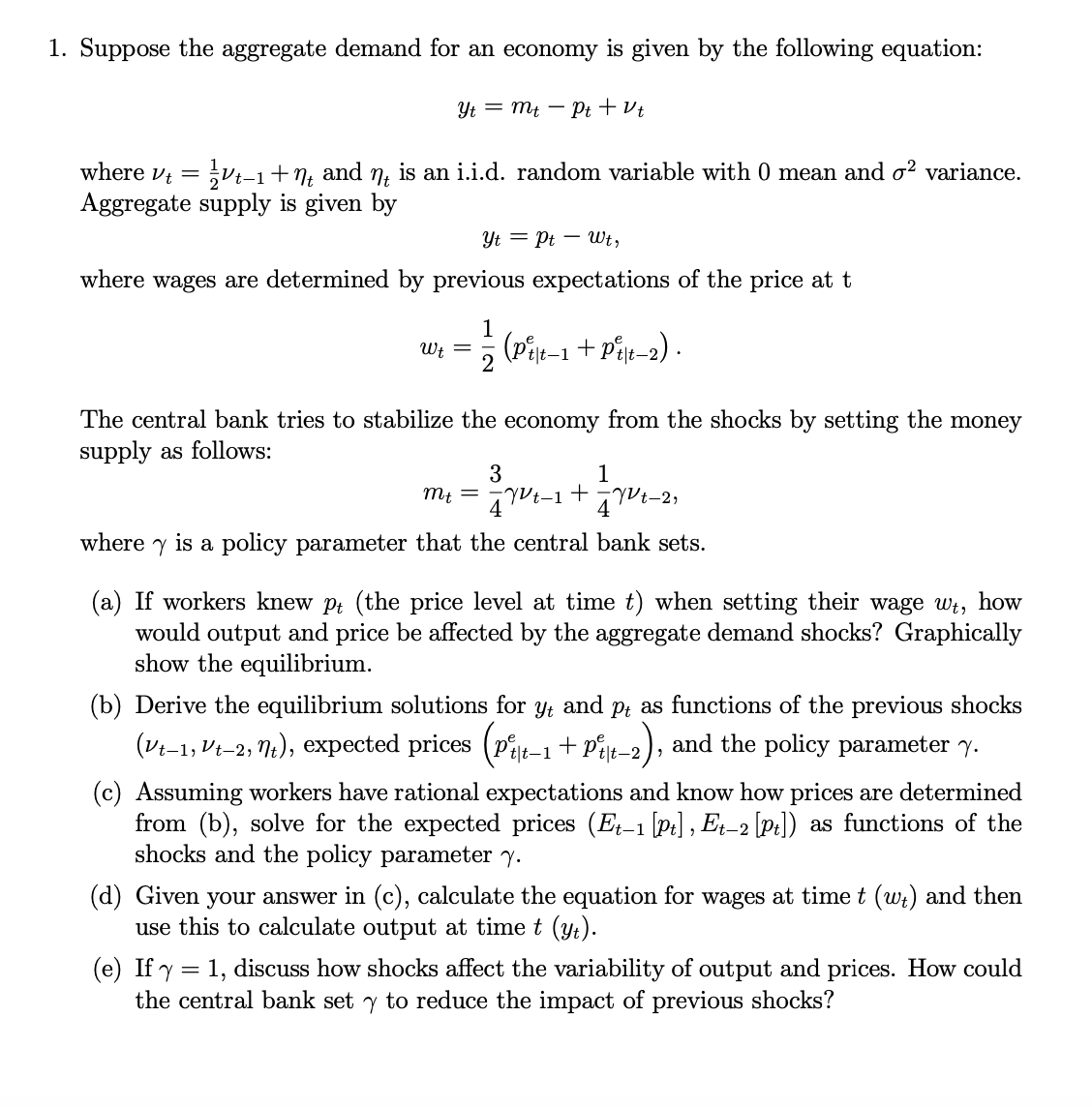
1. Suppose the aggregate demand for an economy is given by the following equation: yt=mtPt+1't where V; = lls1 + W: and fl: is an i.i.d. random variable with 0 mean and (:2 variance. Aggregate supply is given by %=mWa where wages are determined by previous expectations of the price at t 1 10: = i (Pia1 "Hoar2) - The central bank tries to stabilize the economy from the shocks by setting the money supply as follows: 3 +1 m=I/_ V_ t 47:1 47:2: where qr is a policy parameter that the central bank sets. (a) If workers knew pt (the price level at time if) when setting their wage wt, how would output and price be affected by the aggregate demand shocks? Graphically show the equilibrium. (b) Derive the equilibrium solutions for y; and p; as functions of the previous shocks (Vt_1, 11:4, m), expected prices (Pin1 + p|t_2) , and the policy parameter 7. (c) Assuming workers have rational expectations and know how prices are determined from (b), solve for the expected prices (Et_1 [p3] , Et_2 [pt]) as functions of the shocks and the policy parameter 7. (d) Given your answer in (c), calculate the equation for wages at time t (wt) and then use this to calculate output at time t (gt). (e) If 7 = 1, discuss how shocks affect the variability of output and prices. How could the central bank set 7 to reduce the impact of previous shocks
Step by Step Solution
There are 3 Steps involved in it

Get step-by-step solutions from verified subject matter experts
 Study Help