



Question: add the first 12 rows of simulation additionally solve a,b,c Answer each question using simulation. Attach a screenshot of the first--12 rows of simulation for
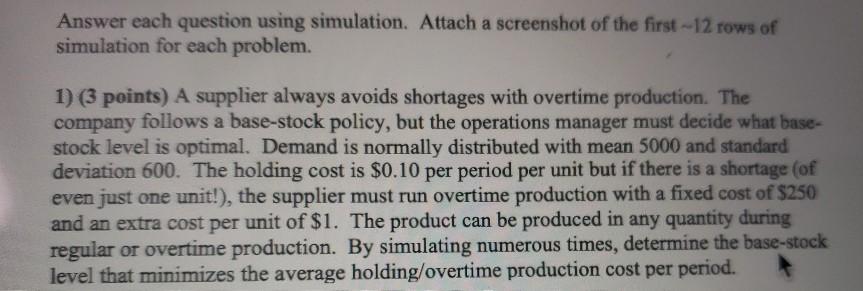
add the first 12 rows of simulation

additionally solve a,b,c
Answer each question using simulation. Attach a screenshot of the first--12 rows of simulation for each problem. 1) (3 points) A supplier always avoids shortages with overtime production. The company follows a base-stock policy, but the operations manager must decide what base- stock level is optimal. Demand is normally distributed with mean 5000 and standard deviation 600. The holding cost is $0.10 per period per unit but if there is a shortage (of even just one unit!), the supplier must run overtime production with a fixed cost of $250 and an extra cost per unit of $1. The product can be produced in any quantity during regular or overtime production. By simulating numerous times, determine the base-stock level that minimizes the average holding/overtime production cost per period. a) What are the best base-stock level and b) the corresponding average cost per period? c) During what proportion of periods is overtime production required (for the best base- stock level)? Answer each question using simulation. Attach a screenshot of the first--12 rows of simulation for each problem. 1) (3 points) A supplier always avoids shortages with overtime production. The company follows a base-stock policy, but the operations manager must decide what base- stock level is optimal. Demand is normally distributed with mean 5000 and standard deviation 600. The holding cost is $0.10 per period per unit but if there is a shortage (of even just one unit!), the supplier must run overtime production with a fixed cost of $250 and an extra cost per unit of $1. The product can be produced in any quantity during regular or overtime production. By simulating numerous times, determine the base-stock level that minimizes the average holding/overtime production cost per period. a) What are the best base-stock level and b) the corresponding average cost per period? c) During what proportion of periods is overtime production required (for the best base- stock level)
Step by Step Solution
There are 3 Steps involved in it

Get step-by-step solutions from verified subject matter experts