



Question: Add the objective and constraints (1), (2), (4) and (5). Parameters: p/A: processing time of job jon machine A p;B: processing time of job jon
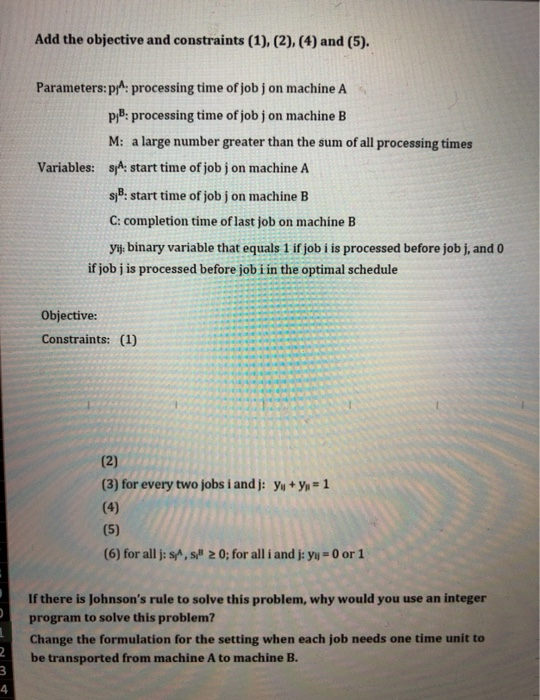
Add the objective and constraints (1), (2), (4) and (5). Parameters: p/A: processing time of job jon machine A p;B: processing time of job jon machine B M: a large number greater than the sum of all processing times Variables: SA: start time of job jon machine A SB: start time of job jon machine B C: completion time of last job on machine B yij: binary variable that equals 1 if job i is processed before job j, and 0 if job jis processed before job i in the optimal schedule Objective: Constraints: (1) (2) (3) for every two jobs i and j: Yu+ y = 1 (5) (6) for all j: SA, B 2 0; for all i and j: yy= 0 or 1 If there is Johnson's rule to solve this problem, why would you use an integer program to solve this problem? Change the formulation for the setting when each job needs one time unit to be transported from machine A to machine B. 2 4 Add the objective and constraints (1), (2), (4) and (5). Parameters: p/A: processing time of job jon machine A p;B: processing time of job jon machine B M: a large number greater than the sum of all processing times Variables: SA: start time of job jon machine A SB: start time of job jon machine B C: completion time of last job on machine B yij: binary variable that equals 1 if job i is processed before job j, and 0 if job jis processed before job i in the optimal schedule Objective: Constraints: (1) (2) (3) for every two jobs i and j: Yu+ y = 1 (5) (6) for all j: SA, B 2 0; for all i and j: yy= 0 or 1 If there is Johnson's rule to solve this problem, why would you use an integer program to solve this problem? Change the formulation for the setting when each job needs one time unit to be transported from machine A to machine B. 2 4
Step by Step Solution
There are 3 Steps involved in it

Get step-by-step solutions from verified subject matter experts