



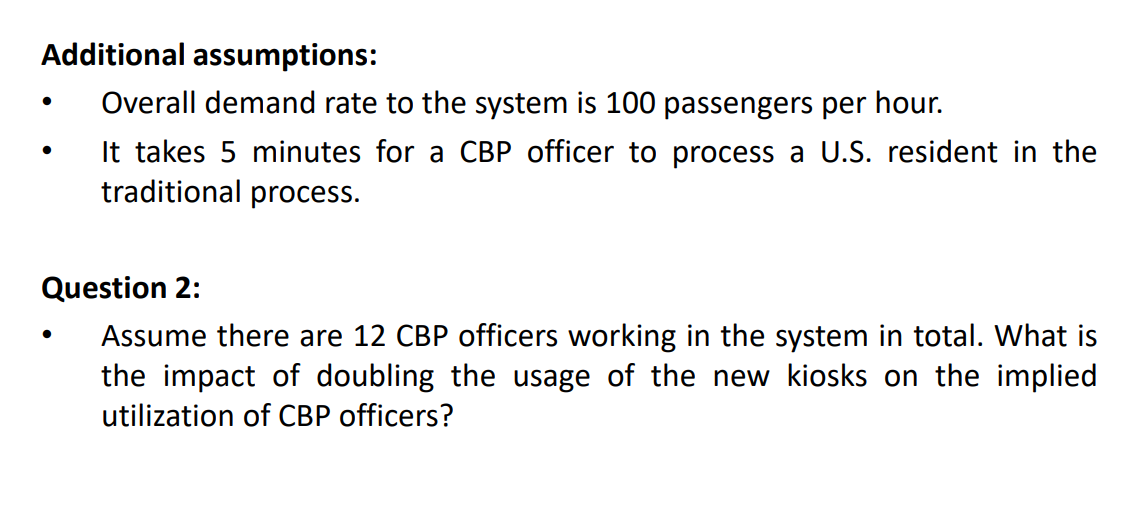
Question: Additional assumptions: Overall demand rate to the system is 1 0 0 passengers per hour. It takes 5 minutes for a CBP officer to process
Additional assumptions:
Overall demand rate to the system is passengers per hour.
It takes minutes for a CBP officer to process a US resident in the
traditional process.
Question :
Assume there are CBP officers working in the system in total. What is
the impact of doubling the usage of the new kiosks on the implied
utilization of CBP officers?On a typical day, more than a quarter of a million passengers
and crew members arrive at US airports, requiring the attention
of US Customs and Border Protection CBP For many years, this
process was organized as follows. Passengers would move from their
landing gates to the CBP officers. Passengers would then join one
of two lines. US citizens and permanent residents would be
welcomed by one set of officers. Visitors from other countries
would join another line leading to a separate set of officers.
Typically, waiting times were longer for visitors than for
citizens, though this could change depending on the day, and a
substantial waiting time was possible for citizens as well as
visitors. Because all visitors are fingerprinted, they take longer
to be processed by the CBP In the early s the United States
and Canada instituted the NEXUS program initially known as the
Trusted Traveler Program The program allows eligible travelers
who have been prescreened to bypass the lines using selfservice
technology at a number of kiosks. At the kiosks, the passenger
answers a couple of questions, the passport and NEXUS membership
card are scanned, fingerprints are scanned and compared to
fingerprints on record, and a photo is taken. From there, most
travelers can proceed directly to the luggage area. Only a randomly
selected sample of passengers must be seen by a CBP officer. In
several airports, including Los Angeles LAX introduced an
additional technology to streamline the process at CBP creating a
third flow of travelers. LAX, together with other US airports,
allows eligible travelers to seek out a selfservice kiosk. US
citizens and permanent residents are eligible, and so are travelers
from nations that are part of the US waiver program. Similar
to NEXUS, at the kiosks, passengers answer a couple of questions,
their passport is scanned, fingerprints are scanned for nonUS
citizens, and a photo is taken. At the end of their selfcheckin
customers receive a printout that they then must personally present
to a CBP officer. Passengers who have taken advantage of the kiosks
require less time with the CBP officer, creating an overall
increase in capacity and hence a reduction in waiting times. For
the following calculations, assume that It takes the CBP officer
twice as long to process a visitor compared to a US citizen or
permanent resident. This is true for the traditional process, the
randomly chosen passengers in the NEXUS process, and the new kiosk
process. Eighty percent of the passengers use the traditional
process, percent use the NEXUS process, and percent use the
new kiosks. In each of these processes, the share of US citizens
and permanent residents is about percent. Passengers spend no
time with a CBP officer in the Nexus process except when they are
randomly sampled for an inspection. In that case, they spend the
same amount of time with the CBP officer as in the traditional
process. Five percent of passengers are randomly chosen for
inspection independent of being visitors or US residents
Compared to the traditional process, passengers spend percent
less time when using the new kiosks though US residents still
only spend half the time with the CBP compared to visitors
Question : Evaluate the impact of increasing the usage of the new
kiosks. To do this, first draw a process flow diagram that combines
the three different flows traditional process, NEXUS program, new
kiosks Then, compute by what percentage the workload of the CBP
officers would decrease if the usage of the new kiosks doubled
from the current percent, percent, and percent for
traditional, NEXUS, and new kiosks to percent, percent, and
percent
Step by Step Solution
There are 3 Steps involved in it
1 Expert Approved Answer
Step: 1 Unlock

Question Has Been Solved by an Expert!
Get step-by-step solutions from verified subject matter experts
Step: 2 Unlock
Step: 3 Unlock