





Question: Additional directions : use appropriate header and source files Exercises in this collection revolve around the foundations of the Ctstandard ibrary and, especially, usage patterns
Additional directions : use appropriate header and source files  Additional directions : use appropriate header and source files Exercises in
this collection revolve around the foundations of the Ctstandard ibrary and, especially,

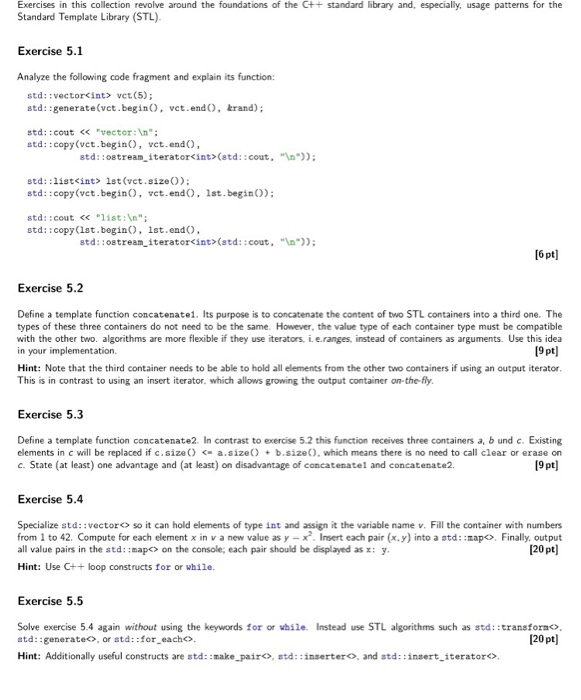
Exercises in this collection revolve around the foundations of the Ctstandard ibrary and, especially, usage patterns for the Standard Template Library (STL). Exercise 5.1 Analyze the following code fragment and explain its function: std: :vector vct(5) std: :gene(ct.beginO, t.en, rand): std::cout (std::cout, "n) std: :list lst (vct.size)) std: :copy (vct.beginO, vctendO 1st.begin) std::cout (std::cout, ) [6pt] Exercise 5.2 Define a template function concatenate1, Its purpose is to concatenate the content of two STL containers into a third one. The types of these three containers do not need to be the same. However, the value type of each container type must be compatible with the other two. algorithms are more flexible if they use iterators i.e.ranges, instead of containers as arguments. Use this idea in your implementation. 9 pt] Hint: Note that the third container needs to be able to hold all elements from the other two containers if using an output iterator. This is in contrast to using an insert iterator, which allows growing the output container on-the-fly Exercise 5.3 Define a template function concatenate2. In contrast to exercise 5.2 this function receives three containers a, b und c. Existing elements in c will be replaced if c.size

Step by Step Solution

There are 3 Steps involved in it

1 Expert Approved Answer
Step: 1 Unlock blur-text-image
Question Has Been Solved by an Expert!

Get step-by-step solutions from verified subject matter experts

Step: 2 Unlock
Step: 3 Unlock

Students Have Also Explored These Related Databases Questions!