







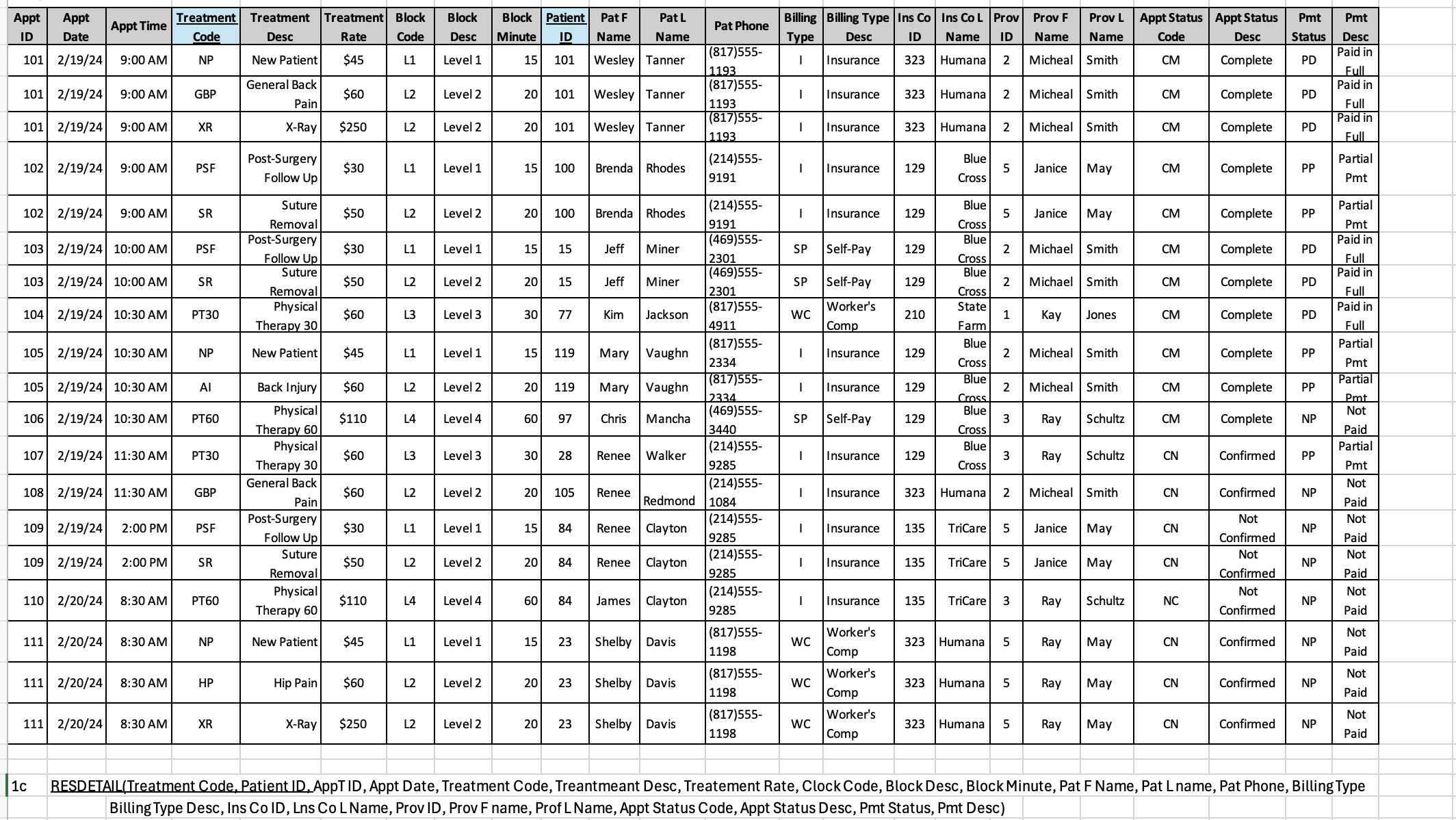
Question: Additional Information: - Each patient has at least one appointment. Each appointment is for a specific patient. - Each appointment is handled by a specific
Additional Information:
Each patient has at least one appointment. Each appointment is for a specific patient.
Each appointment is handled by a specific provider. Each provider may handle one or more appointments or may have no appointments
Each appointment has one or more block codes. Each block code is for a specific number of minutes and can be applied to one or more
appointments.
Each appointment has one or more treatment codes. Each treatment code has a specific block code and a specific rate and can be applied to one or more appointments.
Each appointment has one billing type. Each billing type may be assigned to one or more appointments or to no appointments
Each appointment has a specific appt status code applied. Each appt status code may be assigned to one or more appointments or to no
appointments
Each appointment has a specific pmt status code applied. Each pmt status code may be assigned to one or more appointments or to no
appointments
Based on the information provided above, complete the following:
FIRST NORMAL FORM NF:
a Create a dependency diagram for the table above.
SECOND NORMAL FORM NF:
a Show the table structure format for each table in NF
b Create the dependency diagrams for the resulting tables.
THIRD NORMAL FORM NF:
a Convert to NF and show the table structure format for each table.
b Create the dependency diagrams for the resulting tables.
ENTITYRELATIONSHIP MODEL:
a Create the Relational Schema for all the NF tables.
b Using Chen notation, create an ERD showing all the NF tables. You must show the entities, relationships, connectivity, participation, and
cardinality do not show the attributes on the ERD
Step by Step Solution
There are 3 Steps involved in it
1 Expert Approved Answer
Step: 1 Unlock

Question Has Been Solved by an Expert!
Get step-by-step solutions from verified subject matter experts
Step: 2 Unlock
Step: 3 Unlock
 Study Help