







Question: Advanced Macroeconomics (5th Edition) Chapter 2, Problem 10P Bookmark Show all steps: ON K7 Problem Capital taxation in the Ramsey-Cass-Koopmans model. Consider a Ramsey-Cass- Koopmans
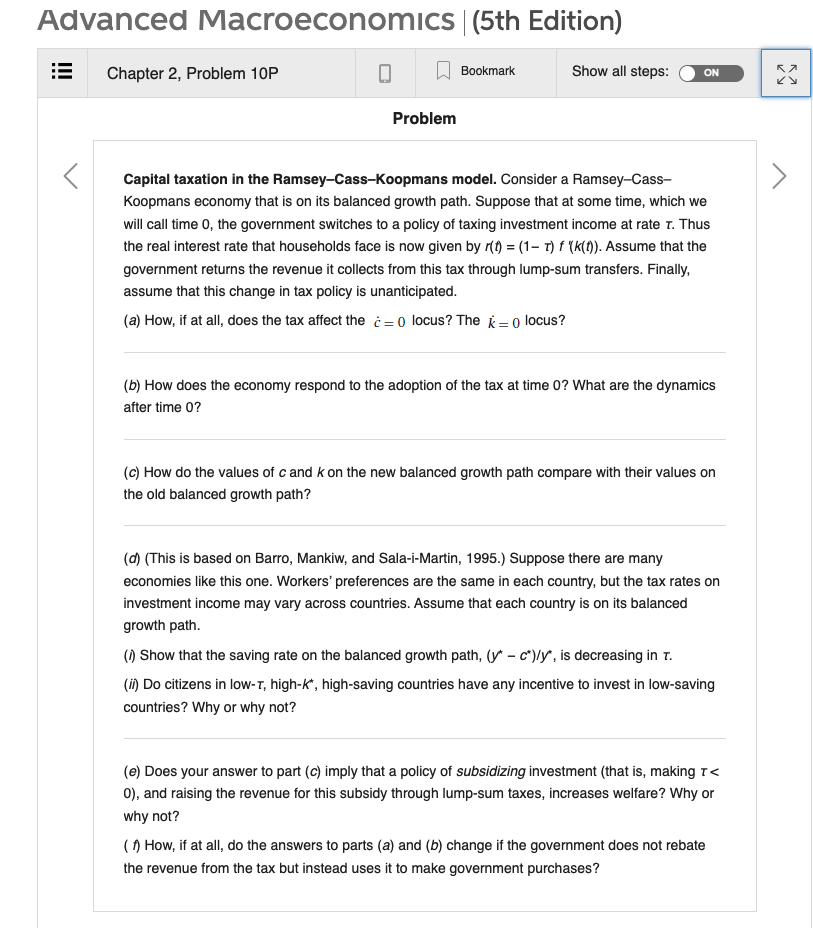
Advanced Macroeconomics (5th Edition) Chapter 2, Problem 10P Bookmark Show all steps: ON K7 Problem Capital taxation in the Ramsey-Cass-Koopmans model. Consider a Ramsey-Cass- Koopmans economy that is on its balanced growth path. Suppose that at some time, which we will call time 0, the government switches to a policy of taxing investment income at rate t. Thus the real interest rate that households face is now given by r(t) = (1 t) f (t)). Assume that the government returns the revenue it collects from this tax through lump-sum transfers. Finally, assume that this change in tax policy is unanticipated. (a) How, if at all, does the tax affect the c = 0 locus? The k = 0 locus? (6) How does the economy respond to the adoption of the tax at time o? What are the dynamics after time 0? (C) How do the values of cand k on the new balanced growth path compare with their values on the old balanced growth path? (d) (This is based on Barro, Mankiw, and Sala-i-Martin, 1995.) Suppose there are many economies like this one. Workers' preferences are the same in each country, but the tax rates on investment income may vary across countries. Assume that each country is on its balanced growth path. (1) Show that the saving rate on the balanced growth path, (* - C*)/y, is decreasing in T. (ii) Do citizens in low-t, high-k*, high-saving countries have any incentive to invest in low-saving countries? Why or why not? (e) Does your answer to part (c) imply that a policy of subsidizing investment that is, making T
Step by Step Solution
There are 3 Steps involved in it

Get step-by-step solutions from verified subject matter experts
 Study Help