



Question: AFR Manufacturing Companys senior management asked the internal audit function to conduct an operational safety audit of the production facilitys metal drill press unit. More
AFR Manufacturing Companys senior management asked the internal audit function to conduct an operational safety audit of the production facilitys metal drill press unit. More specifically, the internal audit function was asked to determine how well the metal drill press equipment and equipment operators comply with company safety policies. Five downtime injuries of drill press operators occurred in the last six months. The total downtime for the five injuries was 37 hours. Management estimated that the drill press downtime, and the resultant decrease in overall productivity, reduced revenue by approximately $265,000. In addition to the downtime injuries, two drill press operators experienced detectible hearing loss during the six-month period. The internal auditors learned that the companys safety policies include the following: Operators are required to wear safety glasses, ear plugs, and protective gloves. The drill presses are required to have a clear, plastic safety shield and a protected channel to safely feed the metal through the press. The drill is operated by a knee switch. The operator engages and disengages the drill by shifting his or her right knee. The internal auditors found the equipment to be in relatively poor condition with little evidence of any regular maintenance. Drill bits were not replaced as they became dull, and broken bits often were used because new bits were not kept in supply. Two of the 10 drill press machines were missing safety shields. Five of the 10 machine operators were using the protective ear plugs at the time the auditors visited the plant and six were wearing safety glasses. Four of the knee switches were found to be sticking occasionally in both the off and on positions. The auditors perceived a general sense of negligencenegligence by production management, drill press equipment operators, and maintenance employees.
A. Based on the scenario presented above: 1. Clearly state the internal audit engagement objective. 2. Prepare one or more well-written internal audit observations that include: condition, criteria, consequence(s), and cause(s).
B. Refer to exhibit 12-4. At what level would you position the observation(s) you prepared in A.2. above? Clearly explain your rationale.
C. Draft a memo to senior management in which you describe a consulting engagement that the internal audit function could perform in response to the operational safety audit results.
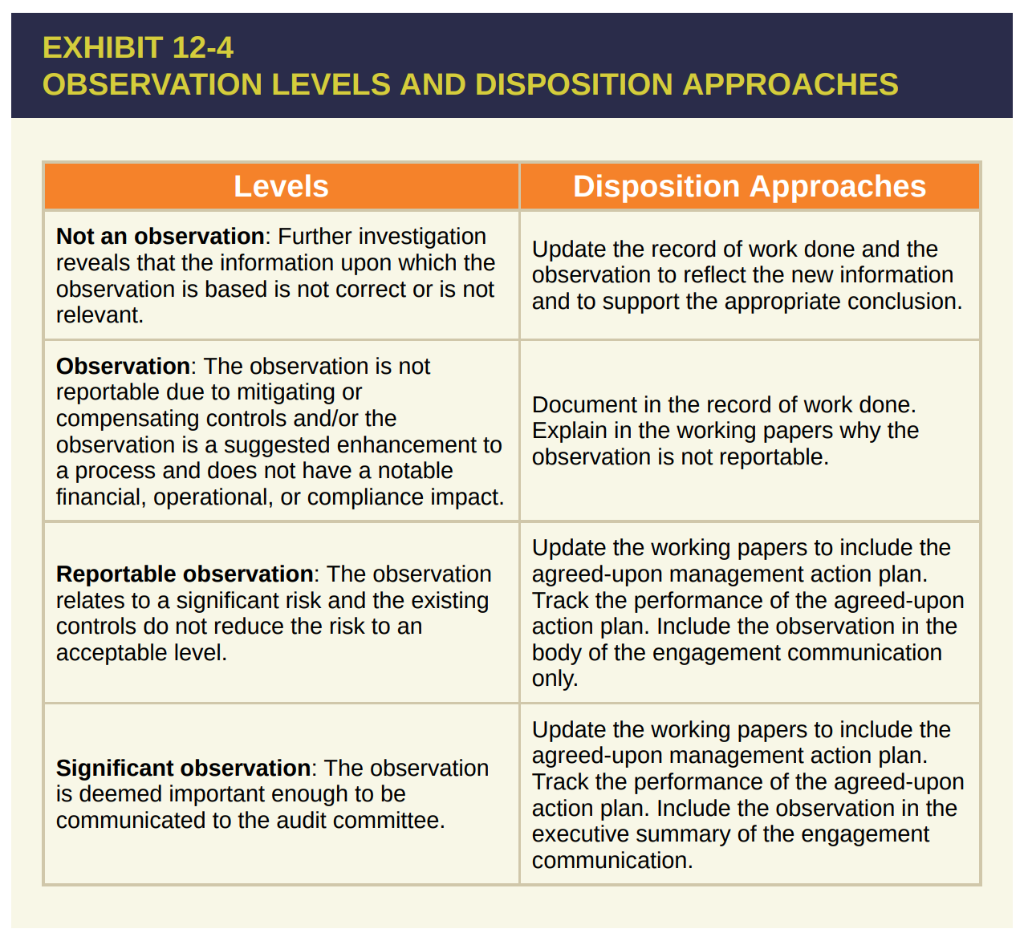
EXHIBIT 12-4 OBSERVATION LEVELS AND DISPOSITION APPROACHES Levels Disposition Approaches Not an observation: Further investigation reveals that the information upon which the observation is based is not correct or is not relevant. Update the record of work done and the observation to reflect the new information and to support the appropriate conclusion. Observation: The observation is not reportable due to mitigating or compensating controls and/or the observation is a suggested enhancement to a process and does not have a notable financial, operational, or compliance impact. Document in the record of work done. Explain in the working papers why the observation is not reportable. Reportable observation: The observation relates to a significant risk and the existing controls do not reduce the risk to an acceptable level. Update the working papers to include the agreed-upon management action plan. | Track the performance of the agreed-upon action plan. Include the observation in the body of the engagement communication only. Significant observation: The observation is deemed important enough to be communicated to the audit committee. Update the working papers to include the agreed-upon management action plan. Track the performance of the agreed-upon action plan. Include the observation in the executive summary of the engagement communication. EXHIBIT 12-4 OBSERVATION LEVELS AND DISPOSITION APPROACHES Levels Disposition Approaches Not an observation: Further investigation reveals that the information upon which the observation is based is not correct or is not relevant. Update the record of work done and the observation to reflect the new information and to support the appropriate conclusion. Observation: The observation is not reportable due to mitigating or compensating controls and/or the observation is a suggested enhancement to a process and does not have a notable financial, operational, or compliance impact. Document in the record of work done. Explain in the working papers why the observation is not reportable. Reportable observation: The observation relates to a significant risk and the existing controls do not reduce the risk to an acceptable level. Update the working papers to include the agreed-upon management action plan. | Track the performance of the agreed-upon action plan. Include the observation in the body of the engagement communication only. Significant observation: The observation is deemed important enough to be communicated to the audit committee. Update the working papers to include the agreed-upon management action plan. Track the performance of the agreed-upon action plan. Include the observation in the executive summary of the engagement communication
Step by Step Solution
There are 3 Steps involved in it

Get step-by-step solutions from verified subject matter experts