







Question: a)From the information provided on the keystream generator, what would be the period and the desired linear complexity that the sequence c(n) produced? (b) Perform
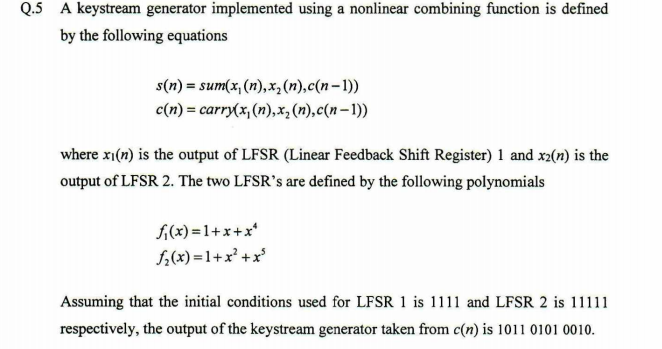
a)From the information provided on the keystream generator, what would be the
period and the desired linear complexity that the sequence c(n) produced?
(b) Perform a frequency test for the sequence c(ri) and determine if it meets the
confusion criteria.
(c) Perform a correlation attack on the sequence c(n) using the LFSR 1 and discuss
the outcome of the attack.
(d) If it is desired to extend the key length to 32-bits, what are the possible lengths of
LFSR 1 and LFSR 2?
please answer all questions
Q.5 A keystream generator implemented using a nonlinear combining function is defined by the following equations s(n) = sum(x, (n),x2 (n),c(n-1)) c(n)= carry(x,(n),x, (n),c(n-1)) where xi(n) is the output of LFSR (Linear Feedback Shift Register) 1 and x2(n) is the output of LFSR 2. The two LFSR's are defined by the following polynomials f(x)=1+x+x* 12(x)=1+x + x Assuming that the initial conditions used for LFSR 1 is 1111 and LFSR 2 is 11111 respectively, the output of the keystream generator taken from c(n) is 1011 0101 0010. Q.5 A keystream generator implemented using a nonlinear combining function is defined by the following equations s(n) = sum(x, (n),x2 (n),c(n-1)) c(n)= carry(x,(n),x, (n),c(n-1)) where xi(n) is the output of LFSR (Linear Feedback Shift Register) 1 and x2(n) is the output of LFSR 2. The two LFSR's are defined by the following polynomials f(x)=1+x+x* 12(x)=1+x + x Assuming that the initial conditions used for LFSR 1 is 1111 and LFSR 2 is 11111 respectively, the output of the keystream generator taken from c(n) is 1011 0101 0010
Step by Step Solution
There are 3 Steps involved in it

Get step-by-step solutions from verified subject matter experts
 Study Help