







Question: After completing the Gender-Career Implicit Association Test (IAT), please response to the questions below: What role might unconscious bias play in everyday decisions in the
After completing the Gender-Career Implicit Association Test (IAT), please response to the questions below:
- What role might unconscious bias play in everyday decisions in the workplace?
- What can be done to ensure that important organizational decisions (e.g., hiring, promotions, etc) are made as objectively and effectively as possible?
- What role can self-awareness (through using tools like the IAT) play in this process?
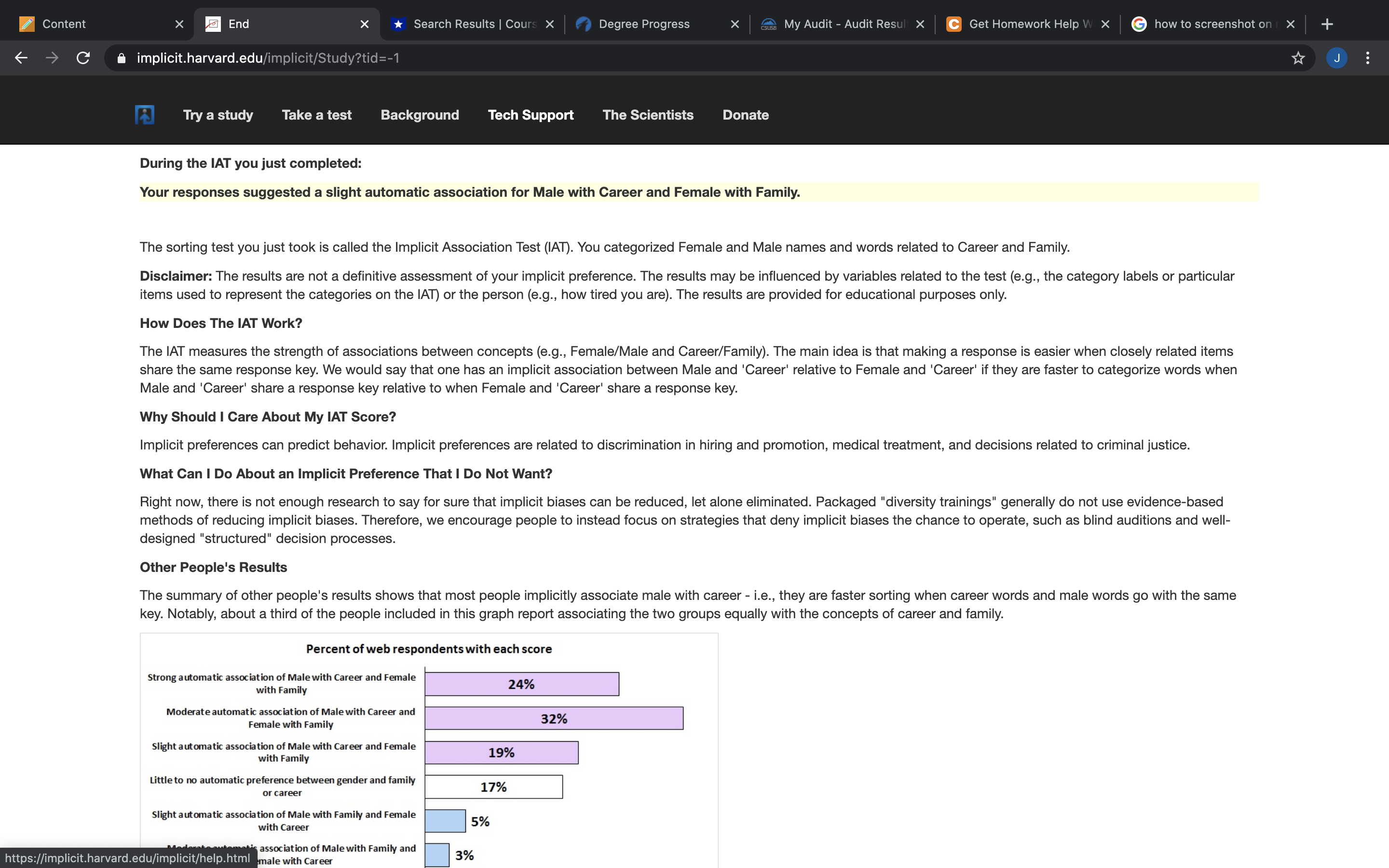
Content X End X Search Results | Cours X Degree Progress X extend My Audit - Audit Resul > C Get Homework Help W X how to screenshot on X C A implicit.harvard.edu/implicit/Study?tid=-1 J : Try a study Take a test Background Tech Support The Scientists Donate During the IAT you just completed: Your responses suggested a slight automatic association for Male with Career and Female with Family. The sorting test you just took is called the Implicit Association Test (IAT). You categorized Female and Male names and words related to Career and Family. Disclaimer: The results are not a definitive assessment of your implicit preference. The results may be influenced by variables related to the test (e.g., the category labels or particular items used to represent the categories on the IAT) or the person (e.g., how tired you are). The results are provided for educational purposes only. How Does The IAT Work? The IAT measures the strength of associations between concepts (e.g., Female/Male and Career/Family). The main idea is that making a response is easier when closely related items share the same response key. We would say that one has an implicit association between Male and 'Career' relative to Female and 'Career' if they are faster to categorize words when Male and 'Career' share a response key relative to when Female and 'Career' share a response key. Why Should I Care About My IAT Score? Implicit preferences can predict behavior. Implicit preferences are related to discrimination in hiring and promotion, medical treatment, and decisions related to criminal justice. What Can I Do About an Implicit Preference That I Do Not Want? Right now, there is not enough research to say for sure that implicit biases can be reduced, let alone eliminated. Packaged "diversity trainings" generally do not use evidence-based methods of reducing implicit biases. Therefore, we encourage people to instead focus on strategies that deny implicit biases the chance to operate, such as blind auditions and well- designed "structured" decision processes. Other People's Results The summary of other people's results shows that most people implicitly associate male with career - i.e., they are faster sorting when career words and male words go with the same key. Notably, about a third of the people included in this graph report associating the two groups equally with the concepts of career and family. Percent of web respondents with each score Strong automatic association of Male with Career and Female with Family 24% Moderate automatic association of Male with Career and Female with Family 32% Slight automatic association of Male with Career and Female with Family 19% Little to no automatic preference between gender and family or career 17% Slight automatic association of Male with Family and Female with Career 5% association of Male with Family and https://implicit.harvard.edu/implicit/help.html male with Career 3%
Step by Step Solution
There are 3 Steps involved in it

Get step-by-step solutions from verified subject matter experts
 Study Help