







Question: after read the picture please answer this question upto 150 words How has eCommerce changed the way global trade takes place ? Part II -
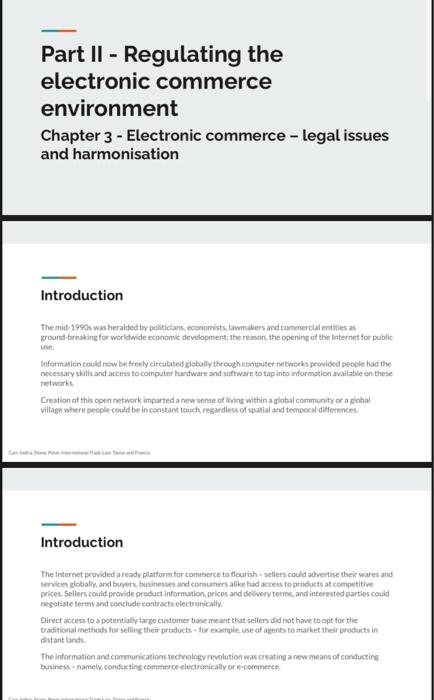
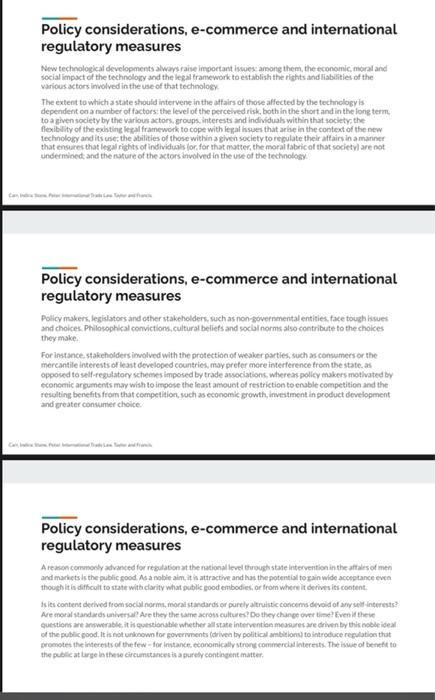
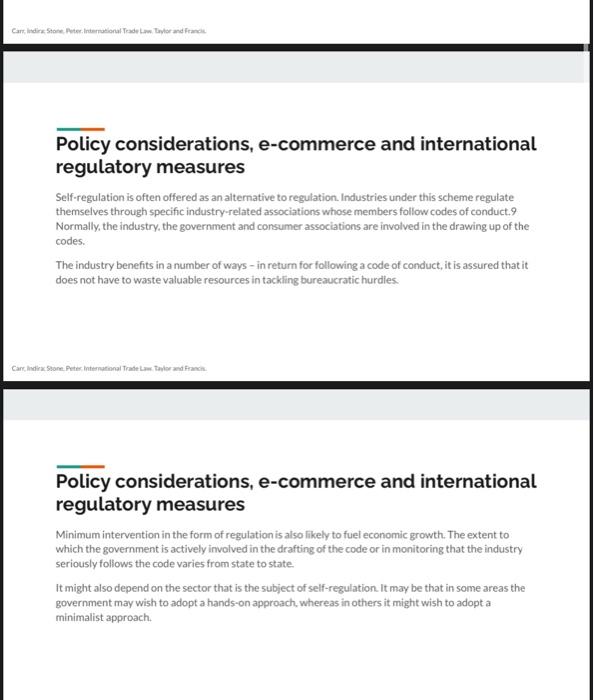
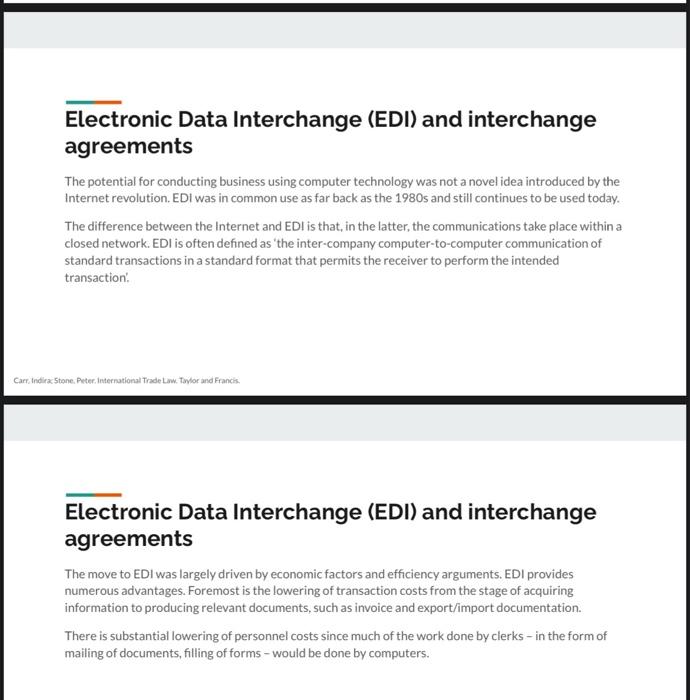
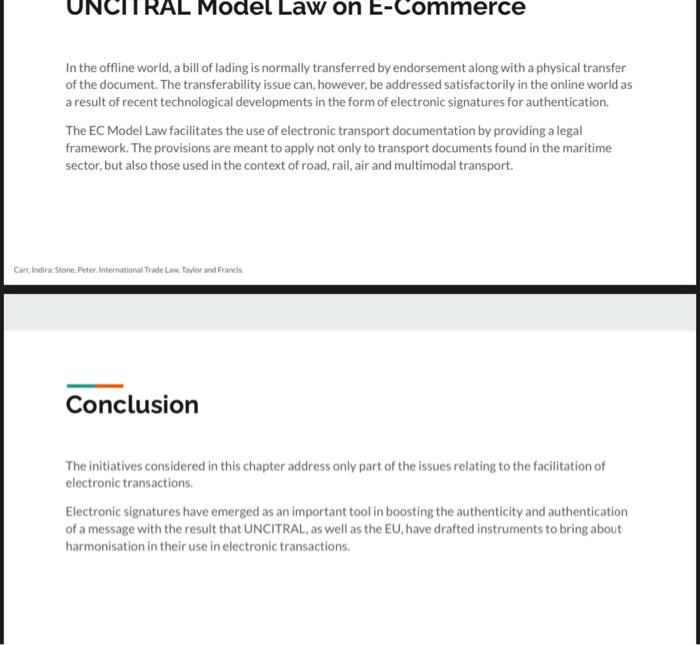
Part II - Regulating the electronic commerce environment Chapter 3 - Electronic commerce - legal issues and harmonisation Introduction The mid- 19905 was heralded by politiclans, economists, lawinaters and connercial entities as ground-breakine for worldwide econamic development; the reason, the opening of the lnternet for public ure. Informatien could now be freely circulated glabally through cemputer netwerks prowided people had the necessary skilis and access to computer hardware and software to tap into information available on these networks. Creation af this open inetwark imparted a new sense of wving within a mlobal community or a glabal village where people could be in constam touch, regardless of spatial and temporal differences. Introduction The Internet provided aready platform for commserce to flourish - sellers could advertise their wares and services giobally, and buyers, businesses and consumers alike had access to products at competitive prices. 5ellers could provide product information, prices and deilvery terms, and interested parties could nigotiate terms and conclude contracts electronically. Direct access to a potentially large customer base meant that sellers did not have to opt for the tracitional inethods for selling their products - for example. use of agents to marhet their products in distant lands. The information and communications techrology revolution was creating a new means of conducting buriness - namely conducting commerce electronically or e-cornmerce. Policy considerations, e-commerce and international regulatory measures New technological developments always raise important iswoes amone them, the ecconomic, moral and social ienpoct of the technolosy and the legal tramework to establish fhe rights and liabilities of the various actors involved in the use of that techmology. The extent to which a state should intervene in the affairs of those affected by the technclogy is dependent on a number of factoes: the level of the percelved risk, both in the short and in the long term. to a given society by the various actors, groups, interests and individuals within that soclety, the flexibwity of the existing leeal framework to cope with iegal insues that arise in the context of the new. technoloig and its use, the abilities of those within a given society to regulate their affairs in a manner that ensares that lesal rights of ind hiduals for, for that matter, the moral fabric ot that societivi are not undermined and the rafure of the actors inyolved in the use of the technoloky. Policy considerations, e-commerce and international regulatory measures Pollcy makers, legislators and other stakeholders, such as non-governmental entities, face tough hisues and choices. Philosophical convictions, cultural beliefs and socili norms also contribute to the choices they make. For instance, stakeholders imolved with the protection of weaker parties, such as consumers or the mercantile interests of least developed countries, may prefer mere interference from the state. as opposed to self-regulatory schemes imposed by trade associations, whereappolicy makers motivated by economic arguments may wish to impose the feast amouet of restriction to enuble competition and the resulting benefits from that competition, such as economic growth, investrnent in product development and greater consumer choice. Policy considerations, e-commerce and international regulatory measures A reapon commonly advinced for regulation at the national level through state intervention in the affairs of men and marhets is the public good As a moble ain, it is attractive and has the potentidi togain wide accegtance even though it is diffcult to state with darity what public good embodies, or Irom where it derives its cootent. Are moral stand ards univerad? Ace they the saine across cultures? Do they changt over time? fiven lif theie euestions are anowerable it is queceionable whether alli state intervention meanares are dribwn by this noble ideal of the public good, it is not unboown for governnents (deiven by political ambigions) to introduce regulation that gromptes the interests of the few - for instande, economically strune commendad interets. The isuie of beteft to the putlic at lurge in these circumctances is a purely contingent inateer. Policy considerations, e-commerce and international regulatory measures Self-regulation is often offered as an alternative to regulation. Industries under this scheme regulate themselves through specific industry-related associations whose members follow codes of conduct. 9 Normally, the industry, the government and consumer associations are involved in the drawing up of the codes. The industry benefits in a number of ways - in return for following a code of conduct, it is assured that it does not have to waste valuable resources in tackling bureaucratic hurdies. Policy considerations, e-commerce and international regulatory measures Minimum intervention in the form of regulation is also likely to fuel economic growth. The extent to which the government is actively involved in the drafting of the code or in monitoring that the industry seriously follows the code varies from state to state. It might also depend on the sector that is the subject of self-regulation. It may be that in some areas the government may wish to adopt a hands-on approach, whereas in others it might wish to adopt a minimalist approach. Electronic Data Interchange (EDI) and interchange agreements The potential for conducting business using computer technology was not a novel idea introduced by the Internet revolution. EDI was in common use as far back as the 1980 s and still continues to be used today. The difference between the Internet and EDI is that, in the latter, the communications take place within a closed network. EDI is often defined as 'the inter-company computer-to-computer communication of standard transactions in a standard format that permits the receiver to perform the intended transaction'. Electronic Data Interchange (EDI) and interchange agreements The move to EDI was largely driven by economic factors and efficiency arguments. EDI provides numerous advantages. Foremost is the lowering of transaction costs from the stage of acquiring information to producing relevant documents, such as invoice and export/import documentation. There is substantial lowering of personnel costs since much of the work done by clerks - in the form of mailing of documents, filling of forms - would be done by computers. 12 of 21 Data Interchange (EDI) and interchange agreements The move to EDI was largely driven by economic factors and ethciency argumenti. fiOl provides numerous advantages foremost is the lowering of transaction costs from the stage of acquiring: information to producing relevast documents, such as invoice and export/lmoart documentation. There is substantial lowering of personnel costs since muich of the work done by clerks - in the form of mailing of documents, filling of forms - would be done by computers. agreements Since computers, unilike humans, are urable to arrange infoemation sent in frec text inte an iriteifigible format, it was necessary to adopt standards in relation to pertinent indormation. such as mallinghhioping Information, order number, price and quantity that would enable a computer to recognise and process the incoming data. Industries, such as the motor industry in Europe, set about to create their own standtard h QDETTE. and the chemical industry in CEFIC. These standards normally would specify the type of documents feg. invoices) that can be transmitted electronically, the order of the data, their sequence and their interpretation, it was, bowever, felt that there was a need to adopt an international standard if EDI was to prove eflective. UNCITRAL Model Law on E-Commerce Background, guiding principles and harmonisation: The text of the UNCITRAL. Model Law on Electronic Coenmerce was adopted in 1996 its oriein, homever, is traceable to 1985 when the Commission considered a report highlighting the legal probiltru associated with the use of computer-to-computer communications. The report focused on the writing requirement and signatares for the purposes of validity and enforceability of contract and recommended that governments revitw existing lefai nules that required paper documentation or signatures as conditions for the validity or enforceability of a transaction with a view to amending them suitably to permit docurnents in a computer-readable form. Work on electronic contract formation continued within UNCITRAL, and it was felt that a common legal framework facilitating electronic data interchange was required to impart legal certainty while mindful of the retention of a flesibie approach where legislative action may be regarded an premature. In 1992, a Working Group on Electronic Data interchange was set up. The emergence of the Internet widened the focus of the Working Group to include more modern methods ot communication alongside EDI. Their work resulted in what we now know as the Moded Law on Electronic Commerce (hereinafter 'ECModel Lawh UNCITRAL Model Law on E-Commerce It mast be noted that a model law does not have the same legslative weignt as a corvention and perhaps does not bring the same level of unification. However, it does away with many of the delays and bureaucratic measures associated with conventions. States are free to adope the model law as it stands or base their law using the model low as a starting point. The aim of the EC Modes Law is to facilitate electronic commerce by removing the legal uncertainties that may surround data sent through electronic means. However, before moving onto mubstantive provisions. a few words must be said about the guiding principles of this model taw: functional equivalence, party autonomy and uniformity. UNCITRAL Model Law on E-Commerce Part I-e-commerce Scope, requirements of form and evidential issues: The scope of application is laid out in Art 1. which states that the EC Model Law is to acply to commercial activities, Commercial activities include not just sales, but other commercial rebtionships, such as factoring, agency agreements, distribution agreements, leases, industrial co-operation and transportation of goods by air, sea, rail or roud. UNCITRAL Model Law on E-Commerce Work on electronic contract formation continued wathin UACITRAL, and it was feit that a common lepal frantwork tac aicating doctronic data bifercharge was required to ingart leal certainty while mindfat of the retertion of a fiexibie aporoach where legidative action may be tegarded as premature. In 1992 a Warking Group on Electronic Data Interchange was set up. The emergente of the internet wisened the focus of the Working Croup to include more moden methods of cammunication aloncuite EDI. Their work thultid in what we now inow as the Model Law on Electronic Commerce Ahtreinafter 'ECModelLank UNCITRAL Model Law on E-Commerce It must be nated that a model law does not hove the same legistative weight as a comention and perthapt docs not bring the same level of urification. However, it does away with many of the delays and bureaucratic measures asvociated with comentions, States are tree te adopt the model law as it stiondser bave their law using the model lave as a startine point. The aim of the EC Model Lw is to fadihate electronic comnerce by removing the legal uncertainties thut may surround data sent theugh electrocic means. However, before moving onto subtantive provisions. a few words must be said about the guidint orinciples of this model law functional ecuivalenoc. party mutonomy and uniforretty. UNCITRAL Model Law on E-Commerce Part 1-e-cammerice Scope, requlnements of form and evidential issues: The scope of application is laid out in Aet 1 . which states that the EC Model Lw is to apply to commercial activities, Commercial activities include not just sales, but other commercial relationships such a factoring, agency adreements, datribution agreements leats. industrial co-operation and tramportation of goods by ali, sea, rall or read. Part 1-e-commerce Scope, requirements of form and evidential issues: The scope of application is laid out in Art 1. which states that the EC Model Law is to apply to coenmertial activities. Commercial activities include not just sales, but other commorcial relationships, such is factoring agency agreements, distratution agreements. Ieases indwatrial co-ogeration and transportation of goods by air, sea, rail oc road. UNCITRAL Model Law on E-Commerce Consumers are not specifically addressed since different jurisictions have ditterent consumer protection regulations guided ty their national policies. The Guide. however, indicates that national legisiators adopting the EC Model Law are free to oatend its applicability to consumer contracts. It must aho be noted that the footnote defining commercial activities includes carriage of passengers by rail, rosd, air and sea. UNCITRAL Model Law on E-Commerce Part 11 - Carrize of goods The focus of this part is e-commerce in specific areas - more particularly, carriage of goods. Transportation of goods is central to international sale of gochs and, an indicated in Part ilil of this book, transport documents in the form of bills of lading play a central role in the salelpurchase chain. The issue of using paperiess transport documents has been discussed since the 1990s. Although the move to eiectronic documentation where transport documents simply act asreceipts oe notity parties of the terms and conditions of carriage is seen as unoroblematic the puperiess medfum poses problems where transferability is required In the offline worid, a bill of lading is normally transferred by endorsement along with a physical transfer of the document. The transferability issue can, however, be addressed satisfactorily in the online world as a result of recent technological developments in the form of electronic signatures for authentication. The EC Model Law facilitates the use of electronic transport documentation by providing a legal framework. The provisions are meant to apply not only to transport documents found in the maritime sector, but also those used in the context of road, rail, air and multimodal transport. Conclusion The initiatives considered in this chapter address only part of the issues relating to the facilitation of electronic transactions. Electronic signatures have emerged as an important tool in boosting the authenticity and authentication of a message with the result that UNCITRAL, as well as the EU, have drafted instruments to bring about harmonisation in their use in electronic transactions
Step by Step Solution
There are 3 Steps involved in it

Get step-by-step solutions from verified subject matter experts
 Study Help