







Question: After reading 5 tips to improve your critical thinking. by Samantha Agoos, think about a ecent decision you had to make and consider: -
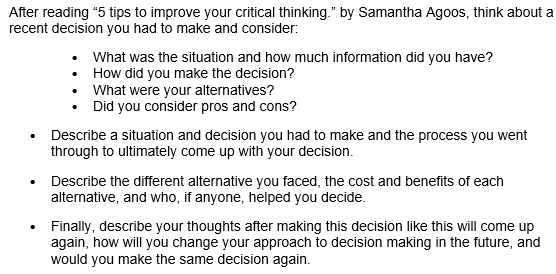
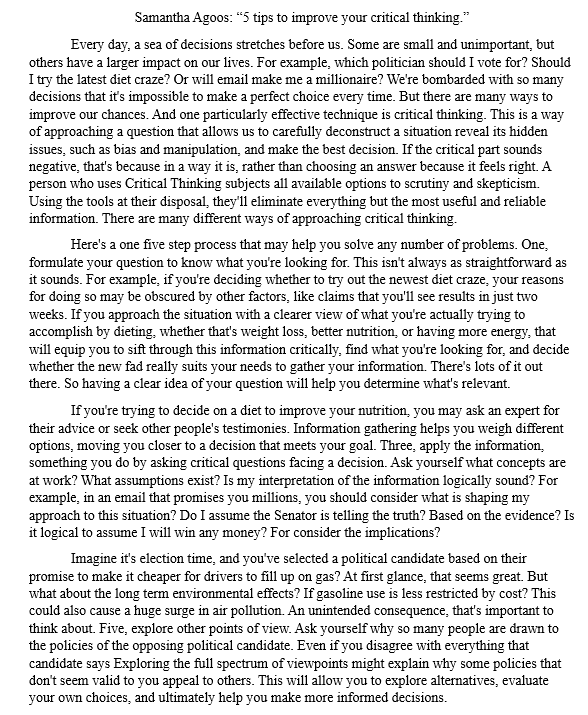

After reading " 5 tips to improve your critical thinking." by Samantha Agoos, think about a ecent decision you had to make and consider: - What was the situation and how much information did you have? - How did you make the decision? - What were your alternatives? - Did you consider pros and cons? - Describe a situation and decision you had to make and the process you went through to ultimately come up with your decision. - Describe the different alternative you faced, the cost and benefits of each alternative, and who, if anyone, helped you decide. - Finally, describe your thoughts after making this decision like this will come up again, how will you change your approach to decision making in the future, and would you make the same decision again. Samantha Agoos: "5 tips to improve your critical thinking." Every day, a sea of decisions stretches before us. Some are small and unimportant, but others have a larger impact on our lives. For example, which politician should I vote for? Should I try the latest diet craze? Or will email make me a millionaire? We're bombarded with so many decisions that it's impossible to make a perfect choice every time. But there are many ways to improve our chances. And one particularly effective technique is critical thinking. This is a way of approaching a question that allows us to carefully deconstruct a situation reveal its hidden issues, such as bias and manipulation, and make the best decision. If the critical part sounds negative, that's because in a way it is, rather than choosing an answer because it feels right. A person who uses Critical Thinking subjects all available options to scrutiny and skepticism. Using the tools at their disposal, they'1l eliminate everything but the most useful and reliable information. There are many different ways of approaching critical thinking. Here's a one five step process that may help you solve any number of problems. One, formulate your question to know what you're looking for. This isn't always as straightforward as it sounds. For example, if you're deciding whether to try out the newest diet craze, your reasons for doing so may be obscured by other factors, like claims that you'11 see results in just two weeks. If you approach the situation with a clearer view of what you're actually trying to accomplish by dieting, whether that's weight loss, better nutrition, or having more energy, that will equip you to sift through this information critically, find what you're looking for, and decide whether the new fad really suits your needs to gather your information. There's lots of it out there. So having a clear idea of your question will help you determine what's relevant. If you're trying to decide on a diet to improve your nutrition, you may ask an expert for their advice or seek other people's testimonies. Information gathering helps you weigh different options, moving you closer to a decision that meets your goal. Three, apply the information, something you do by asking critical questions facing a decision. Ask yourself what concepts are at work? What assumptions exist? Is my interpretation of the information logically sound? For example, in an email that promises you millions, you should consider what is shaping my approach to this situation? Do I assume the Senator is telling the truth? Based on the evidence? Is it logical to assume I will win any money? For consider the implications? Imagine it's election time, and you've selected a political candidate based on their promise to make it cheaper for drivers to fill up on gas? At first glance, that seems great. But what about the long term environmental effects? If gasoline use is less restricted by cost? This could also cause a huge surge in air pollution. An unintended consequence, that's important to think about. Five, explore other points of view. Ask yourself why so many people are drawn to the policies of the opposing political candidate. Even if you disagree with everything that candidate says Exploring the full spectrum of viewpoints might explain why some policies that don't seem valid to you appeal to others. This will allow you to explore alternatives, evaluate your own choices, and ultimately help you make more informed decisions. This five step process is just one tool, and it certainly won't eradicate difficult decisions from our lives. But it can help us increase the number of positive choices we make. Critical thinking can give us the tools to sift through a sea of information and find what we're looking for. And if enough of us use it, it has the power to make the world a more reasonable place. After reading " 5 tips to improve your critical thinking." by Samantha Agoos, think about a ecent decision you had to make and consider: - What was the situation and how much information did you have? - How did you make the decision? - What were your alternatives? - Did you consider pros and cons? - Describe a situation and decision you had to make and the process you went through to ultimately come up with your decision. - Describe the different alternative you faced, the cost and benefits of each alternative, and who, if anyone, helped you decide. - Finally, describe your thoughts after making this decision like this will come up again, how will you change your approach to decision making in the future, and would you make the same decision again. Samantha Agoos: "5 tips to improve your critical thinking." Every day, a sea of decisions stretches before us. Some are small and unimportant, but others have a larger impact on our lives. For example, which politician should I vote for? Should I try the latest diet craze? Or will email make me a millionaire? We're bombarded with so many decisions that it's impossible to make a perfect choice every time. But there are many ways to improve our chances. And one particularly effective technique is critical thinking. This is a way of approaching a question that allows us to carefully deconstruct a situation reveal its hidden issues, such as bias and manipulation, and make the best decision. If the critical part sounds negative, that's because in a way it is, rather than choosing an answer because it feels right. A person who uses Critical Thinking subjects all available options to scrutiny and skepticism. Using the tools at their disposal, they'1l eliminate everything but the most useful and reliable information. There are many different ways of approaching critical thinking. Here's a one five step process that may help you solve any number of problems. One, formulate your question to know what you're looking for. This isn't always as straightforward as it sounds. For example, if you're deciding whether to try out the newest diet craze, your reasons for doing so may be obscured by other factors, like claims that you'11 see results in just two weeks. If you approach the situation with a clearer view of what you're actually trying to accomplish by dieting, whether that's weight loss, better nutrition, or having more energy, that will equip you to sift through this information critically, find what you're looking for, and decide whether the new fad really suits your needs to gather your information. There's lots of it out there. So having a clear idea of your question will help you determine what's relevant. If you're trying to decide on a diet to improve your nutrition, you may ask an expert for their advice or seek other people's testimonies. Information gathering helps you weigh different options, moving you closer to a decision that meets your goal. Three, apply the information, something you do by asking critical questions facing a decision. Ask yourself what concepts are at work? What assumptions exist? Is my interpretation of the information logically sound? For example, in an email that promises you millions, you should consider what is shaping my approach to this situation? Do I assume the Senator is telling the truth? Based on the evidence? Is it logical to assume I will win any money? For consider the implications? Imagine it's election time, and you've selected a political candidate based on their promise to make it cheaper for drivers to fill up on gas? At first glance, that seems great. But what about the long term environmental effects? If gasoline use is less restricted by cost? This could also cause a huge surge in air pollution. An unintended consequence, that's important to think about. Five, explore other points of view. Ask yourself why so many people are drawn to the policies of the opposing political candidate. Even if you disagree with everything that candidate says Exploring the full spectrum of viewpoints might explain why some policies that don't seem valid to you appeal to others. This will allow you to explore alternatives, evaluate your own choices, and ultimately help you make more informed decisions. This five step process is just one tool, and it certainly won't eradicate difficult decisions from our lives. But it can help us increase the number of positive choices we make. Critical thinking can give us the tools to sift through a sea of information and find what we're looking for. And if enough of us use it, it has the power to make the world a more reasonable place
Step by Step Solution
There are 3 Steps involved in it

Get step-by-step solutions from verified subject matter experts
 Study Help