



Question: After reading chapter 10, read the attached GMFC Attitude Survey case and respond to the four questions that follow the case. Responses should be substantive

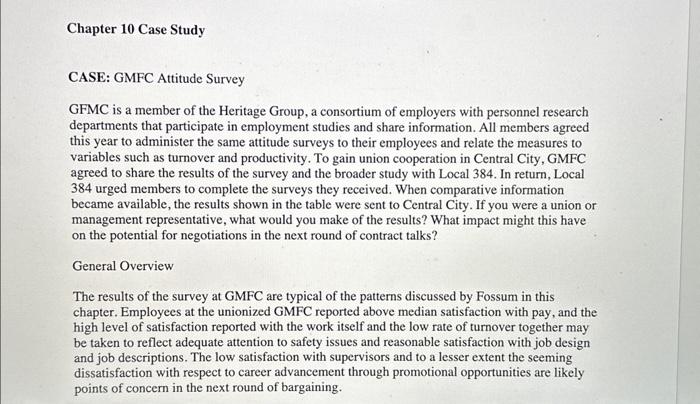
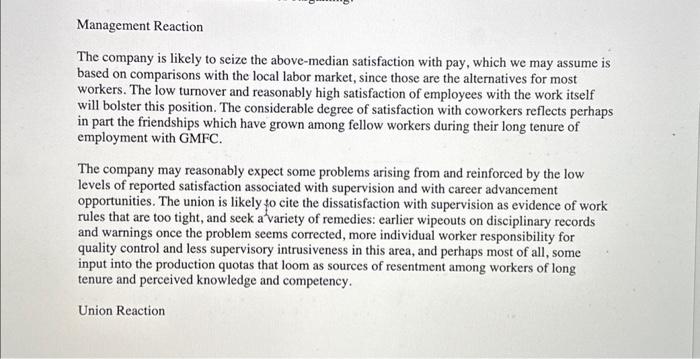
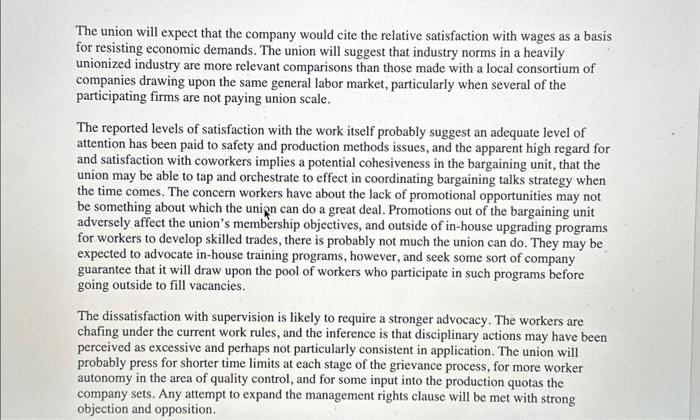
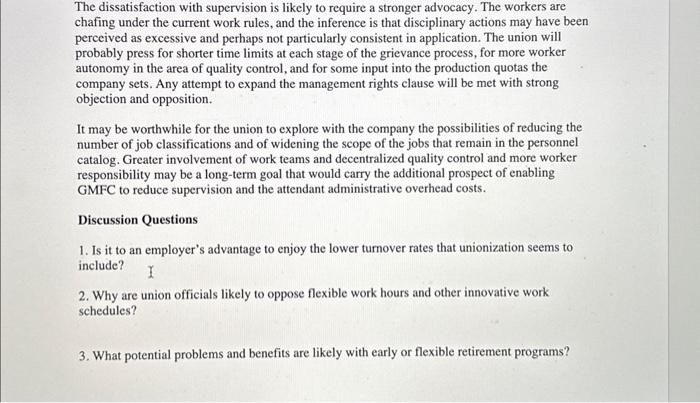

Management Reaction The company is likely to seize the above-median satisfaction with pay, which we may assume is based on comparisons with the local labor market, since those are the alternatives for most workers. The low turnover and reasonably high satisfaction of employees with the work itself will bolster this position. The considerable degree of satisfaction with coworkers reflects perhaps in part the friendships which have grown among fellow workers during their long tenure of employment with GMFC. The company may reasonably expect some problems arising from and reinforced by the low levels of reported satisfaction associated with supervision and with career advancement opportunities. The union is likely fo cite the dissatisfaction with supervision as evidence of work rules that are too tight, and seek a variety of remedies: earlier wipeouts on disciplinary records and warnings once the problem seems corrected, more individual worker responsibility for quality control and less supervisory intrusiveness in this area, and perhaps most of all, some input into the production quotas that loom as sources of resentment among workers of long tenure and perceived knowledge and competency. Union Reaction CASE: GMFC Attitude Survey GFMC is a member of the Heritage Group, a consortium of employers with personnel research departments that participate in employment studies and share information. All members agreed this year to administer the same attitude surveys to their employees and relate the measures to variables such as turnover and productivity. To gain union cooperation in Central City, GMFC agreed to share the results of the survey and the broader study with Local 384. In return, Local 384 urged members to complete the surveys they received. When comparative information became available, the results shown in the table were sent to Central City. If you were a union or management representative, what would you make of the results? What impact might this have on the potential for negotiations in the next round of contract talks? General Overview The results of the survey at GMFC are typical of the patterns discussed by Fossum in this chapter. Employees at the unionized GMFC reported above median satisfaction with pay, and the high level of satisfaction reported with the work itself and the low rate of turnover together may be taken to reflect adequate attention to safety issues and reasonable satisfaction with job design and job descriptions. The low satisfaction with supervisors and to a lesser extent the seeming dissatisfaction with respect to career advancement through promotional opportunities are likely points of concern in the next round of bargaining. The union will expect that the company would cite the relative satisfaction with wages as a basis for resisting economic demands. The union will suggest that industry norms in a heavily unionized industry are more relevant comparisons than those made with a local consortium of companies drawing upon the same general labor market, particularly when several of the participating firms are not paying union scale. The reported levels of satisfaction with the work itself probably suggest an adequate level of attention has been paid to safety and production methods issues, and the apparent high regard for and satisfaction with coworkers implies a potential cohesiveness in the bargaining unit, that the union may be able to tap and orchestrate to effect in coordinating bargaining talks strategy when the time comes. The concern workers have about the lack of promotional opportunities may not be something about which the unipn can do a great deal. Promotions out of the bargaining unit adversely affect the union's membership objectives, and outside of in-house upgrading programs for workers to develop skilled trades, there is probably not much the union can do. They may be expected to advocate in-house training programs, however, and seek some sort of company guarantee that it will draw upon the pool of workers who participate in such programs before going outside to fill vacancies. The dissatisfaction with supervision is likely to require a stronger advocacy. The workers are chafing under the current work rules, and the inference is that disciplinary actions may have been perceived as excessive and perhaps not particularly consistent in application. The union will probably press for shorter time limits at each stage of the grievance process, for more worker autonomy in the area of quality control, and for some input into the production quotas the company sets. Any attempt to expand the management rights clause will be met with strong objection and opposition. After reading chapter 10 , read the attached GMFC Attitude Survey case and respond to the four questions that follow the case. Responses should be substantive and connect to the chapter concepts: 4. Should either unions or managements be concerned with the apparently small effect of higher economic outcomes on overall union member satisfaction? The dissatisfaction with supervision is likely to require a stronger advocacy. The workers are chafing under the current work rules, and the inference is that disciplinary actions may have been perceived as excessive and perhaps not particularly consistent in application. The union will probably press for shorter time limits at each stage of the grievance process, for more worker autonomy in the area of quality control, and for some input into the production quotas the company sets. Any attempt to expand the management rights clause will be met with strong objection and opposition. It may be worthwhile for the union to explore with the company the possibilities of reducing the number of job classifications and of widening the scope of the jobs that remain in the personnel catalog. Greater involvement of work teams and decentralized quality control and more worker responsibility may be a long-term goal that would carry the additional prospect of enabling GMFC to reduce supervision and the attendant administrative overhead costs. Discussion Questions 1. Is it to an employer's advantage to enjoy the lower turnover rates that unionization seems to include? I 2. Why are union officials likely to oppose flexible work hours and other innovative work schedules? 3. What potential problems and benefits are likely with early or flexible retirement programs
Step by Step Solution
There are 3 Steps involved in it

Get step-by-step solutions from verified subject matter experts