Question: After reading chapter 11 you are to develop an introductory compensation plan for a company that has $ 100,000 to spend on salaries and hourly
After reading chapter 11 you are to develop an introductory compensation plan for a company that has $ 100,000 to spend on salaries and hourly workers per month. There are four salaried employees; Manager and three assistant managers. There are 65 hourly employees; 5 shift leaders, 10 assistant shift leaders, and 50 shift workers. Hourly employees are to work 40 hours per week. No need to include FICA, SS, Medical etc. deductions for employees. Justify differences in salaries and hourly rates.
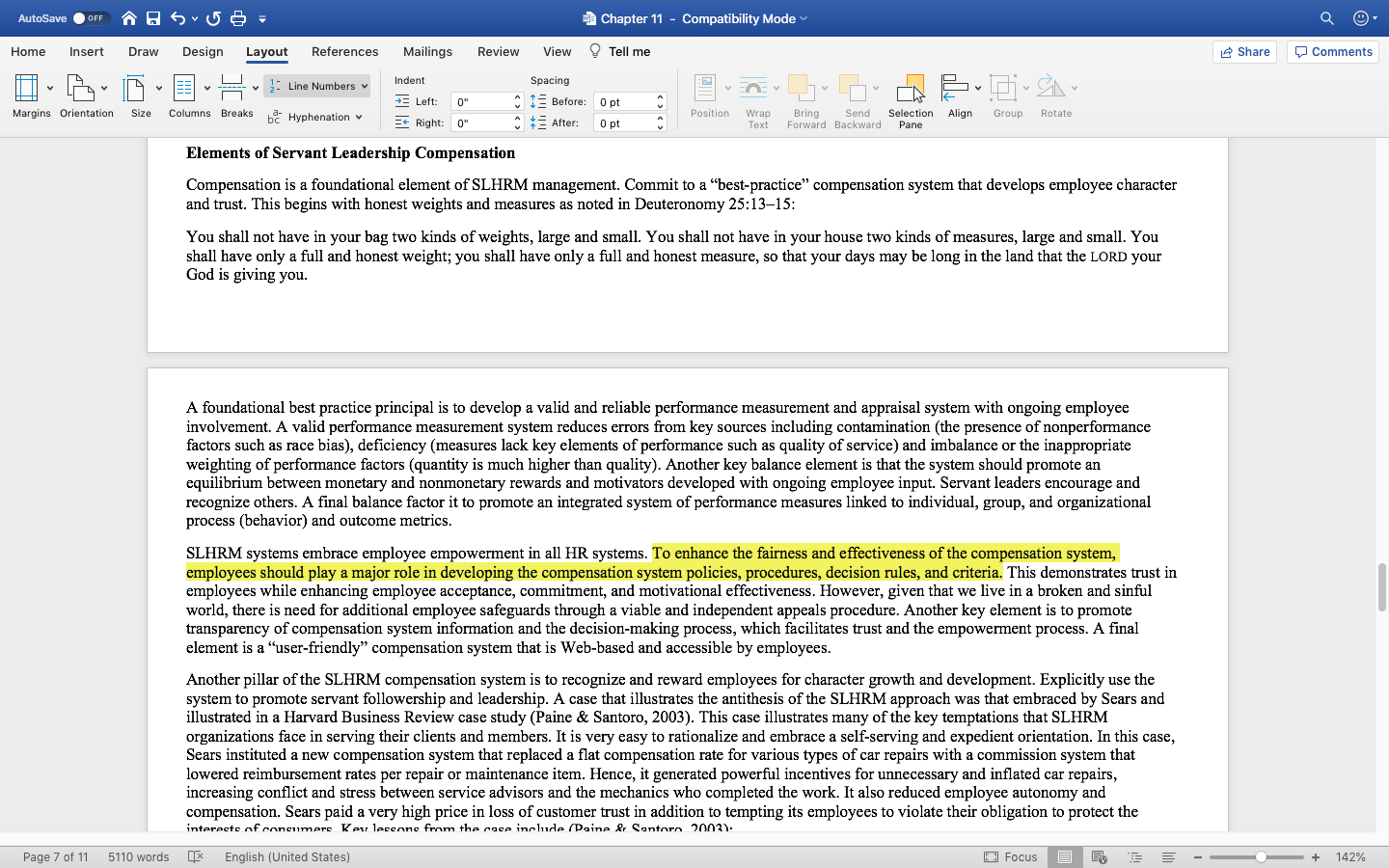
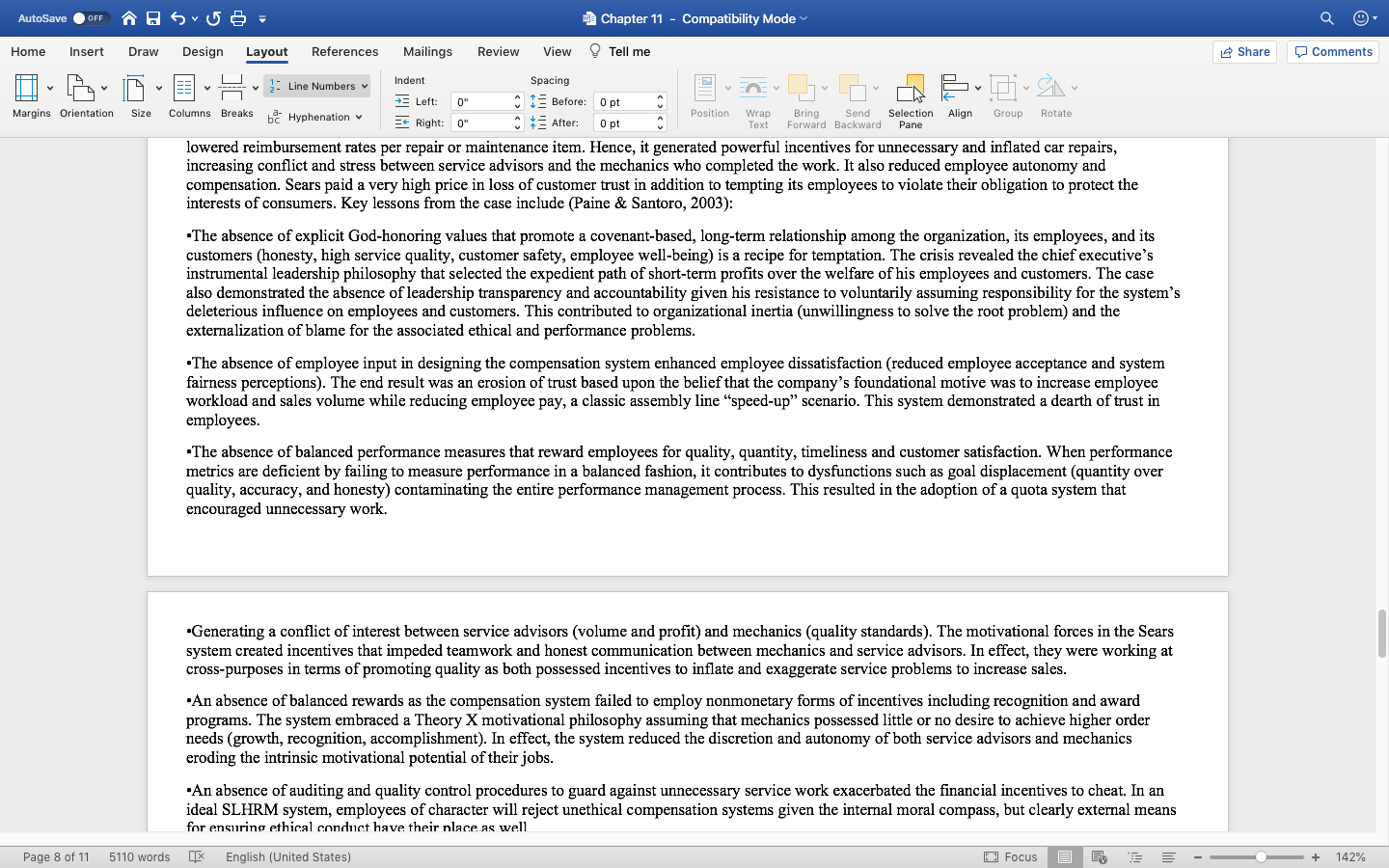
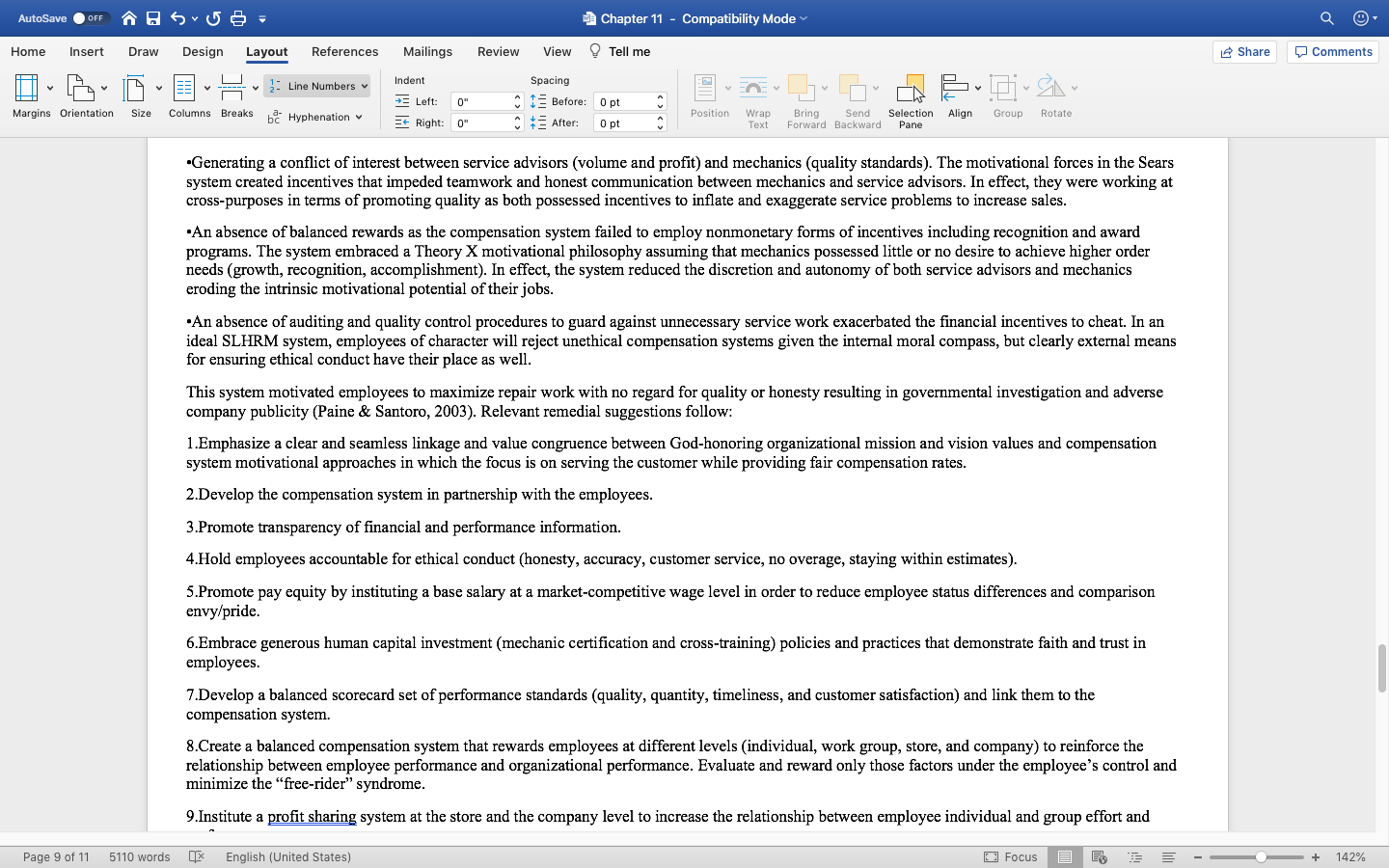
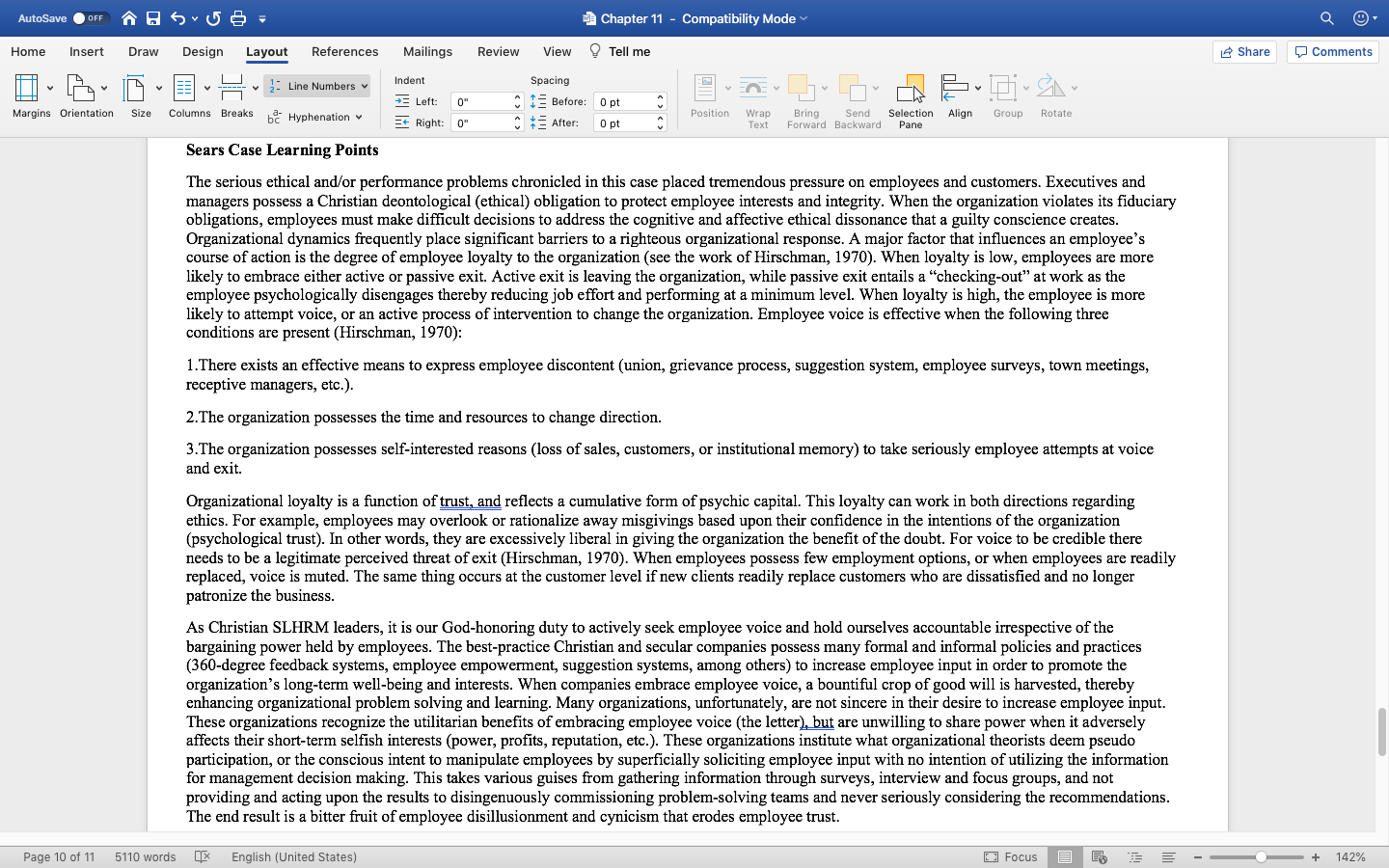
AutoSave OFF ove Chapter 11 - Compatibility Mode Home Insert Draw Design Layout References Mailings Review View Tell me Share 0 Comments Indent V v : Line Numbers ven 0" Spacing 1 Before: After: Margins Orientation Size Columns Breaks Left: + Right: O pt O pt be Hyphenation Position Group Align Rotate Wrap Text Bring Send Forward Backward Selection Pane 0" Compensation System Worldview Compensation is a foundational component of the SLHRM system. As Christian servant leaders, our stewardship of money is a window on our spiritual state and character. The compensation process reveals important worldview elements that manifest profound implications for human resources (HR) practices. One of the most pernicious pathologies of the secular worldview is defining self-worth and identity according to our job accomplishments and the most tangible indicators of "value," our salary. The other element that contributes to our enslavement is rampant materialism, which encourages the belief that happiness is a function of what we own and consume. Second, the goal as Christians is not happiness, which is transitory and influenced by highly variable factors, but deep spiritual joy, generated solely by the presence of the Holy Spirit in our hearts, eternal in nature, an island of peace in the trials and tribulations of our lives. If we embrace the subtle but powerful deception that materialism is the key to happiness, we are at the mercy of a multitude of elements beyond our control. When accomplishments and pay levels determine our value, we worship enslaving idols of the heart that imprison us with pride, fear, and insecurity. Conversely, God embraces money and compensation as a good and necessary element of promoting well-being at all levels, individual, family, and community. The key is recognizing and acknowledging the source (God) of our ability to generate wealth, compensation's purpose in promoting God's will to meet our legitimate and basic needs, and our role as a steward to use compensation wisely to promote Good's plan and purpose. Compensation systems reinforce and support a body of Christ differentiation of talents, gifts, and abilities, reflecting God's joy and pleasure in the process of variety in creation. Hence, every organization's compensation system should reflect God's nature and purpose. Each compensation system embraces an implicit and an explicit view of human nature, a motivational approach that focuses on satisfying selected needs and values. Using the framework of Douglas McGregor, Theory X organizations assume that money is the best motivator, an extrinsic approach; but relying primarily on monetary compensation is a double-edged sword (McGregor, 1960). A reliance on monetary compensation is effective in the short term, but generates many perverse consequences over time. A balanced compensation portfolio consisting of monetary and non-monetary elements is an attribute of management best practice (Jackson & Schuler, 2006). For many jobs, employees are primarily motivated intrinsically and performance enhancement programs using extrinsic approaches such as pay can decrease motivation and performance (Deckop, 1995; Deckop & Cirka, 2000; Markova & Ford, 2011). A theory that provides excellent guidance on the mixed influence of compensation is equity theory (Pynes, 2013). Equity theory accurately describes our reasoning and value assessment process of how we compare our inputs to a job (effort, performance level, qualifications) with the outcomes or the returns (pay levels, promotion, recognition) received. If these ratios are out of balance, the employee attempts to restore equity by adjusting inputs such as reducing work effort. If employee efforts fail to restore balance, workers experience increasing levels of stress and frustration. When organizations invest little effort in non-monetary forms of compensation to reinforce intrinsic motivation, it creates greater levels of compensation dissatisfaction, especially in government and nonprofit organizations. This decoupling of pay with performance occurs in many settings, especially with professional, highly educated occupations. For example, the intrinsic nature of the work is the primary motivator for social service workers and teachers (Borzaga & Tortia, 2006; Bassi & Fave, 2012). A competitive and reasonable level of compensation is a necessary factor, but should not be the primary motivational approach. Page 1 of 11 5110 words IE English (United States) O Focus E E + 142% AutoSave OFF ove Chapter 11 - Compatibility Mode Home Insert Draw Design Layout References Mailings Review View Tell me Share O Comments Indent V 2. Line Numbers ven CA + Left: Spacing 1 Before: After: 0" O pt Margins Orientation Size Columns Breaks bd Hyphenation Position Align Group Rotate + Right: Wrap Text O pt 0" Bring Send Forward Backward Selection Pane Wage System Fairness A key point is an unswerving commitment to wage system faimess. We are autonomous moral agents who cannot claim that we are labor market technicians locked in a machine-like system. Reducing compensation to a market machine process disguises our moral and personal accountability. Clearly, the Bible presents nonpayment or underpayment of wages as a form of theft, as stated in James 5:4, "Listen! The wages of the laborers who mowed your fields, which you kept back by fraud, cry out, and the cries of the harvesters have reached the ears of the Lord of hosts." From a Christian perspective, we must embrace and promote all forms of compensation equity as noted in the points that follow (Pynes, 2013). i. Internal equity: A logical internal hierarchy of job classifications linked to a rational and fair ordering of knowledge, skills, abilities, qualifications, and other human capital characteristics (positions requiring higher skills receive higher compensation). ii. External equity: Pay is market competitive. iii. Individual or merit equity: Pay levels are fair relative to individual performance and skill level (value added to production and service delivery). iv. Employee need equity (Living Wage): Pay a wage that supports human dignity and quality family well-being. As with other aspects of servant leadership, compensation equity requires an ongoing intentional commitment to paying employees according to their contributions. Debate Over the Living Wage One of the most heated compensation debates relates to individual need equity, or the living wage. What are the pro and con arguments? Figart (2001) provides a very cogent summary. The main argument against the living wage is that it distorts the effective and efficient operation of labor markets. A free labor market entails wages linked to productivity rates, the value labor adds to the production process, worker skill levels, and labor demand. Wage payments above the market equilibrium level distort the relation between the marginal value of labor and aggregate wage levels thereby inflating production costs. The result is lower demand for labor and the substitution of capital for labor attenuating overall job creation and economic growth. The end result is an overall decreased societal standard of living, higher taxation levels to support expensive social safety net programs, lower investment in job-creating industries, an increase in governmental dependency, and reduced individual economic and moral self-sufficiency (Figart, 2001). In contrast to the conservative economic views, the Catholic Church's teachings on social justice provide a strong moral and conceptual foundation for the living wage (Figart 2001). The Catholic Church is the primary Christian institutional advocate as represented in a more than one-hundred-year tradition of encyclicals on living wage policy (Zigarelli, 1993). Capitalist labor market theory atomizes workers and falsely assumes that promoting the self-interests of individual employers and employees cumulatively is in the best interests of society. This view is a distortion of the communal and social interconnections of labor to the larger health and well-being of the community and society as a whole. Hence, capitalist labor market theory dehumanizes workers and impedes the ability of employees to support their needs in a dignified manner. The capitalist labor market increases wage Page 5 of 11 5110 words LE English (United States) D Focus + 142% AutoSave OFF ove Chapter 11 - Compatibility Mode Home Insert Draw Design Layout References Mailings Review View Tell me Share O Comments Indent V v): Line Numbers DIA 0" Spacing 13 Before: After: Margins Orientation Size + Left: Et Right: Columns Breaks bd Hyphenation O pt O pt Position Wrap Text Align Rotate Group 0" Selection Pane Bring Send Forward Backward and income inequities between skilled and unskilled labor, which results in outsourcing of labor, substitution of technology for labor, reduction in living wage jobs for minorities, results in decline of cities, and promotes outsourcing of public sector jobs (Figart, 2001). We cannot have a just and healthy society with a large segment of the population burdened by preventable poverty. In order to fully understand the debate, one must understand the philosophical basis of the living wage movement. The foundational principle underlying the living wage movement is that dignified human labor is essential for body, mind, and spiritual health (Figart, 2001). The biblical rationale for the living wage is compelling as well. The Old and New Testaments call employers to treat fairly both the poor and the laborer (Deuteronomy 24:15, James 5:4). Jesus commands us to help the poor meet their basic life needs (Matthew 25:3426). Treating workers fairly glorifies God and enables these workers to serve the Lord effectively in their own personal life ministries and to raise their families in a fashion that promotes healthy spiritual, physical, and mental development. Hence, we promote a more just, moral, and prosperous civil society. Social justice theory states that the ultimate goal of the economy is to meet the material needs of employees to support a good and moral life. Hence, employers possess a moral obligation to provide wage rates that help employees meet their basic needs given that the right of private property is subordinate to human needs. If employers are unable to pay a living wage, society should supplement the salaries of workers with a variety of means including the negative income tax, childcare, and food subsidies, among others. Proponents posit that paying workers a living wage glorifies God and enables workers to more effectively serve the Lord and raise a family thereby promoting a just, moral, and prosperous civil society. Employers who pay less than a living wage receive subsidies through societal cost shifting onto families through working longer hours, the need to work two or more jobs, less time for family needs, poorer quality child rearing, and the associated adverse mental and physical health outcomes with the higher levels of stress (Figart, 2001). Another major source of subsidy is the government through food stamps, welfare, Medicaid, and housing assistance, among other programs. Finally, churches and nonprofit organizations, both faith- based and secular, absorb costs and indirectly subsidize low-wage employers through food banks, housing programs, and other forms of assistance. Living wage supporters in the United States cite decreasing social mobility and increasing income inequality due to the increase in one-parent families in which the parent is usually a woman), the depreciation of the value of the minimum wage, the reduction in unskilled manufacturing jobs, lack of national health insurance, and the globalization of labor markets as key factor justifications. The substitution of capital for labor, lower levels of construction employment, and international competition and the globalization of markets reduces the pool of living wage jobs, forcing more workers into the service economy (Figart, 2001; Economic Policy Institute, 2011). The result is a dramatic increase in jobs that pay below poverty wages with a concurrent erosion of the quality of life for millions of low-wage and skilled workers and their families. The pernicious combination of lower governmental spending in social services given higher deficits in combination with the increased demands and stagnating revenues of the nonprofit and church sector decrease the effectiveness of the social safety net, increasing poverty rates (Figart, 2001). Hence, these sources of church support are unable to meet the needs of the millions of low-wage workers with its present level of resource support, given that less than 5 percent of Christians tithe and the absence of a skilled labor force of paid and volunteer workers (Barna Group, 2013). The living wage generates much controversy, with a considerable contention over the specific definition of basic needs. How can we differentiate necessities from, needs, wants, and luxuries? The definition does vary somewhat by culture, but social scientists have developed well-validated measures of life quality, including access to basic health care, adequate nutrition, and safe and affordable housing, among other key areas (Malik, 2013; Gross National Happiness, 2014). How would you view your compensation policy if the prevailing wage were inadequate to rent a basic apartment or provide health care for your family as it is in many developing countries? Page 6 of 11 5110 words LE English (United States) D Focus + 142% AutoSave OFF ove Chapter 11 - Compatibility Mode Home Insert Draw Design Layout References Mailings Review View Tell me Share O Comments Indent Spacing 1: Line Numbers V n 0" 1 Before: Margins Orientation Size Columns Breaks bd Hyphenation + Left: + Right: O pt O pt Position Group Rotate 0" After: Wrap Text Selection Align Pane Bring Send Forward Backward impose significant externalities upon society (low-wage employers receive indirect subsidies given that they fail to provide health benefits). In addition, markets often internalize other forms of inefficiency, including forms of gender discrimination in which predominately female dominated occupations such as personal care-giving receive lower wages than comparable male professions (Pynes, 2013). This is a very complex issue requiring a delicate balance to preserve the powerful positive incentives of free markets while reducing the impact of their imperfections. Finally, should employers voluntarily provide a higher rate of compensation than the market requires? To be a leader in compensation recognizes the value added by employees. A second important question relates to whether family size or the number of dependents should be a factor in wage levels. Compensating employees at differential wages based on family need raises many issues of internal equity. However, there are no legal prohibitions against considering family need in terms of compensation unless there is an intended or unintended discriminatory impact. We (as a society) must address both individual and systematic factors that contribute to a high degree of stress on our lower income workers. We have micro and macro obligations as Christians. If the labor market human capital elements do not justify a living wage, I posit that SLHRM organizations make every effort to enhance employee human capital skills and performance either to increase employee productivity to justify higher wage or strive to place the employee with a new employer who can utilize his or her talents and meet living wage requirements after a reasonable term of employment. Even though employers may realize a loss on their investment in the short term, the cumulative and aggregate benefit of such a practice will be to enhance the reputation of the employer increasing the quality and quantity of the applicant pool to replace those who left. The focus of the living wage movement is to reduce human suffering and promote the dignity of low-wage earners. Numerous public policy interventions can assist low-wage workers and their families including the earned income tax credit (Hamilton, 2010) and tax credits/subsidies for hiring low-income workers (Hamersma, 2003). Another important area relates to governmental regulation including elevating the minimum wage that has eroded in purchasing power significantly over the last 40 years (Addison, Blackburn, & Cotti, 2013). This area is by definition a political question relating to the balancing of key economic, religious, and social values. Our response, both as an individual employers and a society, are important elements of Christian social responsibility. In conclusion, this discussion addresses very critical compensation and public policy issues. There are several levels of analysis with the most proximate at the level of the individual SLHRM employer and the balance of stewardship and servanthood values. From a stewardship standpoint, employers should provide a compensation system that is internally equitable in relation to job skill requirements and employee merit performance levels, and concurrently labor market competitive. What occurs if the market equitable wage is below a decent standard of living? Does the employer possess any larger servanthood obligations to address unmet employee needs? Our discussion to date has addressed the pros and cons of including employee need as a factor in individual employer compensation decisions. We miss the larger lay of the land if we ignore moral and ethical obligations and the larger market and public policy concerns. This issue will be a matter of ongoing debate. Elements of Servant Leadership Compensation Compensation is a foundational element of SLHRM management. Commit to a best-practice" compensation system that develops employee character and trust. This begins with honest weights and measures as noted in Deuteronomy 25:1315: Page 7 of 11 5110 words [x English (United States) O Focus ES + 142% AutoSave OFF ove Chapter 11 - Compatibility Mode Home Insert Draw Design Layout References Mailings Review View Tell me Share O Comments Indent V Line Numbers ven 0" Spacing I Before: After: Margins Orientation Size Left: Et Right: Columns Breaks bd Hyphenation O pt O pt Position Align Group Rotate Wrap Text 0" Bring Send Forward Backward Selection Pane Elements of Servant Leadership Compensation Compensation is a foundational element of SLHRM management. Commit to a best-practice compensation system that develops employee character and trust. This begins with honest weights and measures as noted in Deuteronomy 25:1315: You shall not have in your bag two kinds of weights, large and small. You shall not have in your house two kinds of measures, large and small. You shall have only a full and honest weight; you shall have only a full and honest measure, so that your days may be long in the land that the LORD your God is giving you. A foundational best practice principal is to develop a valid and reliable performance measurement and appraisal system with ongoing employee involvement. A valid performance measurement system reduces errors from key sources including contamination (the presence of nonperformance factors such as race bias), deficiency (measures lack key elements of performance such as qua of service) and imbalance or the inappropriate weighting of performance factors (quantity is much higher than quality). Another key balance element is that the system should promote an equilibrium between monetary and nonmonetary rewards and motivators developed with ongoing employee input. Servant leaders encourage and recognize others. A final balance factor it to promote an integrated system of performance measures linked to individual, group, and organizational process (behavior) and outcome metrics. SLHRM systems embrace employee empowerment in all HR systems. To enhance the fairness and effectiveness of the compensation system, employees should play a major role in developing the compensation system policies, procedures, decision rules, and criteria. This demonstrates trust in employees while enhancing employee acceptance, commitment, and motivational effectiveness. However, given that we live in a broken and sinful world, there is need for additional employee safeguards through a viable and independent appeals procedure. Another key element is to promote transparency of compensation system information and the decision-making process, which facilitates trust and the empowerment process. A final element is a "user-friendly" compensation system that is Web-based and accessible by employees. Another pillar of the SLHRM compensation system is to recognize and reward employees for character growth and development. Explicitly use the system to promote servant followership and leadership. A case that illustrates the antithesis of the SLHRM approach was that embraced by Sears and illustrated in a Harvard Business Review case study (Paine & Santoro, 2003). This case illustrates many of the key temptations that SLHRM organizations face in serving their clients and members. It is very easy to rationalize and embrace a self-serving and expedient orientation. In this case, Sears instituted a new compensation system that replaced a flat compensation rate for various types of car repairs with a commission system that lowered reimbursement rates per repair or maintenance item. Hence, it generated powerful incentives for unnecessary and inflated car repairs, increasing conflict and stress between service advisors and the mechanics who completed the work. It also reduced employee autonomy and compensation. Sears paid a very high price in loss of customer trust in addition to tempting its employees to violate their obligation to protect the interests of consumers Key leccone from the race include (Paine & Santoro 2002). Page 7 of 11 5110 words LE English (United States) O Focus + 142% AutoSave OFF ove Chapter 11 - Compatibility Mode Home Insert Draw Share O Comments Indent Spacing V v Left: 0" Margins Orientation Size Position Group Rotate 0" O pt Wrap Text Selection Align Pane Design Layout References Mailings Review View Tell me 2: Line Numbers -DIA 1. Before: O pt Columns Breaks b Hyphenation Bring Send + Right: After: Forward Backward lowered reimbursement rates per repair or maintenance item. Hence, it generated powerful incentives for unnecessary and inflated car repairs, increasing conflict and stress between service advisors and the mechanics who completed the work. It also reduced employee autonomy and compensation. Sears paid a very high price in loss of customer trust in addition to tempting its employees to violate their obligation to protect the interests of consumers. Key lessons from the case include (Paine & Santoro, 2003): The absence of explicit God-honoring values that promote a covenant-based, long-term relationship among the organization, its employees, and its customers (honesty, high service quality, customer safety, employee well-being) is a recipe for temptation. The crisis revealed the chief executive's instrumental leadership philosophy that selected the expedient path of short-term profits over the welfare of his employees and customers. The case also demonstrated the absence of leadership transparency and accountability given his resistance to voluntarily assuming responsibility for the system's deleterious influence on employees and customers. This contributed to organizational inertia (unwillingness to solve the root problem) and the externalization of blame for the associated ethical and performance problems. The absence of employee input in designing the compensation system enhanced employee dissatisfaction (reduced employee acceptance and system fairness perceptions). The end result was an erosion of trust based upon the belief that the company's foundational motive was to increase employee workload and sales volume while reducing employee pay, a classic assembly line "speed-up" scenario. This system demonstrated a dearth of trust in employees. The absence of balanced performance measures that reward employees for quality, quantity, timeliness and customer satisfaction. When performance metrics are deficient by failing to measure performance in a balanced fashion, it contributes to dysfunctions such as goal displacement (quantity over quality, accuracy, and honesty) contaminating the entire performance management process. This resulted in the adoption of a quota system that encouraged unnecessary work. Generating a conflict of interest between service advisors (volume and profit) and mechanics (quality standards). The motivational forces in the Sears system created incentives that impeded teamwork and honest communication between mechanics and service advisors. In effect, they were working at cross-purposes in terms of promoting quality as both possessed incentives to inflate and exaggerate service problems to increase sales. An absence of balanced rewards as the compensation system failed to employ nonmonetary forms of incentives including recognition and award programs. The system embraced a Theory X motivational philosophy assuming that mechanics possessed little or no desire to achieve higher order needs (growth, recognition, accomplishment). In effect, the system reduced the discretion and autonomy of both service advisors and mechanics eroding the intrinsic motivational potential of their jobs. An absence of auditing and quality control procedures to guard against unnecessary service work exacerbated the financial incentives to cheat. In an ideal SLHRM system, employees of character will reject unethical compensation systems given the internal moral compass, but clearly external means for ensuring ethical conduct have their nlace as well Page 8 of 11 5110 words English (United States) D Focus + 142% AutoSave OFF ove Chapter 11 - Compatibility Mode Home Insert Draw Design Layout References Mailings Review View Tell me Share O Comments Indent V 1: Line Numbers Di 0" Spacing 1 Before: After: O pt Margins Orientation Size + Left: SE Right: Columns Breaks be Hyphenation Position Align Group Rotate 0" O pt Wrap Text Bring Send Forward Backward Selection Pane Generating a conflict of interest between service advisors (volume and profit) and mechanics (quality standards). The motivational forces in the Sears system created incentives that impeded teamwork and honest communication between mechanics and service advisors. In effect, they were working at cross-purposes in terms of promoting quality as both possessed incentives to inflate and exaggerate service problems to increase sales. An absence of balanced rewards as the compensation system failed to employ nonmonetary forms of incentives including recognition and award programs. The system embraced a Theory X motivational philosophy assuming that mechanics possessed little or no desire to achieve higher order needs (growth, recognition, accomplishment). In effect, the system reduced the discretion and autonomy of both service advisors and mechanics eroding the intrinsic motivational potential of their jobs. An absence of auditing and quality control procedures to guard against unnecessary service work exacerbated the financial incentives to cheat. In an ideal SLHRM system, employees of character will reject unethical compensation systems given the internal moral compass, but clearly external means for ensuring ethical conduct have their place as well. This system motivated employees to maximize repair work with no regard for quality or honesty resulting in governmental investigation and adverse company publicity (Paine & Santoro, 2003). Relevant remedial suggestions follow: 1.Emphasize a clear and seamless linkage and value congruence between God-honoring organizational mission and vision values and compensation system motivational approaches in which the focus is on serving the customer while providing fair compensation rates. 2.Develop the compensation system in partnership with the employees. 3.Promote transparency of financial and performance information. 4.Hold employees accountable for ethical conduct (honesty, accuracy, customer service, no overage, staying within estimates). 5.Promote pay equity by instituting a base salary at a market-competitive wage level in order to reduce employee status differences and comparison envy/pride. 6.Embrace generous human capital investment (mechanic certification and cross-training) policies and practices that demonstrate faith and trust in employees. 7.Develop a balanced Scorecard set of performance standards (quality, quantity, timeliness, and customer satisfaction) and link them to the compensation system. 8. Create a balanced compensation system that rewards employees at different levels (individual, work group, store, and company) to reinforce the relationship between employee performance and organizational performance. Evaluate and reward only those factors under the employee's control and minimize the "free-rider" syndrome. 9.Institute a profit sharing system at the store and the company level to increase the relationship between employee individual and group effort and Page 9 of 11 5110 words LE English (United States) O Focus + 142% AutoSave OFF ove Chapter 11 - Compatibility Mode Home Insert Draw Design Layout References Mailings Review View Tell me Share O Comments Indent V 2Line Numbers ven CA + Left: 0" Spacing C D Before: After: O pt Margins Orientation Size Columns Breaks bd Hyphenation Position Align Group Rotate + Right: 0" O pt Wrap Text Bring Send Forward Backward Selection Pane Sears Case Learning Points The serious ethical and/or performance problems chronicled in this case placed tremendous pressure on employees and customers. Executives and managers possess a Christian deontological (ethical) obligation to protect employee interests and integrity. When the organization violates its fiduciary obligations, employees must make difficult decisions to address the cognitive and affective ethical dissonance that a guilty conscience creates. Organizational dynamics frequently place significant barriers to a righteous organizational response. A major factor that influences an employee's course of action is the degree of employee loyalty to the organization (see the work of Hirschman, 1970). When loyalty is low, employees are more likely to embrace either active or passive exit. Active exit is leaving the organization, while passive exit entails a "checking-out" at work as the employee psychologically disengages thereby reducing job effort and performing at a minimum level. When loyalty is high, the employee is more likely to attempt voice, or an active process of intervention to change the organization. Employee voice is effective when the following three conditions are present (Hirschman, 1970): 1.There exists an effective means to express employee discontent (union, grievance process, suggestion system, employee surveys, town meetings, receptive managers, etc.). 2.The organization possesses the time and resources to change direction. 3.The organization possesses self-interested reasons (loss of sales, customers, or institutional memory) to take seriously employee attempts at voice and exit. Organizational loyalty is a function of trust, and reflects a cumulative form of psychic capital. This loyalty can work in both directions regarding ethics. For example, employees may overlook or rationalize away misgivings based upon their confidence in the intentions of the organization (psychological trust). In other words, they are excessively liberal in giving the organization the benefit of the doubt. For voice to be credible there needs to be a legitimate perceived threat of exit (Hirschman, 1970). When employees possess few employment options, or when employees are readily replaced, voice is muted. The same thing occurs at the customer level if new clients readily replace customers who are dissatisfied and no longer patronize the business. As Christian SLHRM leaders, it is our God-honoring duty to actively seek employee voice and hold ourselves accountable irrespective of the bargaining power held by employees. The best-practice Christian and secular companies possess many formal and informal policies and practices (360-degree feedback systems, employee empowerment, suggestion systems, among others) to increase employee input in order to promote the organization's long-term well-being and interests. When companies embrace employee voice, a bountiful crop of good will is harvested, thereby enhancing organizational problem solving and learning. Many organizations, unfortunately, are not sincere in their desire to increase employee input. These organizations recognize the utilitarian benefits of embracing employee voice (the letter), but are unwilling to share power when it adversely affects their short-term selfish interests (power, profits, reputation, etc.). These organizations institute what organizational theorists deem pseudo participation, or the conscious intent to manipulate employees by superficially soliciting employee input with no intention of utilizing the information for management decision making. This takes various guises from gathering information through surveys, interview and focus groups, and not providing and acting upon the results to disingenuously commissioning problem-solving teams and never seriously considering the recommendations. The end result is a bitter fruit of employee disillusionment and cynicism that erodes employee trust. Page 10 of 11 5110 words LE English (United States) D Focus ES + 142%









 Study Help