Question: After reading Chapters 3 and 4 in your textbook, read Case 3.2 Your Integrated Case and . Based upon this information, prepare a memo (1-2
After reading Chapters 3 and 4 in your textbook, read Case 3.2 Your Integrated Case and
. Based upon this information, prepare a memo (1-2 pages) describing to Nick what you are recommending in terms of the first four steps of the marketing research process. You will need to address the need for the research, define the problem to be addressed in the project, establish the research objectives, and determine the research design. In the research design, you should address the type of research design or designs you are recommending be implemented. This section should also address any possible qualitative research that might be used in the project.
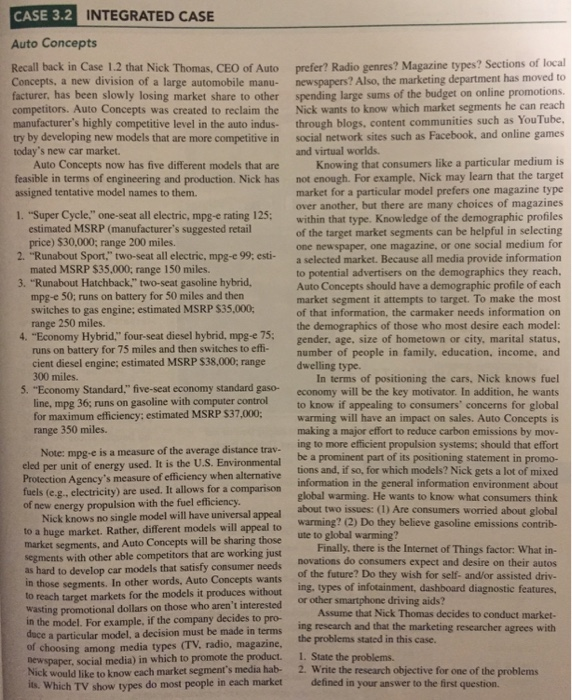
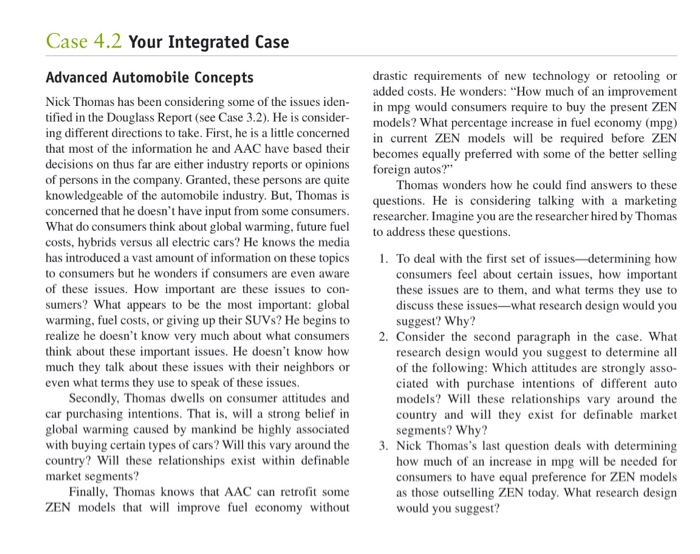
CASE 3.2 INTEGRATED CASE Auto Concepts Recall back in Case 1.2 that Nick Thomas, CEO of Auto Concepts, a new division of a large automobile manu- facturer, has been slowly losing market share to other competitors. Auto Concepts was created to reclaim the manufacturer's highly competitive level in the auto indus- try by developing new models that are more competitive in today's new car market. Auto Concepts now has five different models that are feasible in terms of engineering and production. Nick has assigned tentative model names to them. 1. "Super Cycle," one-seat all electric, mpg-e rating 125; estimated MSRP (manufacturer's suggested retail price) $30,000; range 200 miles. 2. "Runabout Sport," two-seat all electric, mpg-e 99; esti- mated MSRP $35.000; range 150 miles. 3. "Runabout Hatchback," two-seat gasoline hybrid, mpg-e 50; runs on battery for 50 miles and then switches to gas engine; estimated MSRP $35.000; range 250 miles. 4. "Economy Hybrid," four-seat diesel hybrid, mpg-e 75: runs on battery for 75 miles and then switches to effi- cient diesel engine; estimated MSRP $38,000; range 300 miles. 5. "Economy Standard," five-seat economy standard gaso- line, mpg 36; runs on gasoline with computer control for maximum efficiency: estimated MSRP $37.000; range 350 miles. Note: mpg-e is a measure of the average distance trav- eled per unit of energy used. It is the U.S. Environmental Protection Agency's measure of efficiency when alternative fuels (e.g., electricity) are used. It allows for a comparison of new energy propulsion with the fuel efficiency. Nick knows no single model will have universal appeal to a huge market. Rather, different models will appeal to market segments, and Auto Concepts will be sharing those segments with other able competitors that are working just as hard to develop car models that satisfy consumer needs in those segments. In other words, Auto Concepts wants to reach target markets for the models it produces without wasting promotional dollars on those who aren't interested in the model. For example, if the company decides to pro- duce a particular model, a decision must be made in terms of choosing among media types (TV, radio, magazine, newspaper, social media) in which to promote the product. Nick would like to know each market segment's media hab- its. Which TV show types do most people in each market prefer? Radio genres? Magazine types? Sections of local newspapers? Also, the marketing department has moved to spending large sums of the budget on online promotions. Nick wants to know which market segments he can reach through blogs, content communities such as YouTube, social network sites such as Facebook, and online games and virtual worlds. Knowing that consumers like a particular medium is not enough. For example. Nick may learn that the target market for a particular model prefers one magazine type over another, but there are many choices of magazines within that type. Knowledge of the demographic profiles of the target market segments can be helpful in selecting one newspaper, one magazine, or one social medium for a selected market. Because all media provide information to potential advertisers on the demographics they reach. Auto Concepts should have a demographic profile of each market segment it attempts to target. To make the most of that information, the carmaker needs information on the demographics of those who most desire each model: gender, age, size of hometown or city, marital status, number of people in family, education, income, and dwelling type. In terms of positioning the cars. Nick knows fuel economy will be the key motivator. In addition, he wants to know if appealing to consumers' concerns for global warming will have an impact on sales. Auto Concepts is making a major effort to reduce carbon emissions by mov- ing to more efficient propulsion systems; should that effort be a prominent part of its positioning statement in promo- tions and, if so, for which models? Nick gets a lot of mixed information in the general information environment about global warming. He wants to know what consumers think about two issues: (1) Are consumers worried about global warming? (2) Do they believe gasoline emissions contrib- ute to global warming? Finally, there is the Internet of Things factor: What in- novations do consumers expect and desire on their autos of the future? Do they wish for self- and/or assisted driv ing. types of infotainment, dashboard diagnostic features, or other smartphone driving aids? Assume that Nick Thomas decides to conduct market ing research and that the marketing researcher agrees with the problems stated in this case. 1. State the problems 2. Write the research objective for one of the problems defined in your answer to the first question. Case 4.2 Your Integrated Case Advanced Automobile Concepts Nick Thomas has been considering some of the issues iden- tified in the Douglass Report (see Case 3.2). He is consider- ing different directions to take. First, he is a little concerned that most of the information he and AAC have based their decisions on thus far are either industry reports or opinions of persons in the company. Granted, these persons are quite knowledgeable of the automobile industry. But, Thomas is concerned that he doesn't have input from some consumers. What do consumers think about global warming, future fuel costs, hybrids versus all electric cars? He knows the media has introduced a vast amount of information on these topics to consumers but he wonders if consumers are even aware of these issues. How important are these issues to con- sumers? What appears to be the most important: global warming, fuel costs, or giving up their SUVs? He begins to realize he doesn't know very much about what consumers think about these important issues. He doesn't know how much they talk about these issues with their neighbors or even what terms they use to speak of these issues. Secondly, Thomas dwells on consumer attitudes and car purchasing intentions. That is, will a strong belief in global warming caused by mankind be highly associated with buying certain types of cars? Will this vary around the country? Will these relationships exist within definable market segments? Finally, Thomas knows that AAC can retrofit some ZEN models that will improve fuel economy without drastic requirements of new technology or retooling or added costs. He wonders: "How much of an improvement in mpg would consumers require to buy the present ZEN models? What percentage increase in fuel economy (mpg) in current ZEN models will be required before ZEN becomes equally preferred with some of the better selling foreign autos?" Thomas wonders how he could find answers to these questions. He is considering talking with a marketing researcher. Imagine you are the researcher hired by Thomas to address these questions. 1. To deal with the first set of issuesdetermining how consumers feel about certain issues, how important these issues are to them, and what terms they use to discuss these issueswhat research design would you suggest? Why? 2. Consider the second paragraph in the case. What research design would you suggest to determine all of the following: Which attitudes are strongly asso- ciated with purchase intentions of different auto models? Will these relationships vary around the country and will they exist for definable market segments? Why? 3. Nick Thomas's last question deals with determining how much of an increase in mpg will be needed for consumers to have equal preference for ZEN models as those outselling ZEN today. What research design would you suggest









 Study Help