Question: After Reading the Attached Case Study, the resource and process and customer acceptability, Answer the below in no morethan 300 words: NB : Strictly stick
After Reading the Attached Case Study, the resource and process and customer acceptability, Answer the below in no morethan 300 words:
NB : Strictly stick to the context and answer questions asked.
- How would you assess AlphaGo's real-world implementation potential in terms of resource and process "distance", customer acceptability and "adjustment costs"?
- What context-specific issues would need to be taken into account when deploying technologies like AlphaGo in South Africa or under developed country?
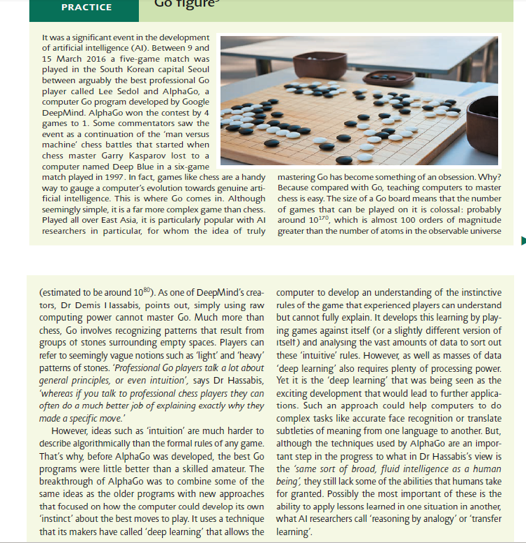
PRACTICE It was a significant event in the development of artificial intelligence (AI). Between 9 and 15 March 2016 a five-game match was played in the South Korean capital Seoul between arguably the best professional Go player called Lee Sedol and AlphaGo, a computer Go program developed by Google DeepMind. AlphaGo won the contest by 4 games to 1. Some commentators saw the event as a continuation of the 'man versus machine' chess battles that started when chess master Garry Kasparov lost to a computer named Deep Blue in a six-game match played in 1997. In fact, games like chess are a handy mastering Go has become something of an obsession. Why? way to gauge a computer's evolution towards genuine arts. Because compared with Go, teaching computers to master ficial intelligence. This is where Go comes in. Although chess is easy. The size of a Go board means that the number seemingly simple, it is a far more complex game than chess of games that can be played on it is colossal: probably Played all over East Asia, it is particularly popular with Al around 10170, which is almost 100 orders of magnitude researchers in particular, for whom the idea of truly greater than the number of atoms in the observable universe (estimated to be around 108). As one of DeepMind's crea- computer to develop an understanding of the instinctive tors, Dr Demis I lassabis, points out, simply using raw rules of the game that experienced players can understand computing power cannot master Go. Much more than but cannot fully explain. It develops this learning by play- chess, Go involves recognizing patterns that result from ing games against itself (or a slightly different version of groups of stones surrounding empty spaces. Players can itselt) and analysing the vast amounts of data to sort out refer to seemingly vague notions such as light' and 'heavy' these 'intuitive rules. However, as well as masses of data patterns of stones. "Professional Go players tak a lot about 'deep learning' also requires plenty of processing power. general principles, or even intuition', says Dr Hassabis. Yet it is the deep learning' that was being seen as the whereas if you talk to professional chess players they can exciting development that would lead to further applica- often do a much better job of explaining exactly why they tions. Such an approach could help computers to do made a specific move." complex tasks like accurate face recognition or translate However, ideas such as intuition' are much harder to subtleties of meaning from one language to another. But, describe algorithmically than the formal rules of any game although the techniques used by AlphaGo are an impor- That's why, before AlphaGo was developed, the best Go tant step in the progress to what in Dr Hassabis's view is programs were little better than a skilled amateur. The the 'some sort of broad, fluid intelligence as a human breakthrough of AlphaGo was to combine some of the being they still lack some of the abilities that humans take same ideas as the older programs with new approaches for granted. Possibly the most important of these is the that focused on how the computer could develop its own ability to apply lessons leared in one situation in another 'instinct about the best moves to play. It uses a technique what Al researchers call 'reasoning by analogy' or 'transfer that its makers have called 'deep learning' that allows the learning news 11:31 24 Put ill 100% Alpha - Read-only H : This account does not allow editing on yo... Resource and process 'distance The degree of difficulty in the implementation of process technology will depend on the degree of novelty of the new technology resources and the changes required in the operation's processes. The less that the new technology resources are understood influenced perhaps by the degree of innovation), the greater their distance from the current technology resource base of the opera- tion. Similarly, the extent to which an implementation requires an operation to modify its existing processes, the greater the process distance'. The greater the resource and process distance, the more difficult any implementation is likely t This is because distance makes it difficult to adopt a systematic approach to analysing change and learning from mistakes. Those implementa- tions which involve relatively little process or resource 'distance provide an ideal opportunity for organizational learning. As in Operations principle any classic scientific experiment, the more variables that are held constant, the more confidence you have in determining cause The difficulty of process technology implementation depends on its degree of and effect. Conversely, in an implementation where the resource novelty and the changes required in the and process distance' means that nearly everything is 'up for operation's processes. grabs', it becomes difficult to know what has worked and what has not. More importantly, it becomes difficult to know why something has or has not worked.11 This idea is illustrated in Figure 8.9. be used to Customer acceptability When an operation's customers interact with its process technology it is essential to consider the customer interaction when evaluating it. If customers are to have direct contact with tech- nology, they must have some idea of how to operate it. Where customers have an active interac- tion with technology, the limitations of their understanding of the technology can be the main constraint on its use. For example, even some domestic technologies such as smart TVs cannot their full potential by some owners. Other customer-driven technologies can face the same problem, with the important addition that if customers cannot use technologies such as internet banking, there are serious commercial consequences for a bank's customer service. Staff in manufacturing operations may require several years of training before they are given control of the technology they operate. Service operations may not have the same opportunity for customer training. Walley and Amin2 suggest that the ability of the operation to train its customers in the use of its technology depends on three factors: complexity, repetition and the variety of tasks performed by the customer. If services are complex, higher levels of training maybe needed for example, the technol- ogies in theme parks and fast-food outlets rely on customers copying the behaviour of others. Frequency of use is important because the payback for the investment in training will be the customer uses the technology frequently. Also, customers may, over time, forget how to use the technology, but regular repetition will reinforce the training. Finally, training will be easier if the customer is presented with a low variety of tasks. For example, vending machines tend to concentrate on one category of product, so that the sequence of tasks required to operate the technology remains consistent. In other cases, the technology may not be trusted by customers because it is technology and not a person. Sometimes we prefer to put ourselves in the care of a person, even if their perfor- mance is inferior to a technology. For example, the use of robot technologies in surgery has distinct advantages over conventional surgery, but in spite of the fact that the surgeon is in control, it is viewed be greater it O









 Study Help