After reading the final case study, "International Paper's Wildlife and Recreation Program," answer the questions at the end of the case study and upload the answers here.
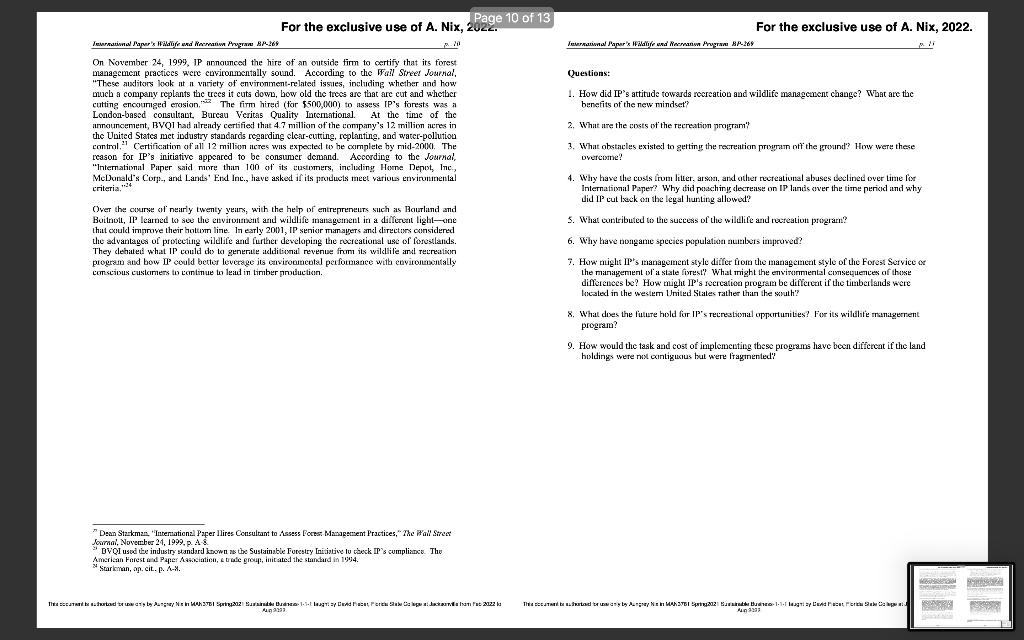
1. How did IPs attitude towards recreation and wildlife management change? What are the benefits of the new mindset?
2. What are the costs of the recreation program?
3. What obstacles existed to getting the recreation program off the ground? How were these overcome?
4. Why have the costs from litter, arson, and other recreational abuses declined over time for International Paper? Why did poaching decrease on IP lands over the time period and why did IP cut back on the legal hunting allowed?
5. What contributed to the success of the wildlife and recreation program?
6. Why have nongame species population numbers improved?
7. How might IPs management style differ from the management style of the Forest Service or the management of a state forest? What might the environmental consequences of those differences be? How might IPs recreation program be different if the timberlands were located in the western United States rather than the south?
8. What does the future hold for IPs recreational opportunities? For its wildlife management program?
9. How would the task and cost of implementing these programs have been different if the land holdings were not contiguous but were fragmented?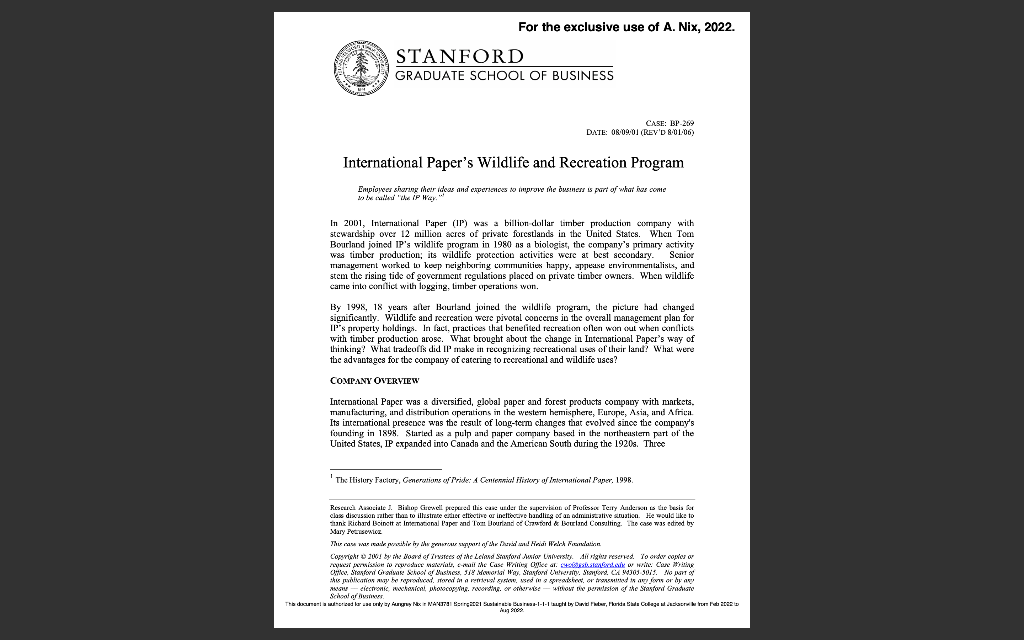
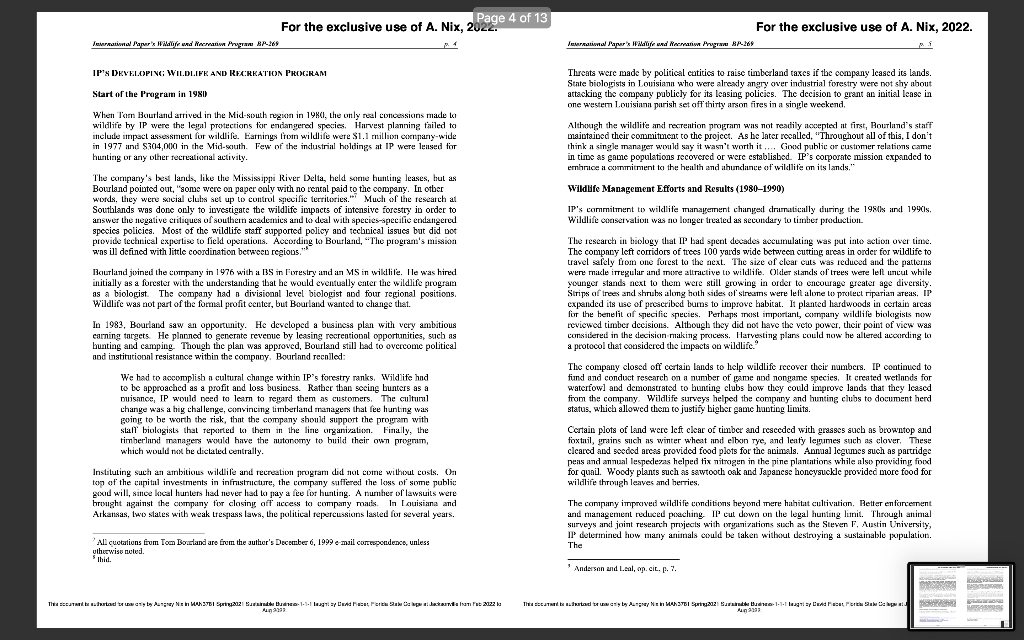
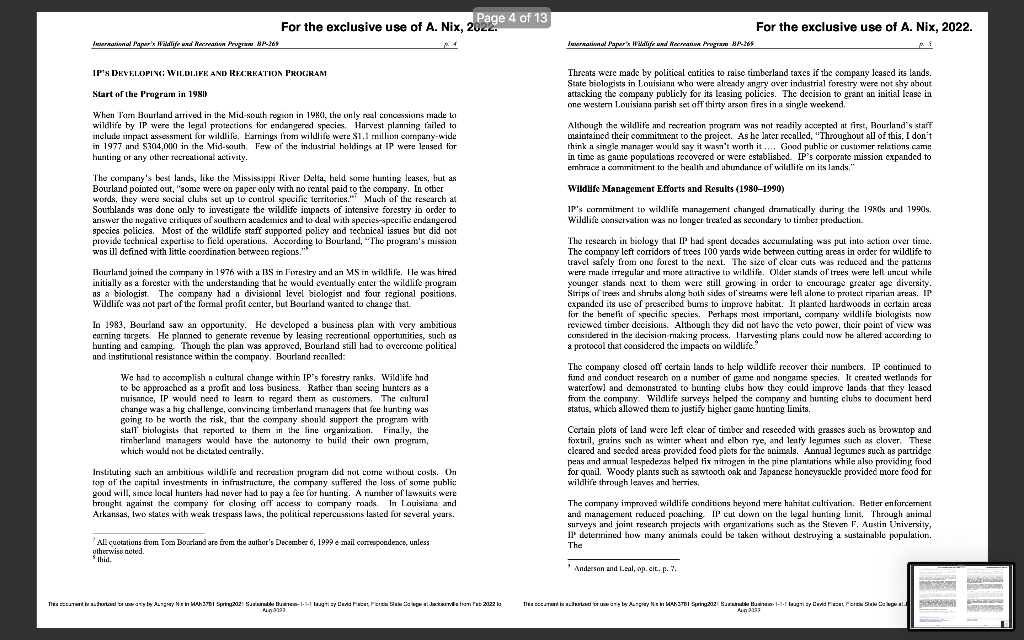
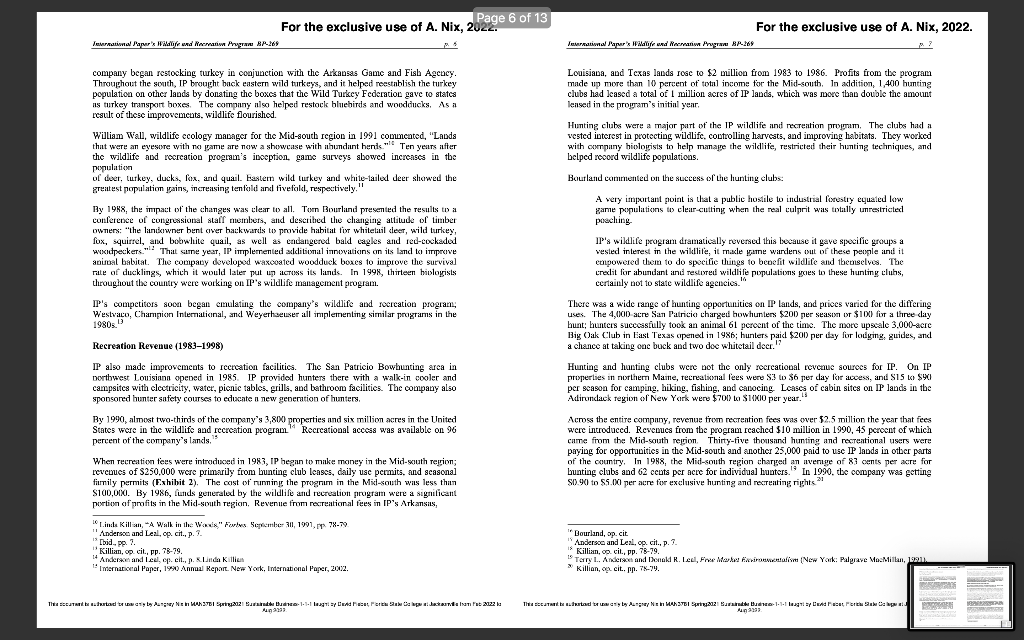
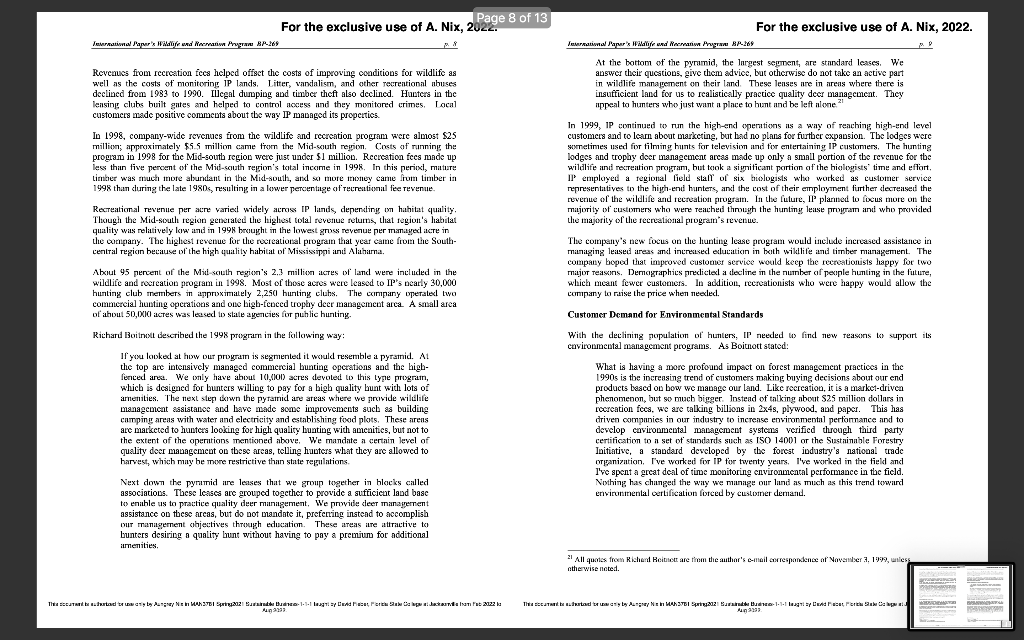
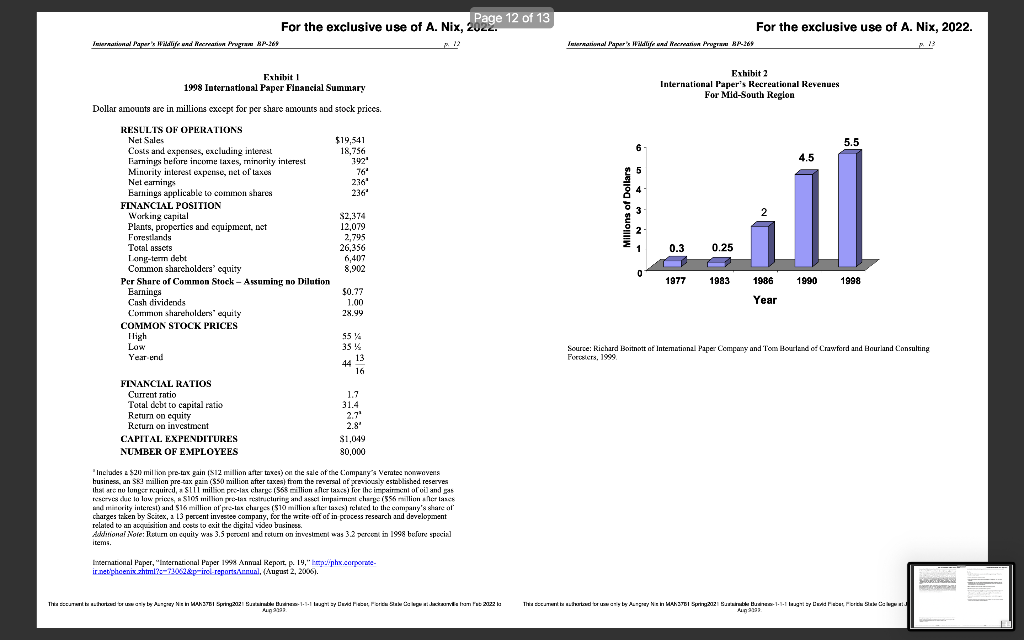
For the exclusive use of A. Nix, 2022. STANFORD GRADUATE SCHOOL OF BUSINESS CASE: BP-269 DATE: 08-09/01 (REV'D 8-01-06) International Paper's Wildlife and Recreation Program Employees sharing their ideas and experiences to improve the business is part of what has come to be called the IP War In 2001, International Paper (IP) was a billion dollar timber production company with stewardship over 12 million acres of private forestlands in the United States. When Tom Bourland joined IP's wildlife program in 1980 as a biologist, the company's primary activity was timber production; its wildlife protection activities were at best secondary. Senior management worked to keep neighboring communities happy, appease environmentalists, and stem the rising tide of government regulations placed on private timber owners. When wildlife came into conflict with logging, timber operations won. By 1998, 18 years after Bourland joined the wildlife program, the picture had changed significantly. Wildlife and recreation were pivotal concerns in the overall management plan for IP's property holdings. In fact, practices that benefited recreation oflen won out when conflicts with timber production arose. What brought about the change in International Paper's way of thinking? What tradeoffs did IP make in recognizing recreational uses of their land? What were the advantages for the company of catering to recreational and wildlife uses? COMPANY OVERVIEW International Paper was a diversified, global paper and forest products company with markets. manufacturing, and distribution operations in the western hemisphere, Europe, Asia, and Africa. Its international presence was the result of long-term changes that evolved since the company's part of the founding in 1898. Started as a pulp and paper company based in the northeastern part of the United States, IP expanded into Canada and the American South during the 1920s. Three The History Factory, Generations of Pride: A Centennial History of International Paper, 1998. Research Associate J. Bishop Grewell prepared this case under the supervision of Professor Terry Anderson is the basis for class discussion rather than to illustrate entier effective or ineffective handling of an administrative situation. He would like to ans Richard Beinett at International Paper and Tom Bourland of Crawford & Borland Consulting. The case was edined by Mary Pesc This car war made percible by the generoase suggpart of the David and Heidi Welch Foundation Copyright 2001 by the Board of Trustees of the Leland Stanford Justor University. All rights reserved. To order coples or request permission to reproduce materials, e-mail the Case Writing Office at. selebaterdaix or write: Care Office Staford Graduate School of Business, 518 Memorial Way, Stanford University, Stanford, CA 94305-3015. No part of this publication may be reproduced, stored in a remteval system, ssed in a spreadsheet, or transmined in any form or by any mons- electronic, mechanical, photocopying, recording, or otherwise without the peradision of the Stanford Graduate School of V The methorized for use only by Aegy Nx in MAN378) Barng2021 Starab Barasa-1-1-1 laught by David Fieber, Frida Sala College at Jadaone from 2002 2009 W International Paper's Wildlife und Recreation Program BP-269 IP'S DEVELOPING WILDLIFE AND RECREATION PROGRAM Start of the Program in 1980 When Tom Bourland arrived in the Mid-south region in 1980, the only real concessions made to wildlife by IP were the legal protections for endangered species. Harvest planning failed to include impact assessment for wildlife. Earnings from wildlife were $1.1 million company-wide in 1977 and $304,000 in the Mid-south. Few of the industrial holdings at IP were leased for hunting or any other recreational activity. The company's best lands, like the Mississippi River Delta, held some hunting leases, but as Bourland pointed out, "some were on paper only with no rental paid to the company. In other words, they were social clubs set up to control specific territories." Much of the research at Southlands was done only to investigate the wildlife impacts of intensive forestry in order to answer the negative critiques of southern academics and to deal with species-specific endangered species policies. Most of the wildlife staff supported policy and technical issues but did not provide technical expertise to field operations. According to Bourland, "The program's mission. was ill defined with little coordination between regions. Bourland joined the company in 1976 with a BS in Forestry and an MS in wildlife. He was hired initially as a forester with the understanding that he would eventually enter the wildlife program as a biologist. The company had a divisional level biologist and four regional positions. Wildlife was not part of the formal profit center, but Bourland wanted to change that. In 1983, Bourland saw an opportunity. He developed a business plan with very ambitious earning targets. He planned to generate revenue by leasing recreational opportunities, such as bunting and camping. Though the plan was approved, Bourland still had to overcome political and institutional resistance within the company. Bourland recalled: We had to accomplish a cultural change within IP's forestry ranks. Wildlife had to be approached as a profit and loss business. Rather than seeing bunters as a nuisance, IP would need to learn to regard them as customers. The cultural change was a big challenge, convincing timberland managers that fee hunting was going to be worth the risk, that the company should support the program with staff biologists that reported to them in the line organization. Finally, the timberland managers would have the autonomy to build their own program, which would not be dictated centrally. Instituting such an ambitious wildlife and recreation program did not come without costs. On top of the capital investments in infrastructure, the company suffered the loss of some public good will, since local hunters had never had to pay a fee for hunting. A number of lawsuits were brought against the company for closing off access to company roads. In Louisiana and Arkansas, two states with weak trespass laws, the political repercussions lasted for several years. All quotations from Tom Bourland are from the author's December 6, 1999 e-mail correspondence, unless otherwise noted. Ihid. cry by Aungey Nin ki MAh 2781 Spi Nix in MAK 3781 The bal branly by Aungsey The Page 4 of 13 For the exclusive use of A. Nix, 2022. Spring202) Sankte Budson-1-1-1 Imagini by David Flabet, Floric State Colge at Jackanda ham Fab 2022 k Jun 2233 For the exclusive use of A. Nix, 2022. International Paper's Wildlife und Recreation Program BP-269 Threats were made by political entities to raise timberland taxes if the company leased its lands. State biologists in Louisiana who were already angry over industrial forestry were not shy about attacking the company publicly for its leasing policies. The decision to grant an initial lease in one western Louisiana parish set off thirty arson fires in a single weekend. Although the wildlife and recreation program was not readily accepted at first, Bourland's staff maintained their commitment to the project. As he later recalled, "Throughout all of this, I don't think a single manager would say it wasn't worth it.... Good public or customer relations came in time as game populations recovered or were established. IP's corporate mission expanded to embrace a commitment to the health and abundance of wildlife on its lands." Wildlife Management Efforts and Results (1980-1990) IP's commitment to wildlife management changed dramatically during the 1980s and 1990s. Wildlife conservation was no longer treated as secondary to timber production. The research in biology that IP had spent decades accumulating was put into action over time. The company left corridors of trees 100 yards wide between cutting areas in order for wildlife to travel safely from one forest to the next. The size of clear cuts was reduced and the patterns were made irregular and more attractive to wildlife. Older stands of trees were left uncut while younger stands next to them were still growing in order to encourage greater age diversity. Strips of trees and shrubs along both sides of streams were left alone to protect riparian areas. IP expanded its use of prescribed bums to improve habitat. It planted hardwoods in certain areas for the benefit of specific species. Perhaps most important, company wildlife biologists now. reviewed timber decisions. Although they did not have the veto power, their point of view was considered in the decision-making process. Harvesting plans could now he altered according to a protocol that considered the impacts on wildlife. The company closed off certain lands to help wildlife recover their numbers. IP continued to fund and conduct research on a number of game and nongame species. It created wetlands for waterfowl and demonstrated to hunting clubs how they could improve lands that they leased from the company. Wildlife surveys helped the company and hunting clubs to document herd status, which allowed them to justify higher game hunting limits. Certain plots of land were left clear of timber and reseeded with grasses such as browntop and foxtail, grains such as winter wheat and elbon rye, and leafy legumes such as clover. These cleared and seeded areas provided food plots for the animals. Annual legumes such as partridge peas and annual lespedezas helped fix nitrogen in the pine plantations while also providing food for quail. Woody plants such as sawtooth oak and Japanese honeysuckle provided more food for wildlife through leaves and berries. The company improved wildlife conditions beyond mere habitat cultivation, Better enforcement and management reduced poaching. IP cut down on the legal hunting limit. Through animal surveys and joint research projects with organizations such as the Steven F. Austin University, IP determined how many animals could be taken without destroying a sustainable population. The Anderson and Leal, op. cit., p. 7. A The tel branly by Aungsey Nix in MAN 3761 Spring202) Sarande Budinem-1-1-1 taught by David Faber, For Sale Ca legend Aug 3233 WAN BASPLENDRYS International Paper's Wildlife und Recreation Program BP-269 IP'S DEVELOPING WILDLIFE AND RECREATION PROGRAM Start of the Program in 1980 When Tom Bourland arrived in the Mid-south region in 1980, the only real concessions made to wildlife by IP were the legal protections for endangered species. Harvest planning failed to include impact assessment for wildlife. Earnings from wildlife were $1.1 million company-wide in 1977 and $304,000 in the Mid-south. Few of the industrial holdings at IP were leased for hunting or any other recreational activity. The company's best lands, like the Mississippi River Delta, held some hunting leases, but as Bourland pointed out, "some were on paper only with no rental paid to the company. In other words, they were social clubs set up to control specific territories." Much of the research at Southlands was done only to investigate the wildlife impacts of intensive forestry in order to answer the negative critiques of southern academics and to deal with species-specific endangered species policies. Most of the wildlife staff supported policy and technical issues but did not provide technical expertise to field operations. According to Bourland, "The program's mission. was ill defined with little coordination between regions. Bourland joined the company in 1976 with a BS in Forestry and an MS in wildlife. He was hired initially as a forester with the understanding that he would eventually enter the wildlife program as a biologist. The company had a divisional level biologist and four regional positions. Wildlife was not part of the formal profit center, but Bourland wanted to change that. In 1983, Bourland saw an opportunity. He developed a business plan with very ambitious earning targets. He planned to generate revenue by leasing recreational opportunities, such as bunting and camping. Though the plan was approved, Bourland still had to overcome political and institutional resistance within the company. Bourland recalled: We had to accomplish a cultural change within IP's forestry ranks. Wildlife had to be approached as a profit and loss business. Rather than seeing bunters as a nuisance, IP would need to learn to regard them as customers. The cultural change was a big challenge, convincing timberland managers that fee hunting was going to be worth the risk, that the company should support the program with staff biologists that reported to them in the line organization. Finally, the timberland managers would have the autonomy to build their own program, which would not be dictated centrally. Instituting such an ambitious wildlife and recreation program did not come without costs. On top of the capital investments in infrastructure, the company suffered the loss of some public good will, since local hunters had never had to pay a fee for hunting. A number of lawsuits were brought against the company for closing off access to company roads. In Louisiana and Arkansas, two states with weak trespass laws, the political repercussions lasted for several years. All quotations from Tom Bourland are from the author's December 6, 1999 e-mail correspondence, unless otherwise noted. Ihid. cry by Aungey Nin ki MAh 2781 Spi Nix in MAK 3781 The bal branly by Aungsey The Page 4 of 13 For the exclusive use of A. Nix, 2022. Spring202) Sankte Budson-1-1-1 Imagini by David Flabet, Floric State Colge at Jackanda ham Fab 2022 k Jun 2233 For the exclusive use of A. Nix, 2022. International Paper's Wildlife und Recreation Program BP-269 Threats were made by political entities to raise timberland taxes if the company leased its lands. State biologists in Louisiana who were already angry over industrial forestry were not shy about attacking the company publicly for its leasing policies. The decision to grant an initial lease in one western Louisiana parish set off thirty arson fires in a single weekend. Although the wildlife and recreation program was not readily accepted at first, Bourland's staff maintained their commitment to the project. As he later recalled, "Throughout all of this, I don't think a single manager would say it wasn't worth it.... Good public or customer relations came in time as game populations recovered or were established. IP's corporate mission expanded to embrace a commitment to the health and abundance of wildlife on its lands." Wildlife Management Efforts and Results (1980-1990) IP's commitment to wildlife management changed dramatically during the 1980s and 1990s. Wildlife conservation was no longer treated as secondary to timber production. The research in biology that IP had spent decades accumulating was put into action over time. The company left corridors of trees 100 yards wide between cutting areas in order for wildlife to travel safely from one forest to the next. The size of clear cuts was reduced and the patterns were made irregular and more attractive to wildlife. Older stands of trees were left uncut while younger stands next to them were still growing in order to encourage greater age diversity. Strips of trees and shrubs along both sides of streams were left alone to protect riparian areas. IP expanded its use of prescribed bums to improve habitat. It planted hardwoods in certain areas for the benefit of specific species. Perhaps most important, company wildlife biologists now. reviewed timber decisions. Although they did not have the veto power, their point of view was considered in the decision-making process. Harvesting plans could now he altered according to a protocol that considered the impacts on wildlife. The company closed off certain lands to help wildlife recover their numbers. IP continued to fund and conduct research on a number of game and nongame species. It created wetlands for waterfowl and demonstrated to hunting clubs how they could improve lands that they leased from the company. Wildlife surveys helped the company and hunting clubs to document herd status, which allowed them to justify higher game hunting limits. Certain plots of land were left clear of timber and reseeded with grasses such as browntop and foxtail, grains such as winter wheat and elbon rye, and leafy legumes such as clover. These cleared and seeded areas provided food plots for the animals. Annual legumes such as partridge peas and annual lespedezas helped fix nitrogen in the pine plantations while also providing food for quail. Woody plants such as sawtooth oak and Japanese honeysuckle provided more food for wildlife through leaves and berries. The company improved wildlife conditions beyond mere habitat cultivation, Better enforcement and management reduced poaching. IP cut down on the legal hunting limit. Through animal surveys and joint research projects with organizations such as the Steven F. Austin University, IP determined how many animals could be taken without destroying a sustainable population. The Anderson and Leal, op. cit., p. 7. A The tel branly by Aungsey Nix in MAN 3761 Spring202) Sarande Budinem-1-1-1 taught by David Faber, For Sale Ca legend Aug 3233 WAN BASPLENDRYS Page 6 of 13 For the exclusive use of A. Nix, 2022. International Paper's Wildlife und Recreation Program BP-269 company began restocking turkey in conjunction with the Arkansas Game and Fish Agency. Throughout the south, IP brought back eastern wild turkeys, and it helped reestablish the turkey population on other lands by donating the boxes that the Wild Turkey Federation gave to states as turkey transport boxes. The company also helped restock bluebirds and woodducks. As a result of these improvements, wildlife flourished. William Wall, wildlife ecology manager for the Mid-south region in 1991 commented, "Lands that were an eyesore with no game are now a showcase with abundant herds." Ten years after the wildlife and recreation program's inception, game surveys showed increases in the population of deer, turkey, ducks, fox, and quail. Eastern wild turkey and white-tailed deer showed the 11 greatest population gains, increasing tenfold and fivefold, respectively. By 1988, the impact of the changes was clear to all. Tom Bourland presented the results to a conference of congressional staff members, and described the changing attitude of timber owners: "the landowner bent over backwards to provide habitat for whitetail deer, wild turkey, fox, squirrel, and bobwhite quail, as well as endangered bald eagles and red-cockaded woodpeckers." That same year, IP implemented additional innovations on its land to improve animal babitat. The company developed waxcoated woodduck boxes to improve the survival rate of ducklings, which it would later put up across its lands. In 1998, thirteen biologists throughout the country were working on IP's wildlife management program. IP's competitors soon began emulating the company's wildlife and recreation program; Westvaco, Champion International, and Weyerhaeuser all implementing similar programs in the 1980. Recreation Revenue (1983-1998) IP also made improvements to recreation facilities. The San Patricio Bowhunting area in northwest Louisiana opened in 1985. IP provided hunters there with a walk-in cooler and campsites with clectricity, water, picnic tables, grills, and bathroom facilities. The company also sponsored hunter safety courses to educate a new generation of hunters. By 1990, almost two-thirds of the company's 3,800 properties and six million acres in the United States were in the wildlife and recreation program Recreational access was available on 96 percent of the company's lands." When recreation fees were introduced in 1983, IP began to make money in the Mid-south region; revenues of $250,000 were primarily from bunting club leases, daily use permits, and seasonal family permits (Exhibit 2). The cost of running the program in the Mid-south was less than $100,000. By 1986, funds generated by the wildlife and recreation program were a significant portion of profits in the Mid-south region, Revenue from recreational fees in IP's Arkansas, Linda Killian, "A Walk in the Woods" Forbes September 31, 1991, pp. 78-79. Anderson and Leal, op. cit., p. 7. Ibid., pp. 7. Killian, op. cit., pp. 78-79. Anderson and Leal, op. cit., p. 8.Linda Killian International Paper, 1990 Annual Report. New York, International Paper, 2002. The bly by Aungsey Nix in MAN3751 Spring202 Sande Budson-1-1-1 lagi by David Face For Sale Cole Jackan han Fab 2022 Jun 2233 For the exclusive use of A. Nix, 2022. International Paper's Wildlife und Recreation Program BP-269 Louisiana, and Texas lands rose to $2 million from 1983 to 1986. Profits from the program made up more than 10 percent of total income for the Mid-south. In addition, 1,400 hunting clubs had leased a total of 1 million acres of IP lands, which was more than double the amount leased in the program's initial year. Hunting clubs were a major part of the IP wildlife and recreation program. The clubs had a vested interest in protecting wildlife, controlling harvests, and improving habitats. They worked with company biologists to help manage the wildlife, restricted their hunting techniques, and helped record wildlife populations. Bourland commented on the success of the hunting clubs: A very important point is that a public hostile to industrial forestry equated low game populations to clear-cutting when the real culprit was totally unrestricted poaching. IP's wildlife program dramatically reversed this because it gave specific groups a vested interest in the wildlife, it made game wardens out of these people and it empowered them to do specific things to benefit wildlife and themselves. The credit for abundant and restored wildlife populations goes to these hunting clubs, certainly not to state wildlife agencies." There was a wide range of hunting opportunities on IP lands, and prices varied for the differing uses. The 4,000 acre San Patricio charged howhunters $200 per season or $100 for a three day hunt; hunters successfully took an animal 61 percent of the time. The more upscale 3,000-acre Big Oak Club in East Texas opened in 1986; hunters paid $200 per day for lodging, guides, and a chance at taking one buck and two doe whitetail deer." Hunting and hunting clubs were not the only recreational revenue sources for IP. On IP properties in northern Maine, recreational fees were $3 to $6 per day for access, and $15 to $90 per season for camping, hiking, fishing, and canocing. Leases of cabin sites on IP lands in the Adirondack region of New York were $700 to $10000 per year." Across the entire company, revenue from recreation fees was over $2.5 million the year that fees were introduced. Revenues from the program reached $10 million in 1990, 45 percent of which came from the Mid-south region. Thirty-five thousand hunting and recreational users were paying for opportunities in the Mid-south and another 25,000 paid to use IP lands in other parts of the country. In 1988, the Mid-south region charged an average of 83 cents per acre for bunting clubs and 62 cents per acre for individual hunters. In 1990, the company was getting $0.90 to $5.00 per acre for exclusive hunting and recreating rights. *Dourland, op. cit. Anderson and Leal, op. cit., p. 7. 1$ *Killian, op. cit., pp. 78-79. Terry L., Anderson and Donald R. Leal, Free Market Evironmentalism (New York: Palgrave MacMillan, 1991). Killian, op. cit., pp. 78-79. The branly by Aungray Nix in MAN 3761 Spring202 Bundle Badison-1-1-1 Imagn by David Faber For Sale at J BOORMEU Jun 2233 Page 8 of 13 For the exclusive use of A. Nix, 2022. International Paper's Wildlife und Recreation Program BP-269 8 Revenues from recreation fees helped offset the costs of improving conditions for wildlife as well as the costs of monitoring IP lands. Litter, vandalism, and other recreational abuses declined from 1983 to 1990. Illegal dumping and timber theft also declined. Hunters in the leasing clubs built gates and helped to control access and they monitored crimes. Local customers made positive comments about the way IP managed its properties. In 1998, company-wide revenues from the wildlife and recreation program were almost $25 million; approximately $5.5 million came from the Mid-south region. Costs of running the program in 1998 for the Mid-south region were just under $1 million. Recreation fees made up less than five percent of the Mid-south region's total income in 1998. In this period, mature timber was much more abundant in the Mid-south, and so more money came from timber in 1998 than during the late 1980s, resulting in a lower percentage of recreational fee revenue. Recreational revenue per acre varied widely across IP lands, depending on habitat quality. Though the Mid-south region generated the highest total revenue retums, that region's habitat quality was relatively low and in 1998 brought in the lowest gross revenue per managed acre in the company. The highest revenue for the recreational program that year came from the South- central region because of the high quality habitat of Mississippi and Alabarna. About 95 percent of the Mid-south region's 2.3 million acres of land were included in the wildlife and recreation program in 1998. Most of those acres were leased to IP's nearly 30,000 hunting club members in approximately 2,250 hunting clubs. The company operated two commercial hunting operations and one high-fenced trophy deer management arca. A small arca of about 50,000 acres was leased to state agencies for public hunting. Richard Boitnot described the 1998 program in the following way: If you looked at how our program is segmented it would resemble a pyramid. At the top are intensively managed commercial hunting operations and the high- fenced area. We only have about 10,000 acres devoted to this type program, which is designed for hunters willing to pay for a high quality bunt with lots of amenities. The next step down the pyramid are areas where we provide wildlife management assistance and have made some improvements such as building camping areas with water and electricity and establishing food plots. These areas are marketed to hunters looking for high quality hunting with amenities, but not to the extent of the operations mentioned above. We mandate a certain level of quality deer management on these areas, telling hunters what they are allowed to harvest, which may be more restrictive than state regulations. Next down the pyramid are leases that we group together in blocks called associations. These leases are grouped together to provide a sufficient land base to enable us to practice quality deer management. We provide deer management assistance on these areas, but do not mandate it, preferring instead to accomplish our management objectives through education. These areas are attractive to bunters desiring a quality hunt without having to pay a premium for additional armenities. The bal branly by Aungsey Nix in MAK2761 Spring202) Bakte Budson-1-1-1 laagri by David Pabet, Floric State Colga al Jackaunda ham Fat 2022 Jun 2233 For the exclusive use of A. Nix, 2022. International Paper's Wildlife und Recreation Program BP-269 At the bottom of the pyramid, the largest segment, are standard leases. We answer their questions, give them advice, but otherwise do not take an active part in wildlife management on their land. These leases are in areas where there is insufficient land for us to realistically practice quality deer management. They appeal to hunters who just want a place to hunt and be left alone. In 1999, IP continued to run the high-end operations as a way of reaching high-end level customers and to learn about marketing, but had no plans for further expansion. The lodges were sometimes used for filming hunts for television and for entertaining IP customers. The hunting lodges and trophy deer management areas made up only a small portion of the revenue for the wildlife and recreation program, but took a significant portion of the biologists' time and effort. IP employed a regional field staff of six biologists who worked as customer service representatives to the high-end hunters, and the cost of their employment further decreased the revenue of the wildlife and recreation program. In the future, IP planned to focus more on the majority of customers who were reached through the hunting lease program and who provided the majority of the recreational program's revenue. The company's new focus on the hunting lease program would include increased assistance in managing leased areas and increased education in both wildlife and timber management. The company hoped that improved customer service would keep the recreationists happy for two major reasons. Demographics predicted a decline in the number of people hunting in the future, which meant fewer customers. In addition, recreationists who were happy would allow the company to raise the price when needed. Customer Demand for Environmental Standards With the declining population of hunters, I needed to find new reasons to support its environmental management programs. As Boitnott stated: What is having a more profound impact on forest management practices in the 1990s is the increasing trend of customers making buying decisions about our end products based on bow we manage our land. Like recreation, it is a market-driven phenomenon, but so much bigger. Instead of talking about $25 million dollars in recreation fees, we are talking billions in 2x4s, plywood, and paper. This has driven companies in our industry to increase environmental performance and to develop environmental management systems verified through third party certification to a set of standards such as ISO 14001 or the Sustainable Forestry Initiative, a standard developed by the forest industry's national trade organization. I've worked for IP for twenty years. I've worked in the field and I've spent a great deal of time monitoring environmental performance in the field. Nothing has changed the way we manage our land as much as this trend toward environmental certification forced by customer demand. All quotes from Richard Beitnett are from the author's e-mail correspondence of November 3, 1999, unles otherwise noted. The catacly by Aungray Nin in MAN 3781 Spring202: Sarad Bhes-1-1-1 Meaght by David Pabet, Floric Stade Colegi J 2233 Page 10 of 13 For the exclusive use of A. Nix, 2022. International Paper's Wildlife und Recreation Program BP-269 20 On November 24, 1999, IP announced the hire of an outside firm to certify that its forest management practices were environmentally sound. According to the Wall Street Journal, "These auditors look at a variety of environment-related issues, including whether and how much a company replants the trees it cuts down, how old the trees are that are cut and whether cutting encouraged erosion. The firm hired (for $500,000) to assess IP's forests was al London-based consultant, Bureau Veritas Quality International. At the time of the announcement, BVQI had already certified that 4.7 million of the company's 12 million acres in the United States met industry standards regarding clear-cutting, replanting, and water-pollution control, Certification of all 12 million acres was expected to be complete by mid-2000. The reason for IP's initiative appeared to be consumer demand. According to the Journal, "International Paper said more than 100 of its customers, including Home Depot, Inc., McDonald's Corp., and Lands' End Inc., have asked if its products meet various environmental criteria."24 Over the course of nearly twenty years, with the help of entrepreneurs such as Bourland and Boitnott, IP learned to see the environment and wildlife management in a different light-one that could improve their hottom line. In early 2001, IP senior managers and directors considered the advantages of protecting wildlife and further developing the recreational use of forestlands. They debated what IP could do to generate additional revenue from its wildlife and recreation program and bow IP could better leverage its environmental performance with environmentally conscious customers to continue to lead in timber production. *Dean Starkman, "International Paper Ilires Consultant to Assess Forest Management Practices, The Wall Street Journal, November 24, 1999, p. A-8 21 "DVQI used the industry standard known as the Sustainable Forestry Initiative to check IP's compliance. The American Forest and Paper Association, & trade group, initiated the standard in 1994. 24 Starkeman, op. cit., p. A-. The bal branly by Aungsey Nix in MAK 3781 Spring202) Sankte Budson-1-1-1 Imagini by David Flabet, Floric State Colge at Jackanda ham Fab 2022 k Jun 2233 For the exclusive use of A. Nix, 2022. International Paper's Wildlife und Recreation Program BP-269 Questions: 1. How did IP's attitude towards recreation and wildlife management change? What are the benefits of the new mindset? 2. What are the costs of the recreation program? 3. What obstacles existed to getting the recreation program off the ground? How were these overcome? 4. Why have the costs from litter, arson, and other recreational abuses declined over time for International Paper? Why did poaching decrease on IP lands over the time period and why did IP cut back on the legal hunting allowed? 5. What contributed to the success of the wildlife and recreation program? 6. Why have nongame species population numbers improved? 7. How might IP's management style differ from the management style of the Forest Service or the management of a state forest? What might the environmental consequences of those differences be? How might IP's recreation program be different if the timberlands were located in the westem United States rather than the south? 8. What does the future hold for IP's recreational opportunities? For its wildlife management program? 9. How would the task and cost of implementing these programs have been different if the land holdings were not contiguous but were fragmented? The branly by Aungray Nix in MAN 3761 Spring202 Bundle Badison-1-1-1 Imagn by David Faber For Sale at J Aug 3233 SA For the exclusive use of A. Nix, 2022. 22 International Paper's Wildlife und Recreation Program BP-269 Exhibit I 1998 International Paper Financial Summary Dollar amounts are in millions except for per share amounts and stock prices. RESULTS OF OPERATIONS Net Sales $19,541 Costs and expenses, excluding interest 18,756 Earnings before income taxes, minority interest Minority interest expense, net of taxes Net earnings Earnings applicable to common shares FINANCIAL POSITION Working capital Plants, properties and equipment, net Forestlands Total assets Long-term debt Common shareholders' equity Per Share of Common Stock-Assuming no Dilution Earnings Cash dividends Common shareholders' equity COMMON STOCK PRICES High Low Year-end FINANCIAL RATIOS Current ratio Total debt to capital ratio Return on equity 2.7 Return on investment 2.8 CAPITAL EXPENDITURES $1,049 80,000 NUMBER OF EMPLOYEES "Includes a $20 million pre-tax gain (S12 million after taxes) on the sale of the Company's Veratec nonwovens business, an $83 million pre-tax gain ($50 million after taxes) from the reversal of previously established reserves that are no longer required, a S111 million pro-tax charge (568 million after taxes) for the impairment of oil and ga reserves due to low prices, a $105 million pro-tax restructuring and asset impairment charge (556 million for taxes and minority interest) and $16 million of pro-tax charges ($10 million after taxes) related to the company's share of charges taken by Scitex, a 13 percent investee company, for the write off of in process research and development related to an acquisition and costs to exit the digital video business. Additional Note: Return on equity was 3.5 percent and return on investment was 3.2 percent in 1998 before special items International Paper, "International Paper 1998 Annual Report, p. 19," httpzphx.corporate- ir.net/phoenix.xhtml?c-73062&p-incl-reportsAnnual, (August 2, 2006). The bal branly by Aungsey Nix in MAK 3781 Spring202) Sankte Budson-1-1-1 Imagini by David Flabet, Floric State Colge at Jackanda ham Fab 2022 k Jun 2233 392 76' 236 236 $2,374 12,079 2,795 26,356 6.407 8,902 $0.77 1.00 28.99 55% 35% 44 Page 12 of 13 4 13 16 1.7 31.4 International Paper's Wildlife und Recreation Program BP-269 Exhibit 2 International Paper's Recreational Revenues For Mid-South Region 4.5 Millions of Dollars 5.5 2 0.3 0.25 1977 1998 1983 1986 1990 Year Source: Richard Boitnott of International Paper Company and Tom Bourland of Crawford and Bourland Consulting Fortsters, 1999. Back The branly by Aungray Nix in MAN 3761 Spring202 Bundle Badison-1-1-1 Imagn by David Faber For Sale at J Aug 3233 5 For the exclusive use of A. Nix, 2022. 3 2




