







Question: After reading the full case Answer the issued question. Question: What can TVS Bangladesh's spare parts wing do to defeat the competitors through pricing and
After reading the full case Answer the issued question.
Question: What can TVS Bangladesh's spare parts wing do to defeat the competitors through pricing and margin to the retailers?
Issues to Discuss
Question: What can TVS Bangladesh's spare parts wing do to defeat the competitors through pricing and margin to the retailers?
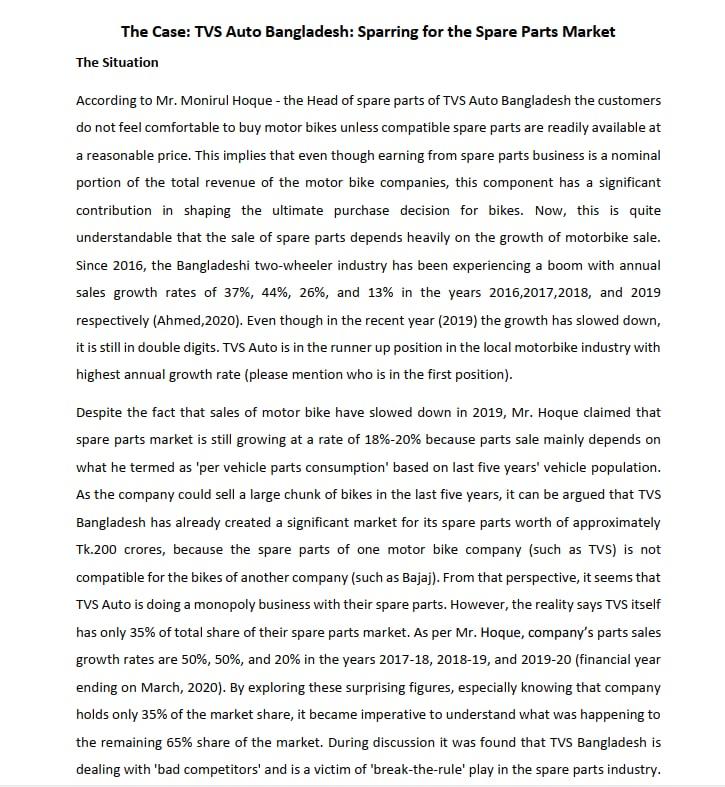
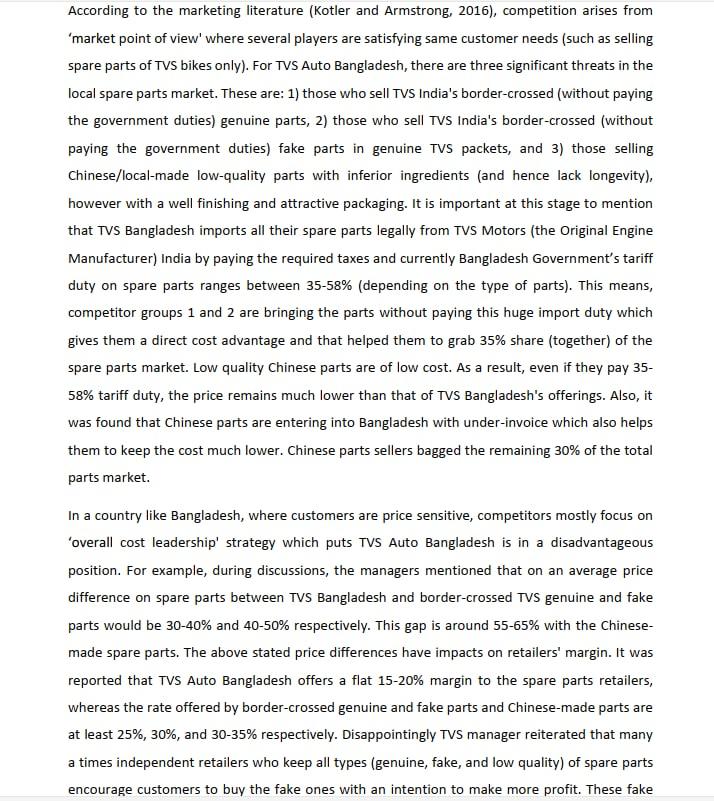
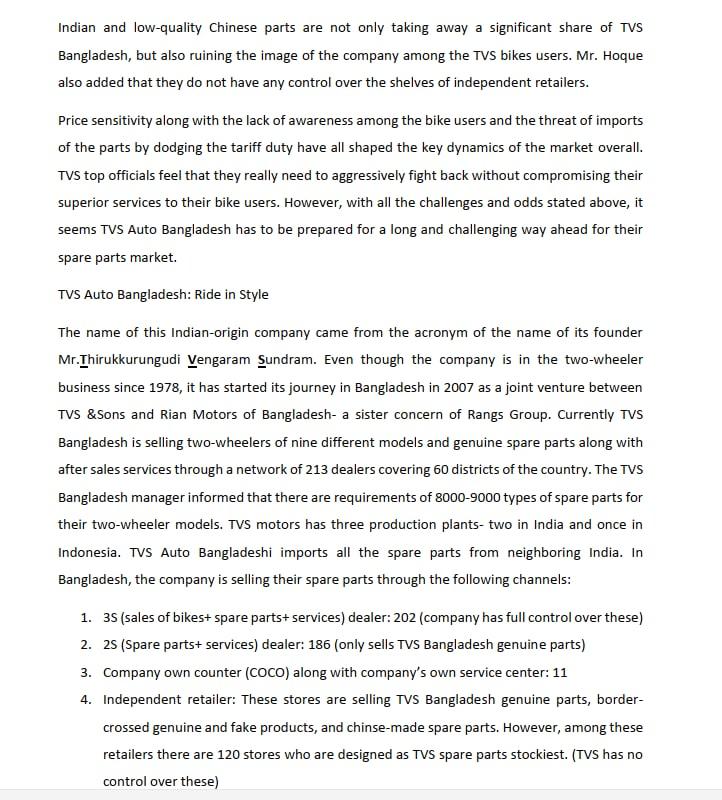
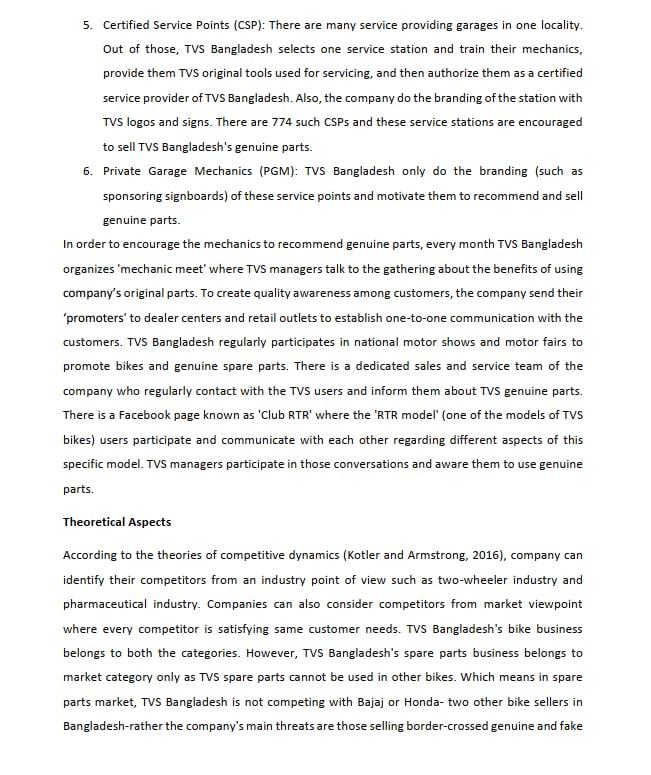
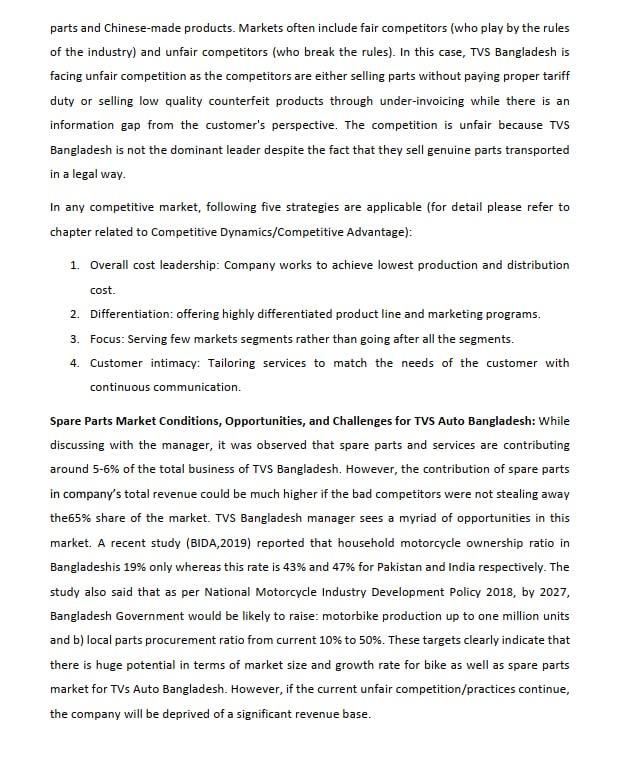
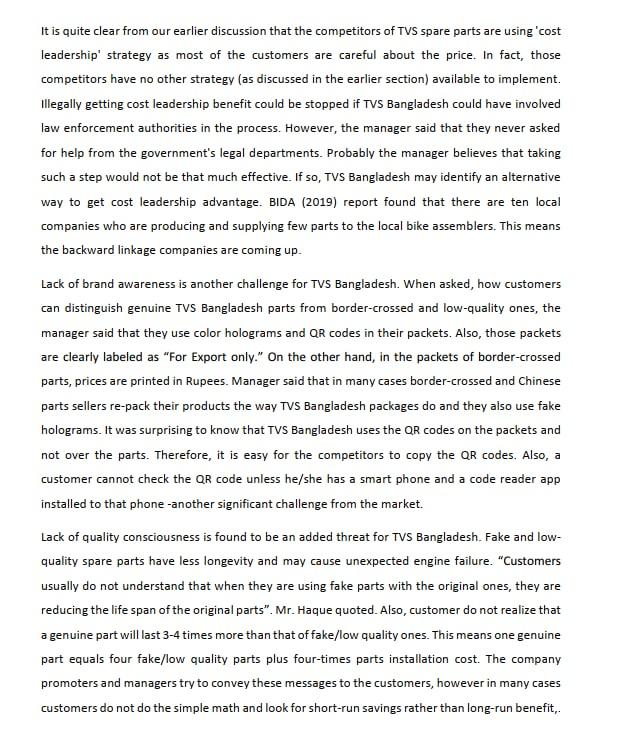
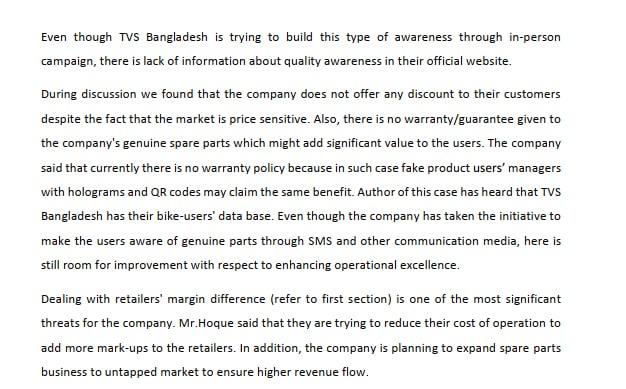
The Case: TVS Auto Bangladesh: Sparring for the Spare Parts Market The situation According to Mr. Monirul Hoque - the Head of spare parts of TVS Auto Bangladesh the customers do not feel comfortable to buy motor bikes unless compatible spare parts are readily available at a reasonable price. This implies that even though earning from spare parts business is a nominal portion of the total revenue of the motor bike companies, this component has a significant contribution in shaping the ultimate purchase decision for bikes. Now, this is quite understandable that the sale of spare parts depends heavily on the growth of motorbike sale. Since 2016, the Bangladeshi two-wheeler industry has been experiencing a boom with annual sales growth rates of 37%,44%,26%, and 13% in the years 2016,2017,2018, and 2019 respectively (Ahmed,2020). Even though in the recent year (2019) the growth has slowed down, it is still in double digits. TVS Auto is in the runner up position in the local motorbike industry with highest annual growth rate (please mention who is in the first position). Despite the fact that sales of motor bike have slowed down in 2019, Mr. Hoque claimed that spare parts market is still growing at a rate of 18%20% because parts sale mainly depends on what he termed as 'per vehicle parts consumption' based on last five years' vehicle population. As the company could sell a large chunk of bikes in the last five years, it can be argued that TVS Bangladesh has already created a significant market for its spare parts worth of approximately Tk.200 crores, because the spare parts of one motor bike company (such as TVS) is not compatible for the bikes of another company (such as Bajaj). From that perspective, it seems that TVS Auto is doing a monopoly business with their spare parts. However, the reality says TVS itself has only 35% of total share of their spare parts market. As per Mr. Hoque, company's parts sales growth rates are 50\%, 50\%, and 20\% in the years 2017-18, 2018-19, and 2019-20 (financial year ending on March, 2020). By exploring these surprising figures, especially knowing that company holds only 35% of the market share, it became imperative to understand what was happening to the remaining 65% share of the market. During discussion it was found that TVS Bangladesh is dealing with 'bad competitors' and is a victim of 'break-the-rule' play in the spare parts industry. According to the marketing literature (Kotler and Armstrong, 2016), competition arises from 'market point of view' where several players are satisfying same customer needs (such as selling spare parts of TVS bikes only). For TVS Auto Bangladesh, there are three significant threats in the local spare parts market. These are: 1) those who sell TVS India's border-crossed (without paying the government duties) genuine parts, 2) those who sell TVS India's border-crossed (without paying the government duties) fake parts in genuine TVS packets, and 3) those selling Chinese/local-made low-quality parts with inferior ingredients (and hence lack longevity), however with a well finishing and attractive packaging. It is important at this stage to mention that TVS Bangladesh imports all their spare parts legally from TVS Motors (the Original Engine Manufacturer) India by paying the required taxes and currently Bangladesh Government's tariff duty on spare parts ranges between 35-58\% (depending on the type of parts). This means, competitor groups 1 and 2 are bringing the parts without paying this huge import duty which gives them a direct cost advantage and that helped them to grab 35% share (together) of the spare parts market. Low quality Chinese parts are of low cost. As a result, even if they pay 3558% tariff duty, the price remains much lower than that of TVS Bangladesh's offerings. Also, it was found that Chinese parts are entering into Bangladesh with under-invoice which also helps them to keep the cost much lower. Chinese parts sellers bagged the remaining 30% of the total parts market. In a country like Bangladesh, where customers are price sensitive, competitors mostly focus on 'overall cost leadership' strategy which puts TVS Auto Bangladesh is in a disadvantageous position. For example, during discussions, the managers mentioned that on an average price difference on spare parts between TVS Bangladesh and border-crossed TVS genuine and fake parts would be 3040% and 4050% respectively. This gap is around 5565% with the Chinesemade spare parts. The above stated price differences have impacts on retailers' margin. It was reported that TVS Auto Bangladesh offers a flat 1520% margin to the spare parts retailers, whereas the rate offered by border-crossed genuine and fake parts and Chinese-made parts are at least 25%,30%, and 3035% respectively. Disappointingly TVS manager reiterated that many a times independent retailers who keep all types (genuine, fake, and low quality) of spare parts encourage customers to buy the fake ones with an intention to make more profit. These fake Indian and low-quality Chinese parts are not only taking away a significant share of TVS Bangladesh, but also ruining the image of the company among the TVS bikes users. Mr. Hoque also added that they do not have any control over the shelves of independent retailers. Price sensitivity along with the lack of awareness among the bike users and the threat of imports of the parts by dodging the tariff duty have all shaped the key dynamics of the market overall. TVS top officials feel that they really need to aggressively fight back without compromising their superior services to their bike users. However, with all the challenges and odds stated above, it seems TVS Auto Bangladesh has to be prepared for a long and challenging way ahead for their spare parts market. TVS Auto Bangladesh: Ride in Style The name of this Indian-origin company came from the acronym of the name of its founder Mr.Thirukkurungudi Vengaram Sundram. Even though the company is in the two-wheeler business since 1978, it has started its journey in Bangladesh in 2007 as a joint venture between TVS \&Sons and Rian Motors of Bangladesh- a sister concern of Rangs Group. Currently TVS Bangladesh is selling two-wheelers of nine different models and genuine spare parts along with after sales services through a network of 213 dealers covering 60 districts of the country. The TVS Bangladesh manager informed that there are requirements of 80009000 types of spare parts for their two-wheeler models. TVS motors has three production plants- two in India and once in Indonesia. TVS Auto Bangladeshi imports all the spare parts from neighboring India. In Bangladesh, the company is selling their spare parts through the following channels: 1. 3S (sales of bikes+ spare parts+ services) dealer: 202 (company has full control over these) 2. 2S (Spare parts+ services) dealer: 186 (only sells TVS Bangladesh genuine parts) 3. Company own counter (COCO) along with company's own service center: 11 4. Independent retailer: These stores are selling TVS Bangladesh genuine parts, bordercrossed genuine and fake products, and chinse-made spare parts. However, among these retailers there are 120 stores who are designed as TVS spare parts stockiest. (TVS has no control over these) 5. Certified Service Points (CSP): There are many service providing garages in one locality. Out of those, TVS Bangladesh selects one service station and train their mechanics, provide them TVS original tools used for servicing, and then authorize them as a certified service provider of TVS Bangladesh. Also, the company do the branding of the station with TVS logos and signs. There are 774 such CSPs and these service stations are encouraged to sell TVS Bangladesh's genuine parts. 6. Private Garage Mechanics (PGM): TVS Bangladesh only do the branding (such as sponsoring signboards) of these service points and motivate them to recommend and sell genuine parts. In order to encourage the mechanics to recommend genuine parts, every month TVS Bangladesh organizes 'mechanic meet' where TVS managers talk to the gathering about the benefits of using company's original parts. To create quality awareness among customers, the company send their 'promoters' to dealer centers and retail outlets to establish one-to-one communication with the customers. TVS Bangladesh regularly participates in national motor shows and motor fairs to promote bikes and genuine spare parts. There is a dedicated sales and service team of the company who regularly contact with the TVS users and inform them about TVS genuine parts. There is a Facebook page known as 'Club RTR' where the 'RTR model' (one of the models of TVS bikes) users participate and communicate with each other regarding different aspects of this specific model. TVS managers participate in those conversations and aware them to use genuine parts. Theoretical Aspects According to the theories of competitive dynamics (Kotler and Armstrong, 2016), company can identify their competitors from an industry point of view such as two-wheeler industry and pharmaceutical industry. Companies can also consider competitors from market viewpoint where every competitor is satisfying same customer needs. TVS Bangladesh's bike business belongs to both the categories. However, TVS Bangladesh's spare parts business belongs to market category only as TVS spare parts cannot be used in other bikes. Which means in spare parts market, TVS Bangladesh is not competing with Bajaj or Honda-two other bike sellers in Bangladesh-rather the company's main threats are those selling border-crossed genuine and fake parts and Chinese-made products. Markets often include fair competitors (who play by the rules of the industry) and unfair competitors (who break the rules). In this case, TVS Bangladesh is facing unfair competition as the competitors are either selling parts without paying proper tariff duty or selling low quality counterfeit products through under-invoicing while there is an information gap from the customer's perspective. The competition is unfair because TVS Bangladesh is not the dominant leader despite the fact that they sell genuine parts transported in a legal way. In any competitive market, following five strategies are applicable (for detail please refer to chapter related to Competitive Dynamics/Competitive Advantage): 1. Overall cost leadership: Company works to achieve lowest production and distribution cost. 2. Differentiation: offering highly differentiated product line and marketing programs. 3. Focus: Serving few markets segments rather than going after all the segments. 4. Customer intimacy: Tailoring services to match the needs of the customer with continuous communication. Spare Parts Market Conditions, Opportunities, and Challenges for TVS Auto Bangladesh: While discussing with the manager, it was observed that spare parts and services are contributing around 5-6\% of the total business of TVS Bangladesh. However, the contribution of spare parts in company's total revenue could be much higher if the bad competitors were not stealing away the 65% share of the market. TVS Bangladesh manager sees a myriad of opportunities in this market. A recent study (BIDA,2019) reported that household motorcycle ownership ratio in Bangladeshis 19% only whereas this rate is 43% and 47% for Pakistan and India respectively. The study also said that as per National Motorcycle Industry Development Policy 2018, by 2027, Bangladesh Government would be likely to raise: motorbike production up to one million units and b) local parts procurement ratio from current 10% to 50%. These targets clearly indicate that there is huge potential in terms of market size and growth rate for bike as well as spare parts market for TVs Auto Bangladesh. However, if the current unfair competition/practices continue, the company will be deprived of a significant revenue base. It is quite clear from our earlier discussion that the competitors of TVS spare parts are using 'cost leadership' strategy as most of the customers are careful about the price. In fact, those competitors have no other strategy (as discussed in the earlier section) available to implement. Illegally getting cost leadership benefit could be stopped if TVS Bangladesh could have involved law enforcement authorities in the process. However, the manager said that they never asked for help from the government's legal departments. Probably the manager believes that taking such a step would not be that much effective. If so, TVS Bangladesh may identify an alternative way to get cost leadership advantage. BIDA (2019) report found that there are ten local companies who are producing and supplying few parts to the local bike assemblers. This means the backward linkage companies are coming up. Lack of brand awareness is another challenge for TVS Bangladesh. When asked, how customers can distinguish genuine TVS Bangladesh parts from border-crossed and low-quality ones, the manager said that they use color holograms and QR codes in their packets. Also, those packets are clearly labeled as "For Export only." On the other hand, in the packets of border-crossed parts, prices are printed in Rupees. Manager said that in many cases border-crossed and Chinese parts sellers re-pack their products the way TVS Bangladesh packages do and they also use fake holograms. It was surprising to know that TVS Bangladesh uses the QR codes on the packets and not over the parts. Therefore, it is easy for the competitors to copy the QR codes. Also, a customer cannot check the QR code unless he/she has a smart phone and a code reader app installed to that phone -another significant challenge from the market. Lack of quality consciousness is found to be an added threat for TVS Bangladesh. Fake and lowquality spare parts have less longevity and may cause unexpected engine failure. "Customers usually do not understand that when they are using fake parts with the original ones, they are reducing the life span of the original parts". Mr. Haque quoted. Also, customer do not realize that a genuine part will last 3-4 times more than that of fake/low quality ones. This means one genuine part equals four fake/low quality parts plus four-times parts installation cost. The company promoters and managers try to convey these messages to the customers, however in many cases customers do not do the simple math and look for short-run savings rather than long-run benefit,. Even though TVS Bangladesh is trying to build this type of awareness through in-person campaign, there is lack of information about quality awareness in their official website. During discussion we found that the company does not offer any discount to their customers despite the fact that the market is price sensitive. Also, there is no warranty/guarantee given to the company's genuine spare parts which might add significant value to the users. The company said that currently there is no warranty policy because in such case fake product users' managers with holograms and QR codes may claim the same benefit. Author of this case has heard that TVS Bangladesh has their bike-users' data base. Even though the company has taken the initiative to make the users aware of genuine parts through SMS and other communication media, here is still room for improvement with respect to enhancing operational excellence. Dealing with retailers' margin difference (refer to first section) is one of the most significant threats for the company. Mr. Hoque said that they are trying to reduce their cost of operation to add more mark-ups to the retailers. In addition, the company is planning to expand spare parts business to untapped market to ensure higher revenue flowStep by Step Solution
There are 3 Steps involved in it
1 Expert Approved Answer
Step: 1 Unlock

Question Has Been Solved by an Expert!
Get step-by-step solutions from verified subject matter experts
Step: 2 Unlock
Step: 3 Unlock
 Study Help