







Question: After reading this, write a 3 paragraph summarizing what you learned from your reflection on the reading. offender's behavior is corrected and she is prepared
After reading this, write a 3 paragraph summarizing what you learned from your reflection on the reading.
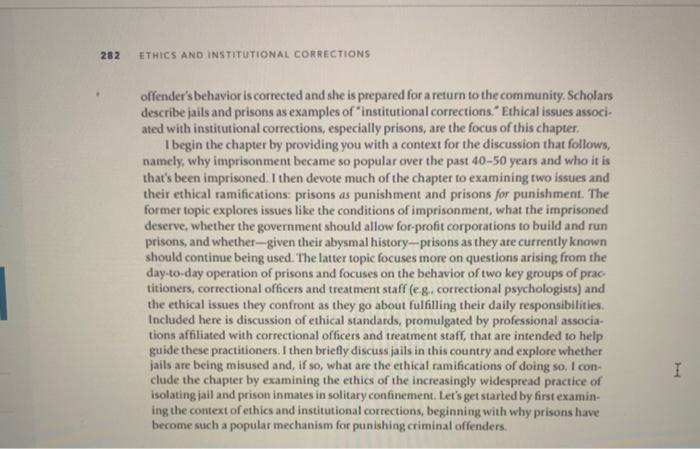
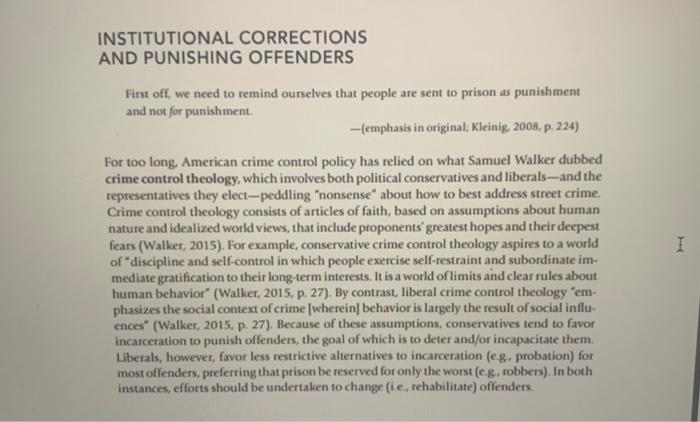
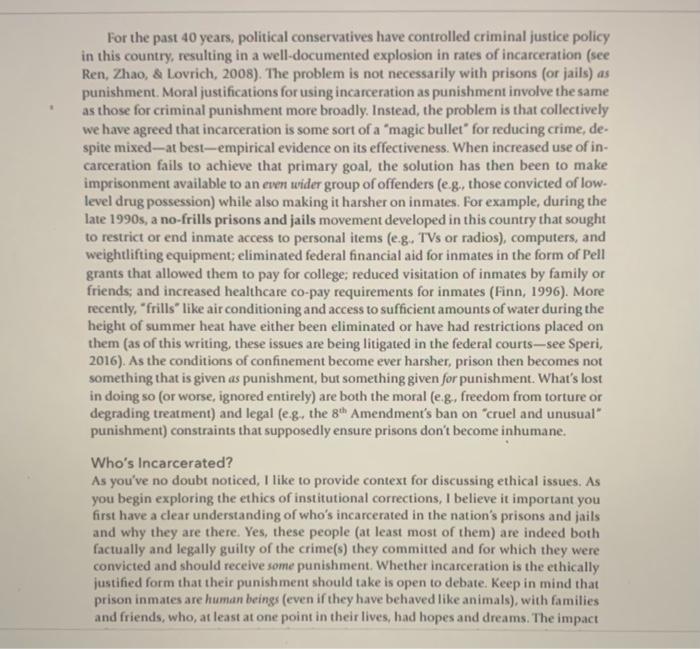
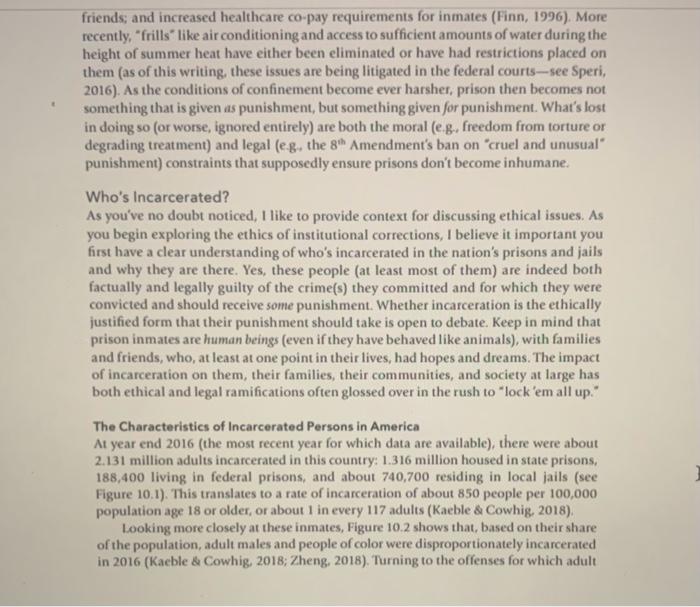
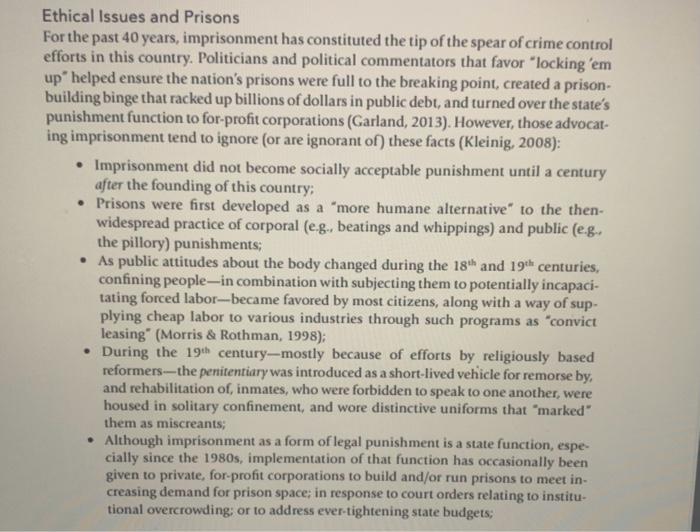
offender's behavior is corrected and she is prepared for a return to the community. Scholars describe jails and prisons as examples of "institutional corrections." Ethical issues associated with institutional corrections, especially prisons, are the focus of this chapter. I begin the chapter by providing you with a context for the discussion that follows, namely, why imprisonment became so popular over the past 4050 years and who it is that's been imprisoned. I then devote much of the chapter to examining two issues and their ethical ramifications: prisons as punishment and prisons for punishment. The former topic explores issues like the conditions of imprisonment, what the imprisoned deserve, whether the government should allow for-profit corporations to build and run prisons, and whether-given their abysmal history-prisons as they are currently known should continue being used. The latter topic focuses more on questions arising from the day-to-day operation of prisons and focuses on the behavior of two key groups of practitioners, correctional officers and treatment staff ( e. . correctional psychologists) and the ethical issues they confront as they go about fulfilling their daily responsibilities. Included here is discussion of ethical standards, promulgated by professional associations affiliated with correctional officers and treatment staff, that are intended to help guide these practitioners. I then briefly discuss jails in this country and explore whether jails are being misused and, if so, what are the ethical ramifications of doing so. I conclude the chapter by examining the ethics of the increasingly widespread practice of isolating iail and prison inmates in solitary confinement. Let's get started by first examining the context of ethics and institutional corrections, beginning with why prisons have become such a popular mechanism for punishing criminal offenders. INSTITUTIONAL CORRECTIONS AND PUNISHING OFFENDERS First off, we need to remind ourselves that people are sent to prison as punishment and not for punishment. - (emphasis in original; Kleinig. 2008, p. 224) For too long, American crime control policy has relied on what Samuel Walker dubbed crime control theology, which involves both political conservatives and liberals -and the representatives they elect-peddling "nonsense" about how to best address street crime. Crime control theology consists of articles of faith, based on assumptions about human nature and idealized world views, that include proponents' greatest hopes and their deepest fears (Walker, 2015). For example, conservative crime control theology aspires to a world of "discipline and self-control in which people exercise self-restraint and subordinate immediate gratification to their long-term interests. It is a world of limits and clear rules about human behavior" (Walker, 2015, p. 27). By contrast, liberal crime control theology "emphasizes the social context of crime [wherein] behavior is largely the result of social influences" (Walket, 2015, p. 27). Because of these assumptions, conservatives tend to favor incarceration to punish offenders, the goal of which is to deter and/or incapacitate them. Liberals, however, favor less restrictive alternatives to incarceration (e.g. probation) for most offenders, preferring that prison be reserved for only the worst (eg., robbers). In both instances, efforts should be undertaken to change (i.e, rehabilitate) offenders. For the past 40 years, political conservatives have controlled criminal justice policy in this country, resulting in a well-documented explosion in rates of incarceration (see Ren, Zhao, \& Lovrich, 2008). The problem is not necessarily with prisons (or jails) as punishment. Moral justifications for using incarceration as punishment involve the same as those for criminal punishment more broadly. Instead, the problem is that collectively we have agreed that incarceration is some sort of a "magic bullet" for reducing crime, despite mixed-at best-empirical evidence on its effectiveness. When increased use of incarceration fails to achieve that primary goal, the solution has then been to make imprisonment available to an even wider group of offenders (e.g., those convicted of lowlevel drug possession) while also making it harsher on inmates. For example, during the late 1990s, a no-frills prisons and jails movement developed in this country that sought to restrict or end inmate access to personal items (e.g. TVs or radios), computers, and weightlifting equipment; eliminated federal financial aid for inmates in the form of Pell grants that allowed them to pay for college; reduced visitation of inmates by family or friends; and increased healthcare co-pay requirements for inmates (Finn, 1996). More recently, "frills" like air conditioning and access to sufficient amounts of water during the height of summer heat have either been eliminated or have had restrictions placed on them (as of this writing, these issues are being litigated in the federal courts-see Speri, 2016). As the conditions of confinement become ever harsher, prison then becomes not something that is given as punishment, but something given for punishment. What's lost in doing so (or worse, ignored entirely) are both the moral (e.g, freedom from torture or degrading treatment) and legal (e.g. the 8th Amendment's ban on "cruel and unusual" punishment) constraints that supposedly ensure prisons don't become inhumane. Who's Incarcerated? As you've no doubt noticed, I like to provide context for discussing ethical issues. As you begin exploring the ethics of institutional corrections, I believe it important you first have a clear understanding of who's incarcerated in the nation's prisons and jails and why they are there. Yes, these people (at least most of them) are indeed both factually and legally guilty of the crime(s) they committed and for which they were convicted and should receive some punishment. Whether incarceration is the ethically justified form that their punishment should take is open to debate. Keep in mind that prison inmates are human beings (even if they have behaved like animals), with families and friends, who, at least at one point in their lives, had hopes and dreams. The impact recently, "frills" like air conditioning and access to sufficient amounts of water during the height of summer heat have either been eliminated or have had restrictions placed on them (as of this writing, these issues are being litigated in the federal courts-see Speri, 2016). As the conditions of confinement become ever harsher, prison then becomes not something that is given as punishment, but something given for punishment. What's lost in doing so (or worse, ignored entirely) are both the moral (e.g. freedom from torture or degrading treatment) and legal (e.g. the 8th Amendment's ban on "cruel and unusual" punishment) constraints that supposedly ensure prisons don't become inhumane. Who's Incarcerated? As you've no doubt noticed, I like to provide context for discussing ethical issues. As you begin exploring the ethics of institutional corrections, I believe it important you first have a clear understanding of who's incarcerated in the nation's prisons and jails and why they are there. Yes, these people (at least most of them) are indeed both factually and legally guilty of the crime(s) they committed and for which they were convicted and should receive some punishment. Whether incarceration is the ethically justified form that their punishment should take is open to debate. Keep in mind that prison inmates are human beings (even if they have behaved like animals), with families and friends, who, at least at one point in their lives, had hopes and dreams. The impact of incarceration on them, their families, their communities, and society at large has both ethical and legal ramifications often glossed over in the rush to "lock'em all up." The Characteristics of Incarcerated Persons in America At year end 2016 (the most recent year for which data are available), there were about 2.131 million adults incarcerated in this country: 1.316 million housed in state prisons. 188,400 living in federal prisons, and about 740,700 residing in local jails (see Figure 10.1). This translates to a rate of incarceration of about 850 people per 100,000 population age 18 or older, or about 1 in every 117 adults (Kaeble & Cowhig. 2018). Looking more closely at these inmates, Figure 10.2 shows that, based on their share of the population, adult males and people of color were disproportionately incarcerated in 2016 (Kacble \& Cowhig, 2018; Zheng, 2018). Turning to the offenses for which adult For the past 40 years, imprisonment has constituted the tip of the spear of crime control efforts in this country. Politicians and political commentators that favor "locking 'em up" helped ensure the nation's prisons were full to the breaking point, created a prisonbuilding binge that racked up billions of dollars in public debt, and turned over the state's punishment function to for-profit corporations (Garland, 2013). However, those advocating imprisonment tend to ignore (or are ignorant of) these facts (Kleinig, 2008): - Imprisonment did not become socially acceptable punishment until a century after the founding of this country; - Prisons were first developed as a "more humane alternative" to the thenwidespread practice of corporal (e.g., beatings and whippings) and public (e.g. the pillory) punishments; - As public attitudes about the body changed during the 18th and 19th centuries, confining people-in combination with subjecting them to potentially incapacitating forced labor-became favored by most citizens, along with a way of supplying cheap labor to various industries through such programs as "convict leasing" (Morris \& Rothman, 1998); - During the 19th century-mostly because of efforts by religiously based reformers - the penitentiary was introduced as a short-lived vehicle for remorse by, and rehabilitation of, inmates, who were forbidden to speak to one another, were housed in solitary confinement, and wore distinctive uniforms that "marked" them as miscreants; - Although imprisonment as a form of legal punishment is a state function, especially since the 1980s, implementation of that function has occasionally been given to private, for-profit corporations to build and/or run prisons to meet increasing demand for prison space; in response to court orders relating to institutional overcrowding; or to address ever-tightening state budgets
Step by Step Solution
There are 3 Steps involved in it

Get step-by-step solutions from verified subject matter experts
 Study Help