Question: After reading Turabian Chapter 1 Please Summarize the chapter, no quotes, Turabian's main points. Include: what is new here for you? A Manual for Writers
After reading Turabian Chapter 1
Please Summarize the chapter, no quotes, Turabian's main points.
Include: what is new here for you?
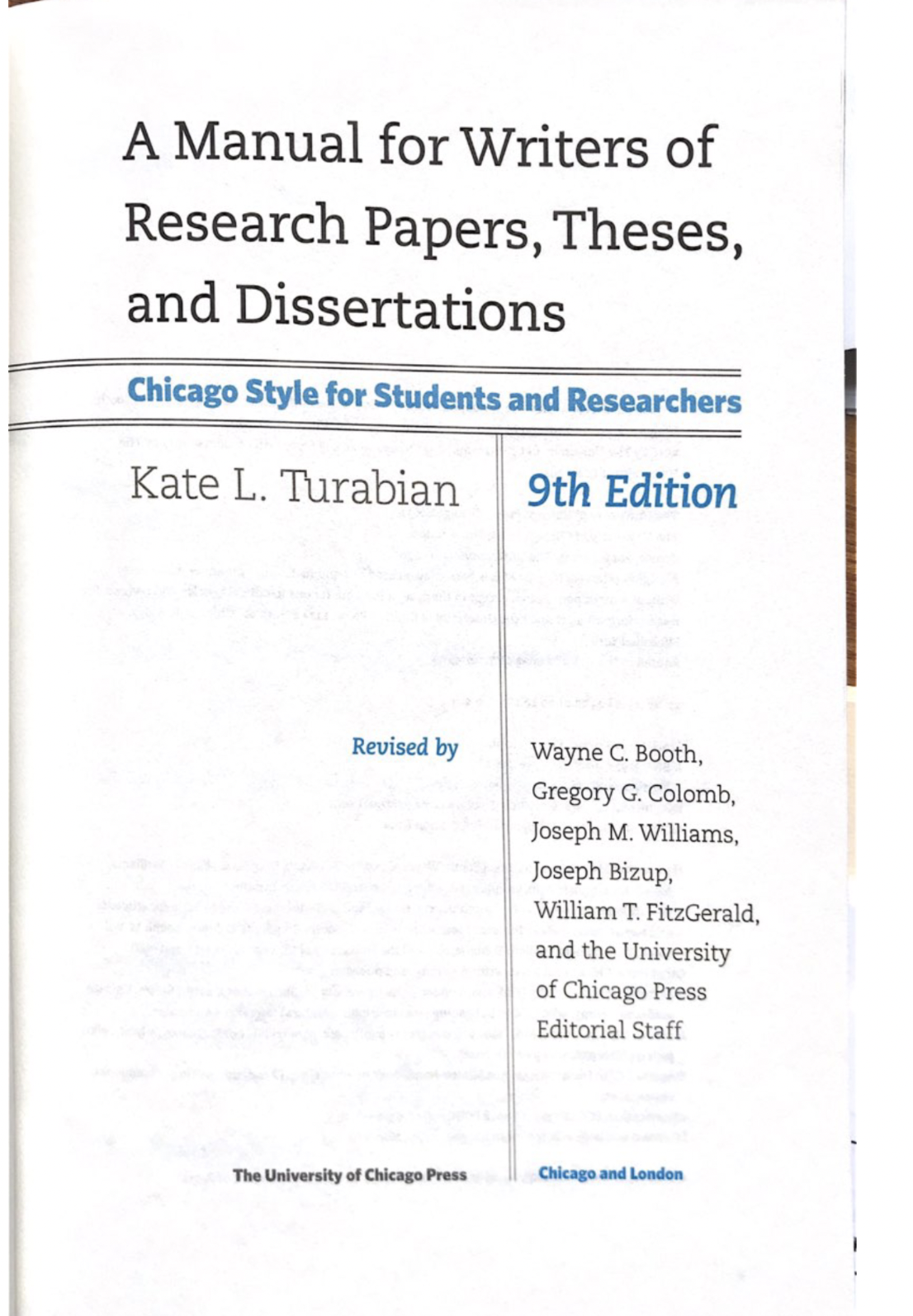
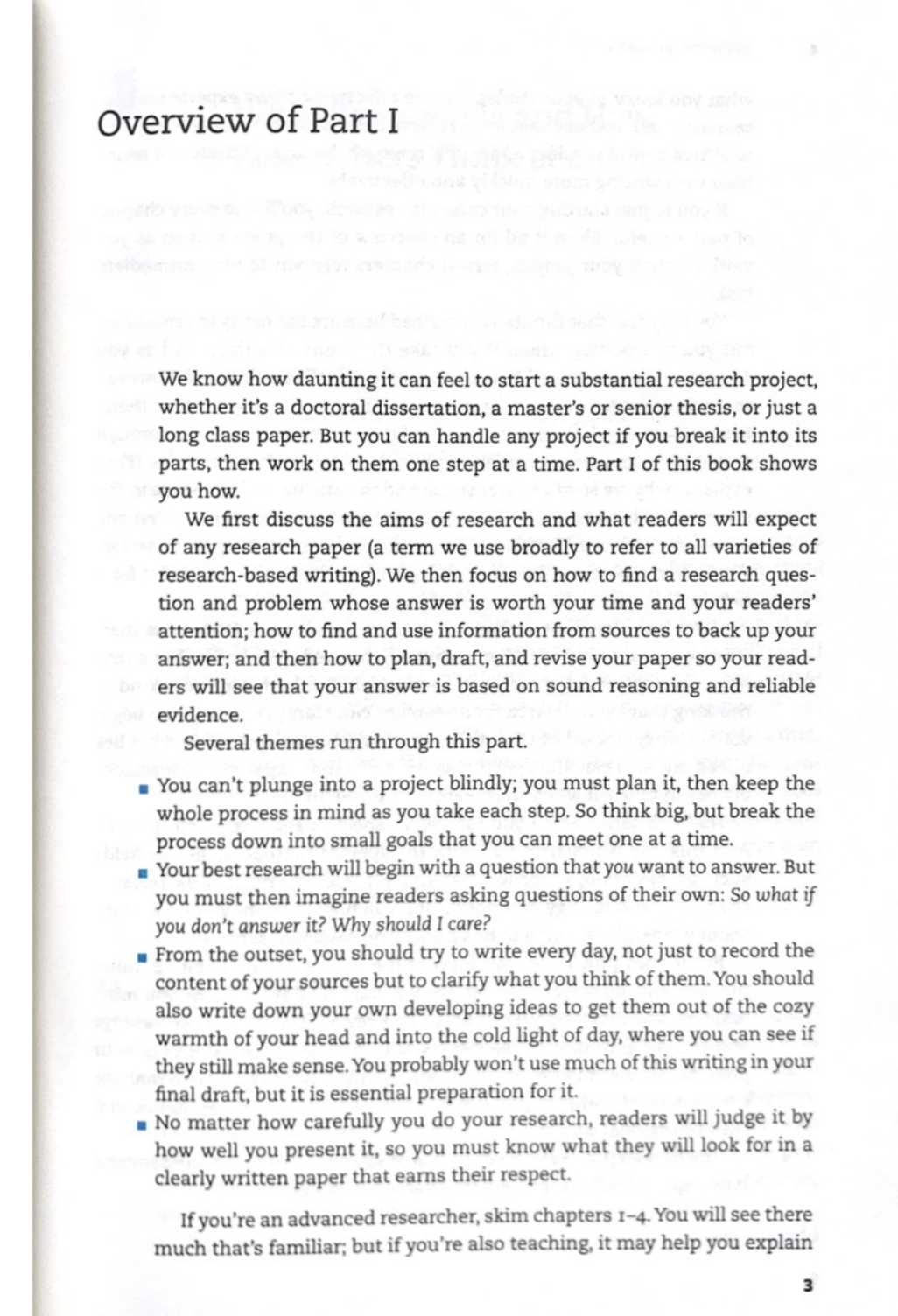
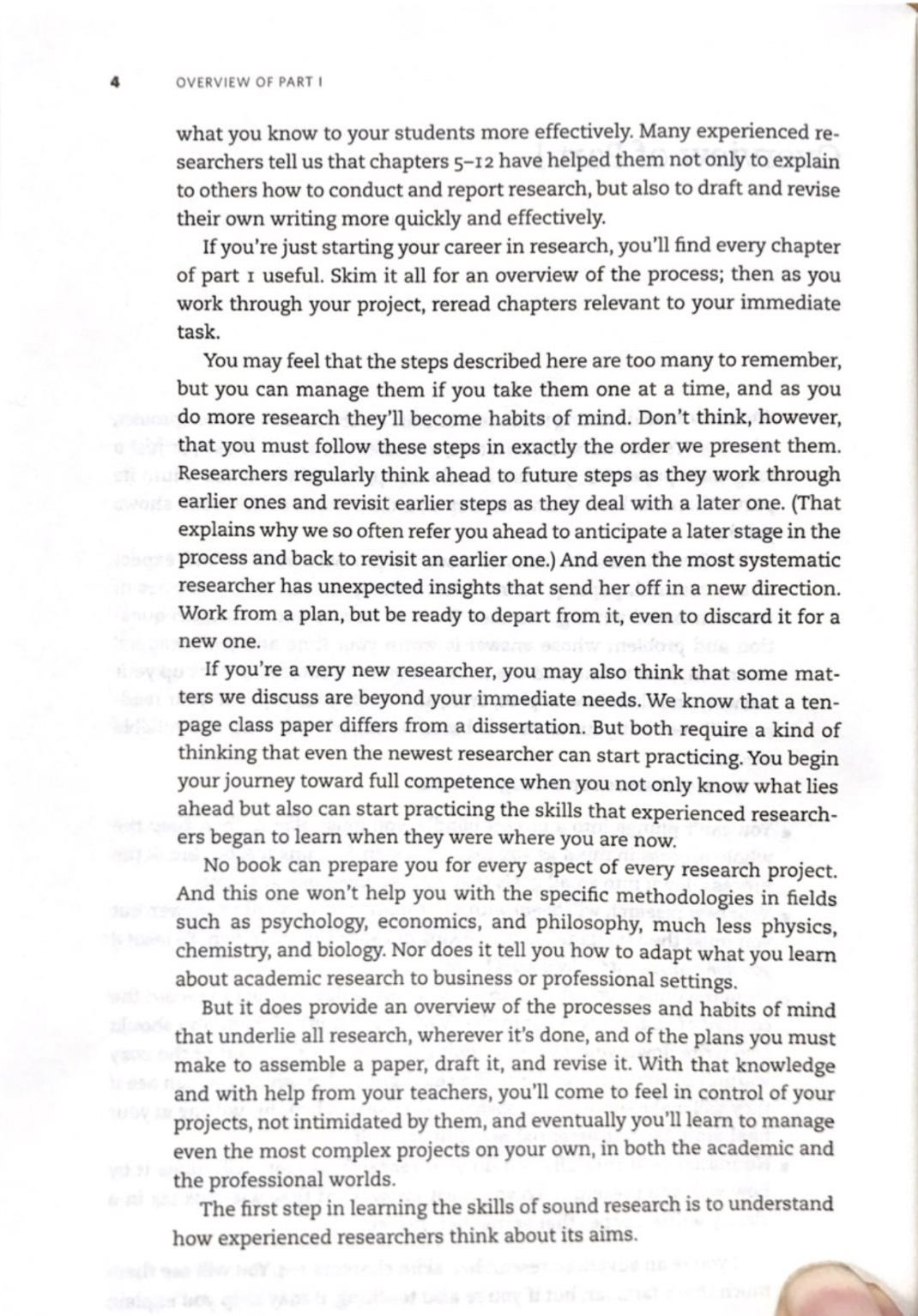
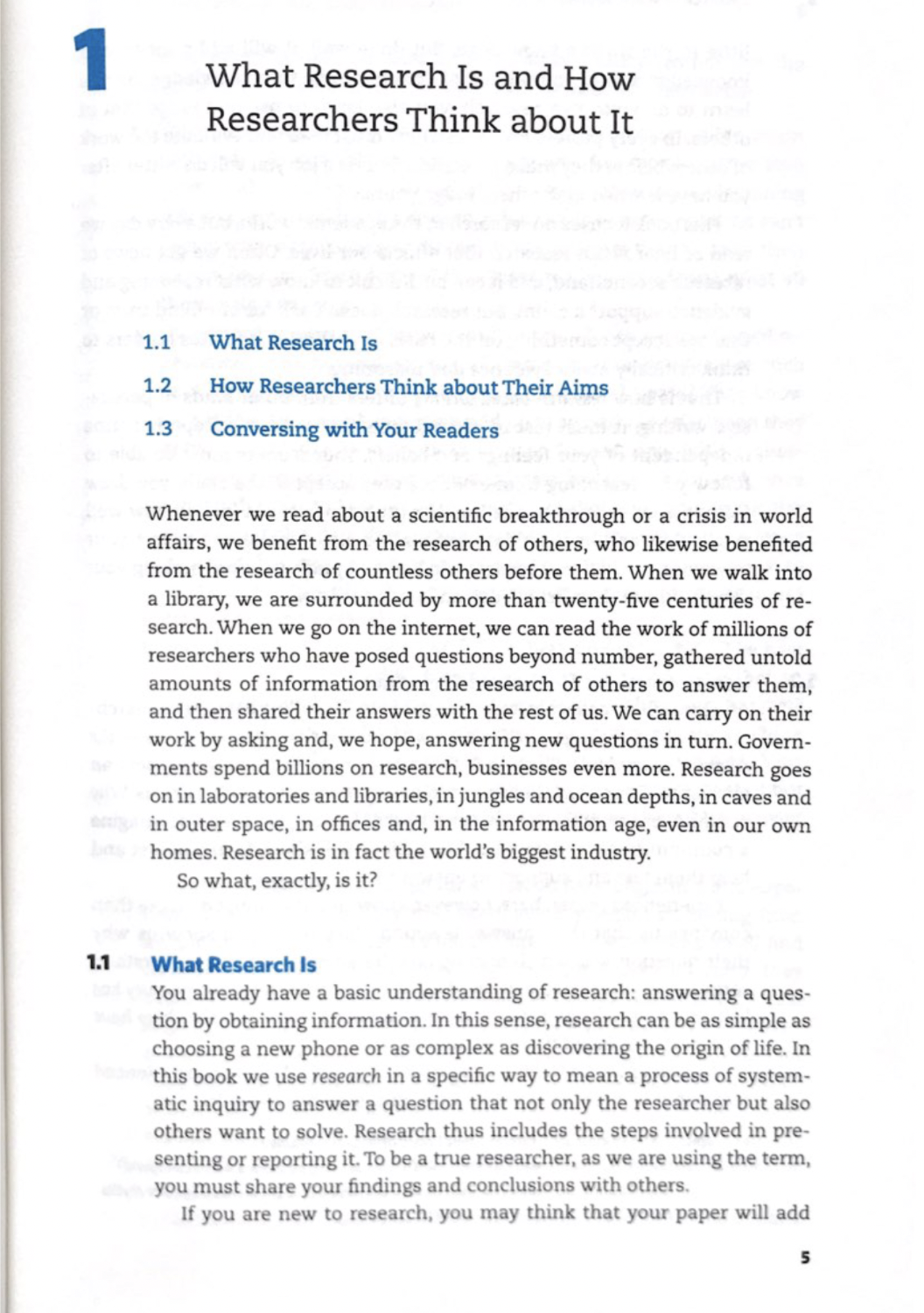
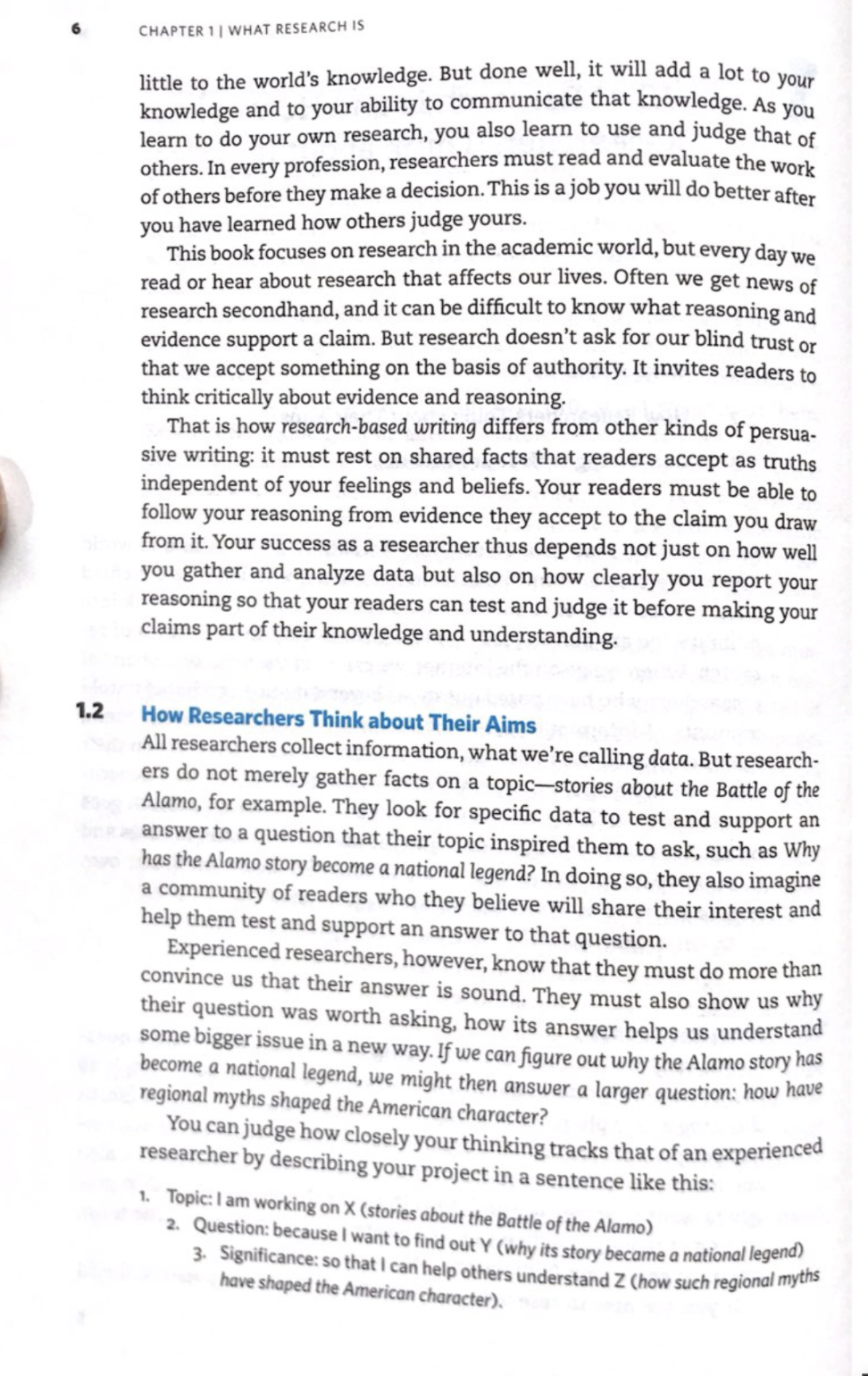
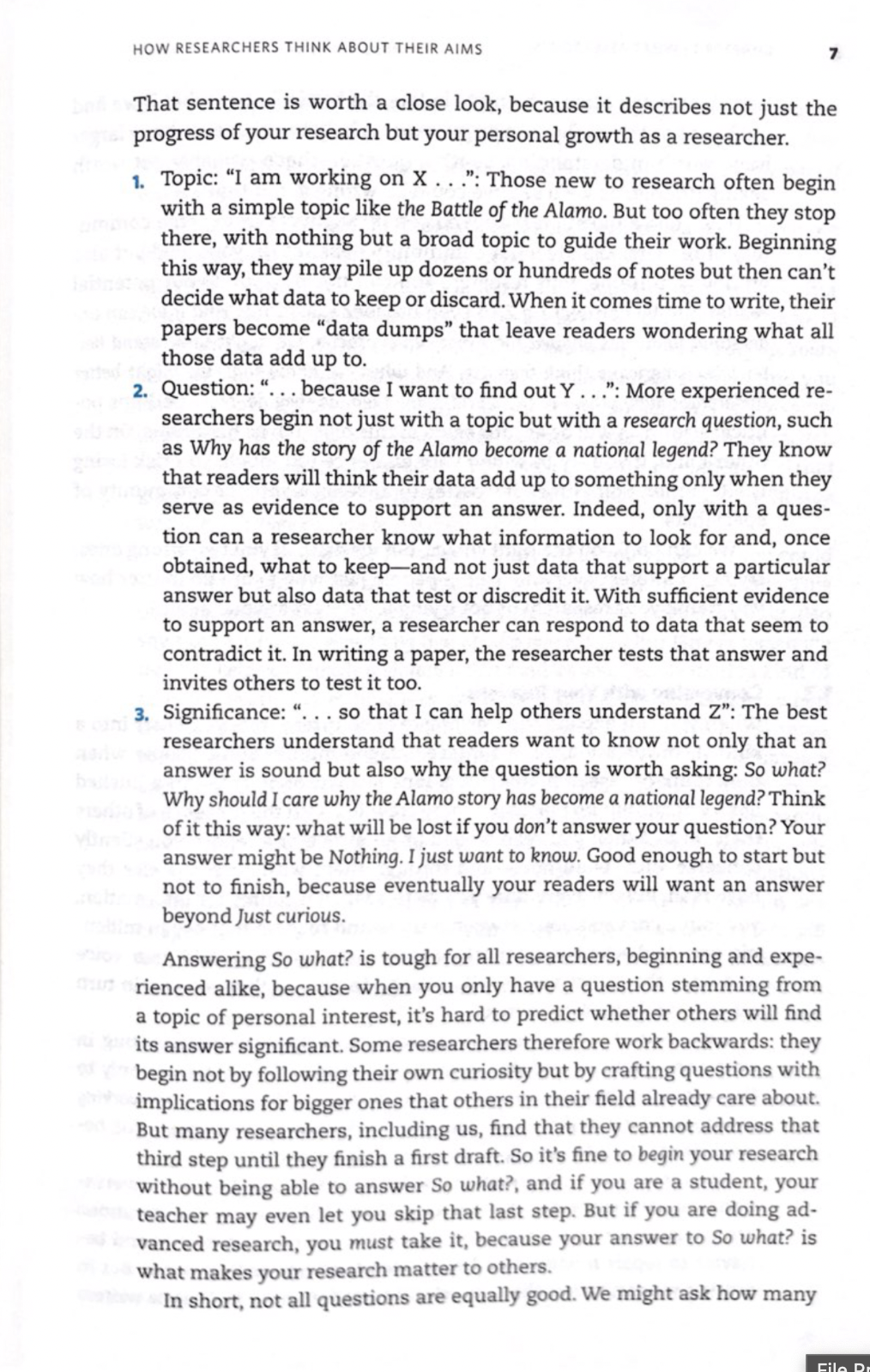
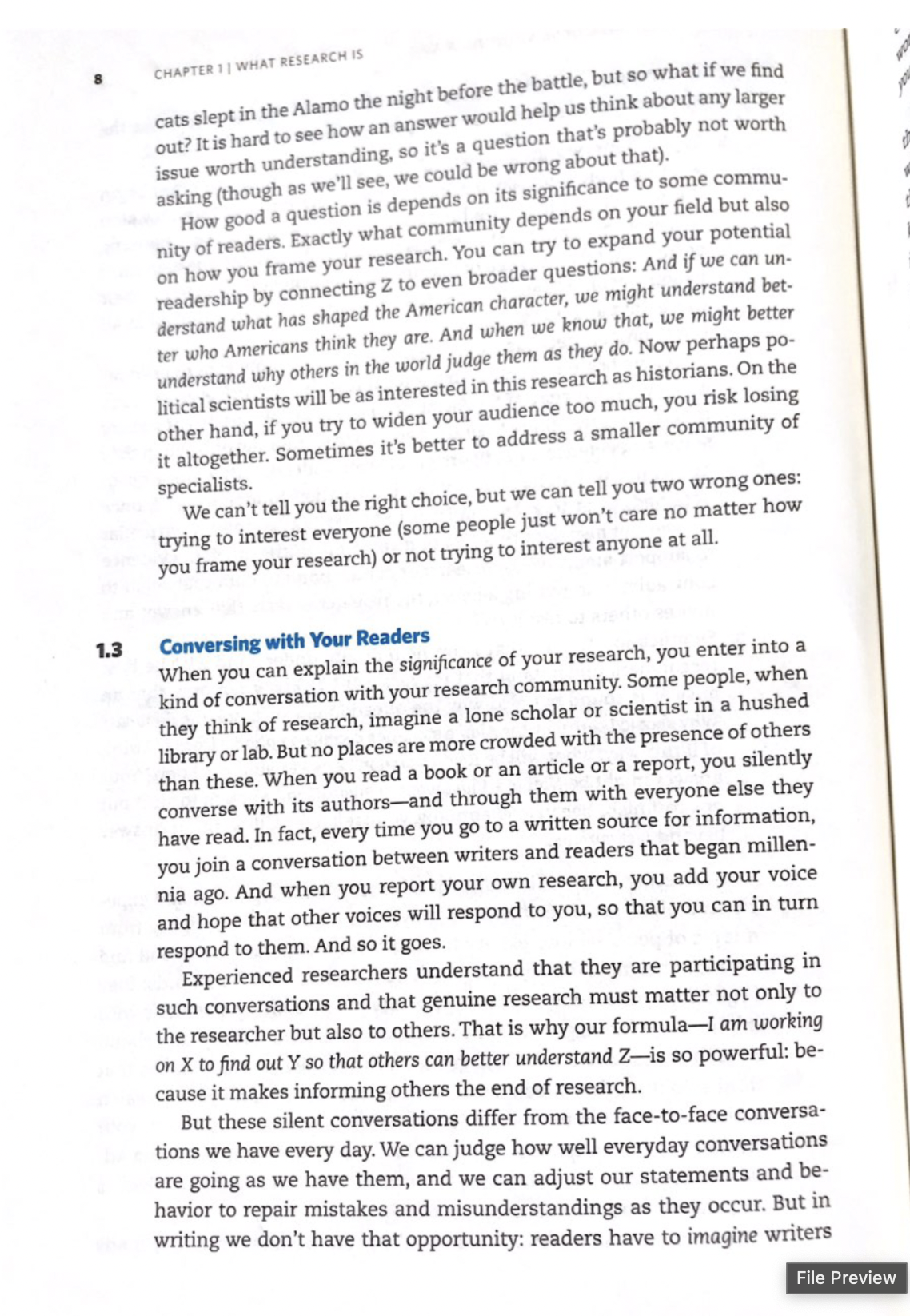
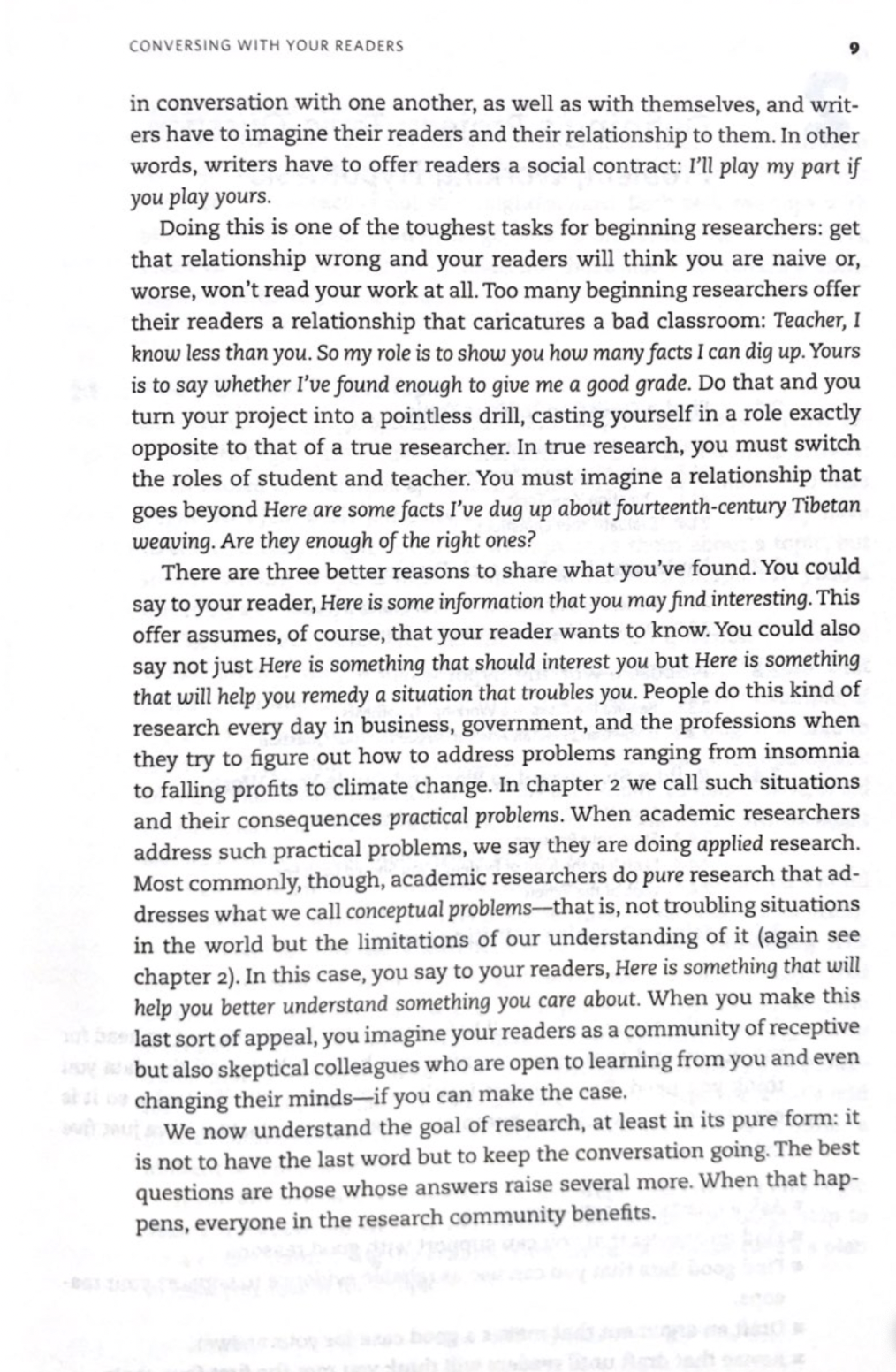
A Manual for Writers of Research Papers, Theses, and Dissertations Chicago Style for Students and Researchers Kate L. Turabian 9th Edition Revised by Wayne C. Booth, Gregory G. Colomb, Joseph M. Williams, Joseph Bizup, William T. FitzGerald, and the University of Chicago Press Editorial Staff The University of Chicago Press Chicago and London\fOverview of Part I We know how daunting it can feel to start a substantial research project, whether it's a doctoral dissertation, a master's or senior thesis, or just a long class paper. But you can handle any project if you break it into its parts, then work on them one step at a time. Part I of this book shows you how. We first discuss the aims of research and what readers will expect of any research paper (a term we use broadly to refer to all varieties of research-based writing). We then focus on how to find a research ques- tion and problem whose answer is worth your time and your readers' attention; how to find and use information from sources to back up your answer; and then how to plan, draft, and revise your paper so your read- ers will see that your answer is based on sound reasoning and reliable evidence. Several themes run through this part. You can't plunge into a project blindly; you must plan it, then keep the whole process in mind as you take each step. So think big, but break the process down into small goals that you can meet one at a time. Your best research will begin with a question that you want to answer. But you must then imagine readers asking questions of their own: So what if you don't answer it? Why should I care? From the outset, you should try to write every day, not just to record the content of your sources but to clarify what you think of them. You should also write down your own developing ideas to get them out of the cozy warmth of your head and into the cold light of day, where you can see if they still make sense. You probably won't use much of this writing in your final draft, but it is essential preparation for it. No matter how carefully you do your research, readers will judge it by how well you present it, so you must know what they will look for in a clearly written paper that earns their respect. If you're an advanced researcher, skim chapters 1-4. You will see there much that's familiar; but if you're also teaching, it may help you explain OVERVIEW OF PART | what you know to your students more effectively. Many experienced re- searchers tell us that chapters s-12 have helped them not only to explain to others how to conduct and report research, but also to draft and revise their own writing more quickly and effectively. If you're just starting your career in research, you'll find every chapter of part 1 useful. Skim it all for an overview of the process; then as you work through your project, reread chapters relevant to your immediate task. You may feel that the steps described here are too many to remember, but you can manage them if you take them one at a time, and as you do more research they'll become habits of mind. Don't think, however, that you must follow these steps in exactly the order we present them. Researchers regularly think ahead to future steps as they work through earlier ones and revisit earlier steps as they deal with a later one. (That explains why we so often refer you ahead to anticipate a later stage in the process and back to revisit an earlier one.) And even the most systematic researcher has unexpected insights that send her off in a new direction. Work from a plan, but be ready to depart from it, even to discard it for a new one. If you're a very new researcher, you may also think that some mat- ters we discuss are beyond your immediate needs. We know that a ten- page class paper differs from a dissertation. But both require a kind of thinking that even the newest researcher can start practicing. You begin your journey toward full competence when you not only know what lies ahead but also can start practicing the skills that experienced research- ers began to learn when they were where you are now. No book can prepare you for every aspect of every research project. And this one won't help you with the specific methodologies in fields such as psychology, economics, and philosophy, much less physics, chemistry, and biology. Nor does it tell you how to adapt what you learn about academic research to business or professional settings. But it does provide an overview of the processes and habits of mind that underlie all research, wherever it's done, and of the plans you must make to assemble a paper, draft it, and revise it. With that knowledge and with help from your teachers, you'll come to feel in control of your projects, not intimidated by them, and eventually you'll learn to manage even the most complex projects on your own, in both the academic and the professional worlds. The first step in learning the skills of sound research is to understand how experienced researchers think about its aims. What Research Is and How Researchers Think about It 1.1 What Research Is 1.2 How Researchers Think about Their Aims 1.3 Conversing with Your Readers Whenever we read about a scientific breakthrough or a crisis in world affairs, we benefit from the research of others, who likewise benefited from the research of countless others before them. When we walk into a library, we are surrounded by more than twenty-five centuries of re- search. When we go on the internet, we can read the work of millions of researchers who have posed questions beyond number, gathered untold amounts of information from the research of others to answer them, and then shared their answers with the rest of us. We can carry on their work by asking and, we hope, answering new questions in turn. Govern- ments spend billions on research, businesses even more. Research goes on in laboratories and libraries, in jungles and ocean depths, in caves and in outer space, in offices and, in the information age, even in our own homes. Research is in fact the world's biggest industry. So what, exactly, is it? What Research Is You already have a basic understanding of research: answering a ques- tion by obtaining information. In this sense, research can be as simple as choosing a new phone or as complex as discovering the origin of life. In this book we use research in a specific way to mean a process of system- atic inquiry to answer a question that not only the researcher but also others want to solve. Research thus includes the steps involved in pre- senting or reporting it. To be a true researcher, as we are using the term, you must share your findings and conclusions with others. If you are new to research, you may think that your paper will add CHAPTER 1 | WHAT RESEARCH IS little to the world's knowledge. But done well, it will add a lot to your knowledge and to your ability to communicate that knowledge. As you learn to do your own research, you also learn to use and judge that of others. In every profession, researchers must read and evaluate the work of others before they make a decision. This is a job you will do better after you have learned how others judge yours. This book focuses on research in the academic world, but every day we read or hear about research that affects our lives. Often we get news of research secondhand, and it can be difficult to know what reasoning and evidence support a claim. But research doesn't ask for our blind trust or that we accept something on the basis of authority. It invites readers to think critically about evidence and reasoning. That is how research-based writing differs from other kinds of persua- sive writing: it must rest on shared facts that readers accept as truths independent of your feelings and beliefs. Your readers must be able to follow your reasoning from evidence they accept to the claim you draw from it. Your success as a researcher thus depends not just on how well you gather and analyze data but also on how clearly you report your reasoning so that your readers can test and judge it before making your claims part of their knowledge and understanding. 1.2 How Researchers Think about Their Aims All researchers collect information, what we're calling data. But research- ers do not merely gather facts on a topic-stories about the Battle of the Alamo, for example. They look for specific data to test and support an answer to a question that their topic inspired them to ask, such as Why has the Alamo story become a national legend? In doing so, they also imagine a community of readers who they believe will share their interest and help them test and support an answer to that question. Experienced researchers, however, know that they must do more than convince us that their answer is sound. They must also show us why their question was worth asking, how its answer helps us understand some bigger issue in a new way. If we can figure out why the Alamo story has become a national legend, we might then answer a larger question: how have regional myths shaped the American character? You can judge how closely your thinking tracks that of an experienced researcher by describing your project in a sentence like this: 1. Topic: I am working on X (stories about the Battle of the Alamo) 2. Question: because I want to find out Y (why its story became a national legend) 3. Significance: so that I can help others understand Z (how such regional myths have shaped the American character).HOW RESEARCHERS THINK ABOUT THEIR AIMS 7 That sentence is worth a close look, because it describes not just the progress of your research but your personal growth as a researcher. 1. Topic: \"I am working on X . . .\": Those new to research often begin with a simple topic like the Battle of the Alamo. But too often they stop there, with nothing but a broad topic to guide their work. Beginning this way, they may pile up dozens or hundreds of notes but then can't decide what data to keep or discard. When it comes time to write, their papers become \"data dumps\" that leave readers wondering what all those data add up to. 2. Question: \".. . because I want to find out Y . . .\": More experienced re- searchers begin not just with a topic but with a research question, such as Why has the story of the Alamo become a national legend? They know that readers will think their data add up to something only when they serve as evidence to support an answer. Indeed, only with a ques- tion can a researcher know what information to look for and, once obtained, what to keepand not just data that support a particular answer but also data that test or discredit it. With sufficient evidence to support an answer, a researcher can respond to data that seem to contradict it. In writing a paper, the researcher tests that answer and invites others to test it too. 3, Significance: \". . . so that I can help others understand Z\": The best researchers understand that readers want to know not only that an answer is sound but also why the question is worth asking: So what? Why should I care why the Alamo story has become a national legend? Think of it this way: what will be lost if you don't answer your question? Your answer might be Nothing. I just want to know. Good enough to start but not to finish, because eventually your readers will want an answer beyond Just curious. Answering So what? is tough for all researchers, beginning and expe- rienced alike, because when you only have a question stemming from a topic of personal interest, it's hard to predict whether others will find its answer significant. Some researchers therefore work backwards: they begin not by following their own curiosity but by crafting questions with implications for bigger ones that others in their field already care about. But many researchers, including us, find that they cannot address that third step until they finish a first draft. So it's fine to begin your research without being able to answer So what?, and if you are a student, your teacher may even let you skip that last step. But if you are doing ad- vanced research, you must take it, because your answer to So what? is what makes your research matter to others. In short, not all questions are equally good. We might ask how many CHAPTER 1 | WHAT RESEARCH IS cats slept in the Alamo the night before the battle, but so what if we find out? It is hard to see how an answer would help us think about any larger issue worth understanding, so it's a question that's probably not worth asking (though as we'll see, we could be wrong about that). How good a question is depends on its significance to some commu- nity of readers. Exactly what community depends on your field but also on how you frame your research. You can try to expand your potential readership by connecting Z to even broader questions: And if we can un- derstand what has shaped the American character, we might understand bet- ter who Americans think they are. And when we know that, we might better understand why others in the world judge them as they do. Now perhaps po- litical scientists will be as interested in this research as historians. On the other hand, if you try to widen your audience too much, you risk losing it altogether. Sometimes it's better to address a smaller community of specialists. We can't tell you the right choice, but we can tell you two wrong ones: trying to interest everyone (some people just won't care no matter how you frame your research) or not trying to interest anyone at all. 1.3 Conversing with Your Readers When you can explain the significance of your research, you enter into a kind of conversation with your research community. Some people, when they think of research, imagine a lone scholar or scientist in a hushed library or lab. But no places are more crowded with the presence of others than these. When you read a book or an article or a report, you silently converse with its authors-and through them with everyone else they have read. In fact, every time you go to a written source for information, you join a conversation between writers and readers that began millen- nia ago. And when you report your own research, you add your voice and hope that other voices will respond to you, so that you can in turn respond to them. And so it goes. Experienced researchers understand that they are participating in such conversations and that genuine research must matter not only to the researcher but also to others. That is why our formula-I am working on X to find out Y so that others can better understand Z-is so powerful: be- cause it makes informing others the end of research. But these silent conversations differ from the face-to-face conversa- tions we have every day. We can judge how well everyday conversations are going as we have them, and we can adjust our statements and be- havior to repair mistakes and misunderstandings as they occur. But in writing we don't have that opportunity: readers have to imagine writers File PreviewCONVERSING WITH YOUR READERS 9 in conversation with one another, as well as with themselves, and writ- ers have to imagine their readers and their relationship to them. In other words, writers have to offer readers a social contract: I'll play my part if you play yours. Doing this is one of the toughest tasks for beginning researchers: get that relationship wrong and your readers will think you are naive or, worse, won''t read your work at all. Too many beginning researchers offer their readers a relationship that caricatures a bad classroom: Teacher, I know less than you. So my role is to show you how many facts I can dig up. Yours is to say whether I''ve found enough to give me a good grade. Do that and you turn your project into a pointless drill, casting yourself in a role exactly opposite to that of a true researcher. In true research, you must switch the roles of student and teacher. You must imagine a relationship that goes beyond Here are some facts I've dug up about fourteenth-century Tibetan weaving. Are they enough of the right ones? There are three better reasons to share what you've found. You could say to your reader, Here is some information that you may find interesting. This offer assumes, of course, that your reader wants to know. You could also say not just Here is something that should interest you but Here is something that will help you remedy a situation that troubles you. People do this kind of research every day in business, government, and the professions when they try to figure out how to address problems ranging from insomnia to falling profits to climate change. In chapter 2 we call such situations and their consequences practical problems. When academic researchers address such practical problems, we say they are doing applied research. Most commonly, though, academic researchers do pure research that ad- dresses what we call conceptual problemsthat is, not troubling situations in the world but the limitations of our understanding of it (again see chapter 2). In this case, you say to your readers, Here is something that will help you better understand something you care about. When you make this last sort of appeal, you imagine your readers as a community of receptive but also skeptical colleagues who are open to learning from you and even changing their mindsif you can make the case. We now understand the goal of research, at least in its pure form: it is not to have the last word but to keep the conversation going. The best questions are those whose answers raise several more. When that hap- pens, everyone in the research community benefits
Step by Step Solution
There are 3 Steps involved in it
1 Expert Approved Answer
Step: 1 Unlock
Question Has Been Solved by an Expert!
Get step-by-step solutions from verified subject matter experts
Step: 2 Unlock
Step: 3 Unlock
Students Have Also Explored These Related Business Writing Questions!









 Study Help