







Question: After the answer please provide a short explanation. 4. (8 points) Do the binary arithmetic: a. 10101 01110 Answer: b. 11001 10011 Answer: c. 01110
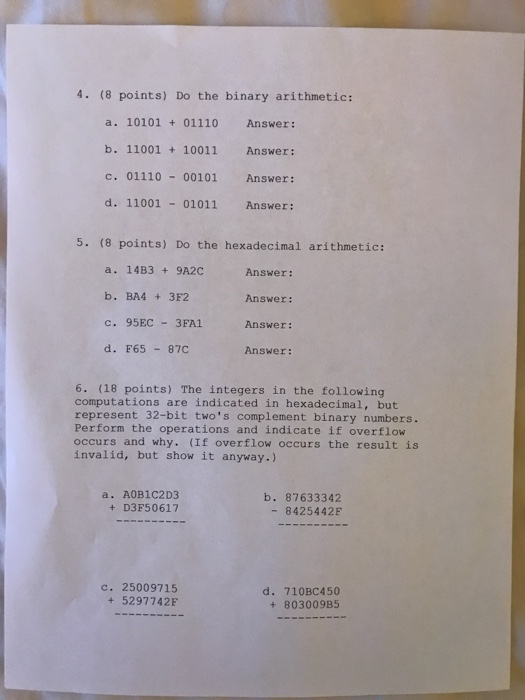
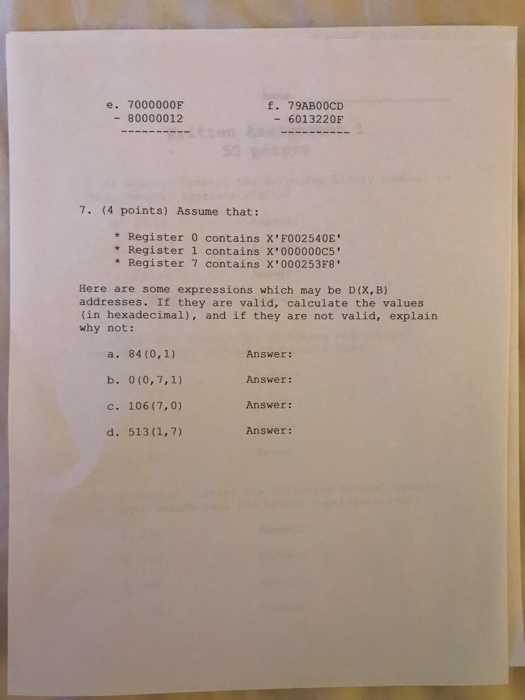
4. (8 points) Do the binary arithmetic: a. 10101 01110 Answer: b. 11001 10011 Answer: c. 01110 00101 Answer: d. 11001 01011 Answer: 5. (8 points) Do the hexadecimal arithmetic: a. 14B3 9A2C b. BA4 3F2 c. 95EC 3FA1 d. F65 87C Answer: Answer: Answer: Answer: 6. (18 points) The integers in the following computations are indicated in hexadecimal, but represent 32-bit two's complement binary numbers. Perform the operations and indicate if overflow occurs and why. (If overflow occurs the result is invalid, but show it anyway.) a. A0B1c2D3 +D3F50617 b. 87633342 8425442F c. 25009715 + 5297742F d. 710BC450 + 803009B5 e. 70000O0F - 80000012 f. 79AB00CD - 6013220F 7. (4 points) Assume that: Register 0 contains X F002540E *Register 1 contains x 000000c5 * Register 7 contains X'000253F8 Here are some expressions which may be D(X, B) addresses. If they are valid, calculate the values (in hexadecimal), and if they are not valid, explain why not: a. 84(0,1) b. 0 (0,7,1) c. 106(7,0) d. 513 (1,7)
Step by Step Solution
There are 3 Steps involved in it

Get step-by-step solutions from verified subject matter experts
 Study Help