







Question: After your apparatus has been checked, start heating the mixture. As soon as the mixture has begun to boil and the refluxing vapors reach the
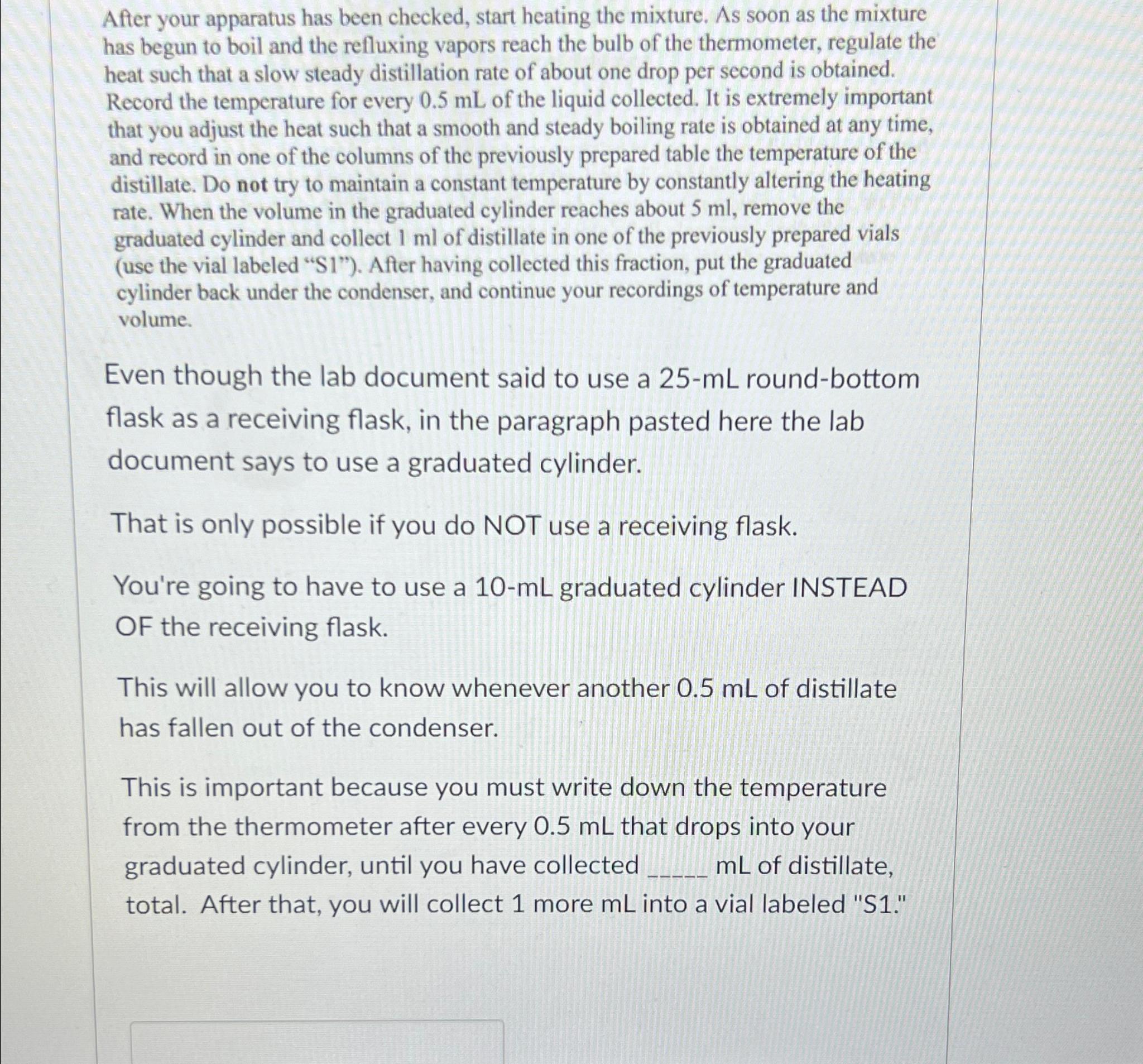
After your apparatus has been checked, start heating the mixture. As soon as the mixture has begun to boil and the refluxing vapors reach the bulb of the thermometer, regulate the heat such that a slow steady distillation rate of about one drop per second is obtained. Record the temperature for every of the liquid collected. It is extremely important that you adjust the heat such that a smooth and steady boiling rate is obtained at any time, and record in one of the columns of the previously prepared table the temperature of the distillate. Do not try to maintain a constant temperature by constantly altering the heating rate. When the volume in the graduated cylinder reaches about remove the graduated cylinder and collect of distillate in one of the previously prepared vials use the vial labeled S After having collected this fraction, put the graduated cylinder back under the condenser, and continue your recordings of temperature and volume.
Even though the lab document said to use a roundbottom flask as a receiving flask, in the paragraph pasted here the lab document says to use a graduated cylinder.
That is only possible if you do NOT use a receiving flask.
You're going to have to use a graduated cylinder INSTEAD OF the receiving flask.
This will allow you to know whenever another of distillate has fallen out of the condenser.
This is important because you must write down the temperature from the thermometer after every that drops into your graduated cylinder, until you have collected of distillate, total. After that, you will collect more into a vial labeled S
Step by Step Solution
There are 3 Steps involved in it
1 Expert Approved Answer
Step: 1 Unlock

Question Has Been Solved by an Expert!
Get step-by-step solutions from verified subject matter experts
Step: 2 Unlock
Step: 3 Unlock
 Study Help