



Question: Agency Conflicts Last question's drop down list has : Reduced or Increased An agency relationship can degenerate into an agency conflict when an agent acts
Agency Conflicts
Last question's drop down list has : Reduced or Increased
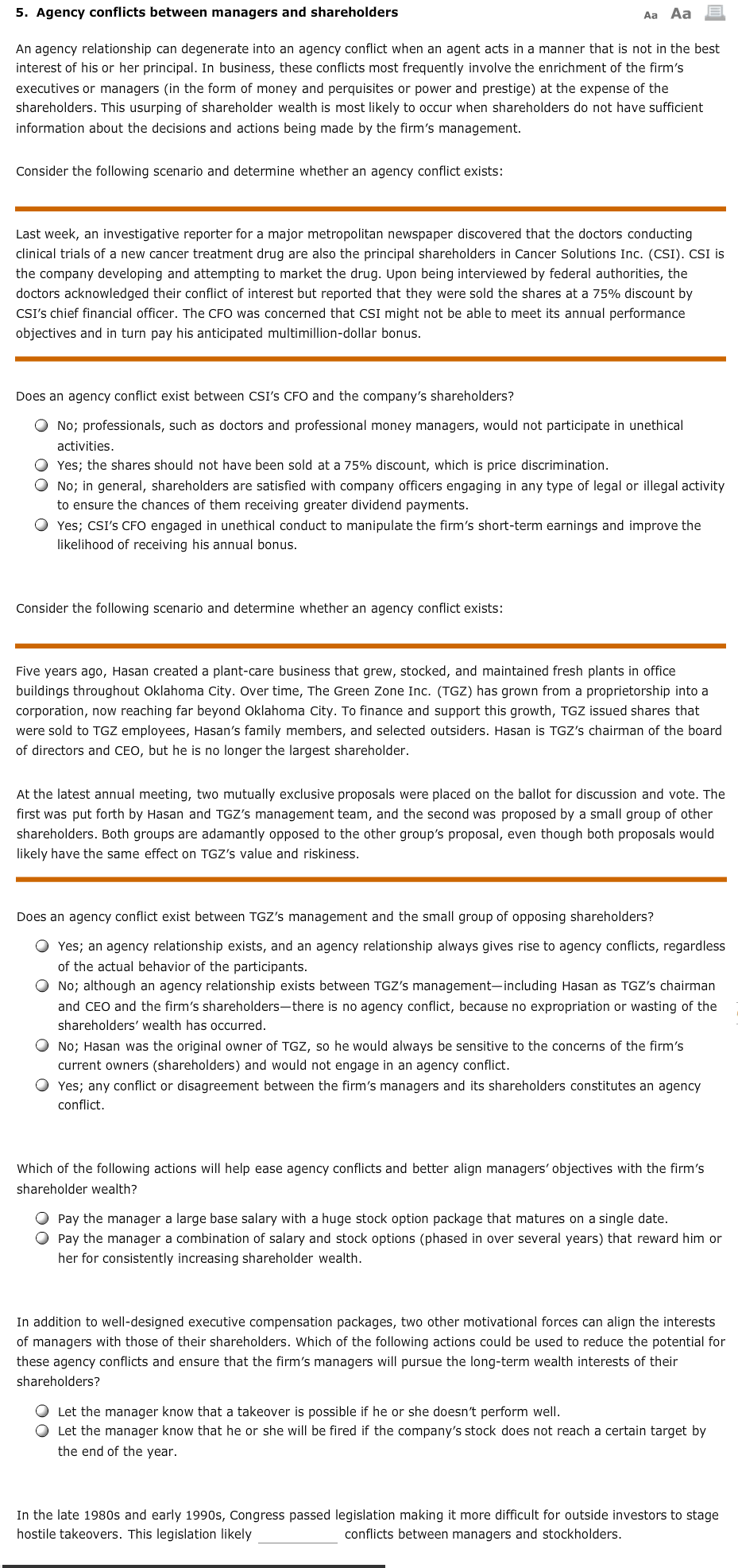
An agency relationship can degenerate into an agency conflict when an agent acts in a manner that is not in the best interest of his or her principal. In business, these conflicts most frequently involve the enrichment of the firm's executives or managers (in the form of money and perquisites or power and prestige) at the expense of the shareholders. This usurping of shareholder wealth is most likely to occur when shareholders do not have sufficient information about the decisions and actions being made by the firm's management. Consider the following scenario and determine whether an agency conflict exists: Last week, an investigative reporter for a major metropolitan newspaper discovered that the doctors conducting clinical trials of a new cancer treatment drug are also the principal shareholders in Cancer Solutions Inc. (CSI). CSI is the company developing and attempting to market the drug. Upon being interviewed by federal authorities, the doctors acknowledged their conflict of interest but reported that they were sold the shares at a 75% discount by CSI's chief financial officer. The CFO was concerned that CSI might not be able to meet its annual performance objectives and in turn pay his anticipated multimillion-dollar bonus. Does an agency conflict exist between CSI's CFO and the company's shareholders? No; professionals, such as doctors and professional money managers, would not participate in unethical activities. Yes; the shares should not have been sold at a 75% discount, which is price discrimination. No; in general, shareholders are satisfied with company officers engaging in any type of legal or illegal activity to ensure the chances of them receiving greater dividend payments. Yes; CSI's CFO engaged in unethical conduct to manipulate the firm's short-term earnings and improve the likelihood of receiving his annual bonus. Consider the following scenario and determine whether an agency conflict exists: Five years ago, Hasan created a plant-care business that grew, stocked, and maintained fresh plants in office buildings throughout Oklahoma City. Overtime, The Green Zone Inc. (TGZ) has grown from a proprietorship into a corporation, now reaching far beyond Oklahoma City. To finance and support this growth, TGZ issued shares that were sold to TGZ employees, Hasan's family members, and selected outsiders. Hasan is TGZ's chairman of the board of directors and CEO, but he is no longer the largest shareholder. At the latest annual meeting, two mutually exclusive proposals were placed on the ballot for discussion and vote. The first was put forth by Hasan and TGZ's management team, and the second was proposed by a small group of other shareholders. Both groups are adamantly opposed to the other group's proposal, even though both proposals would likely have the same effect on TGZ's value and riskiness. Does an agency conflict exist between TGZ's management and the small group of opposing shareholders? Yes; an agency relationship exists, and an agency relationship always gives rise to agency conflicts, regardless of the actual behavior of the participants. No; although an agency relationship exists between TGZ's management-including Hasan as TGZ's chairman and CEO and the firm's shareholders-there is no agency conflict, because no expropriation or wasting of the shareholders' wealth has occurred. No; Hasan was the original owner of TGZ, so he would always be sensitive to the concerns of the firm's current owners (shareholders) and would not engage in an agency conflict. Yes; any conflict or disagreement between the firm's managers and its shareholders constitutes an agency conflict. Which of the following actions will help ease agency conflicts and better align managers' objectives with the firm's shareholder wealth? Pay the manager a large base salary with a huge stock option package that matures on a single date. Pay the manager a combination of salary and stock options (phased in over several years) that reward him or her for consistently increasing shareholder wealth. In addition to well-designed executive compensation packages, two other motivational forces can align the interests of managers with those of their shareholders. Which of the following actions could be used to reduce the potential for these agency conflicts and ensure that the firm's managers will pursue the long-term wealth interests of their shareholders? Let the manager know that a takeover is possible if he or she doesn't perform well. Let the manager know that he or she will be fired if the company's stock does not reach a certain target by the end of the year. In the late 1980s and early 1990s, Congress passed legislation making it more difficult for outside investors to stage hostile takeovers. This legislation likely conflicts between managers and stockholders
Step by Step Solution
There are 3 Steps involved in it

Get step-by-step solutions from verified subject matter experts