







Question: Aggregate Demand and Aggregate Supply 2 Consider an economy whose aggregate demand is described by the NIPA equation: Y=C+I+G+NX (3) where the individual components of
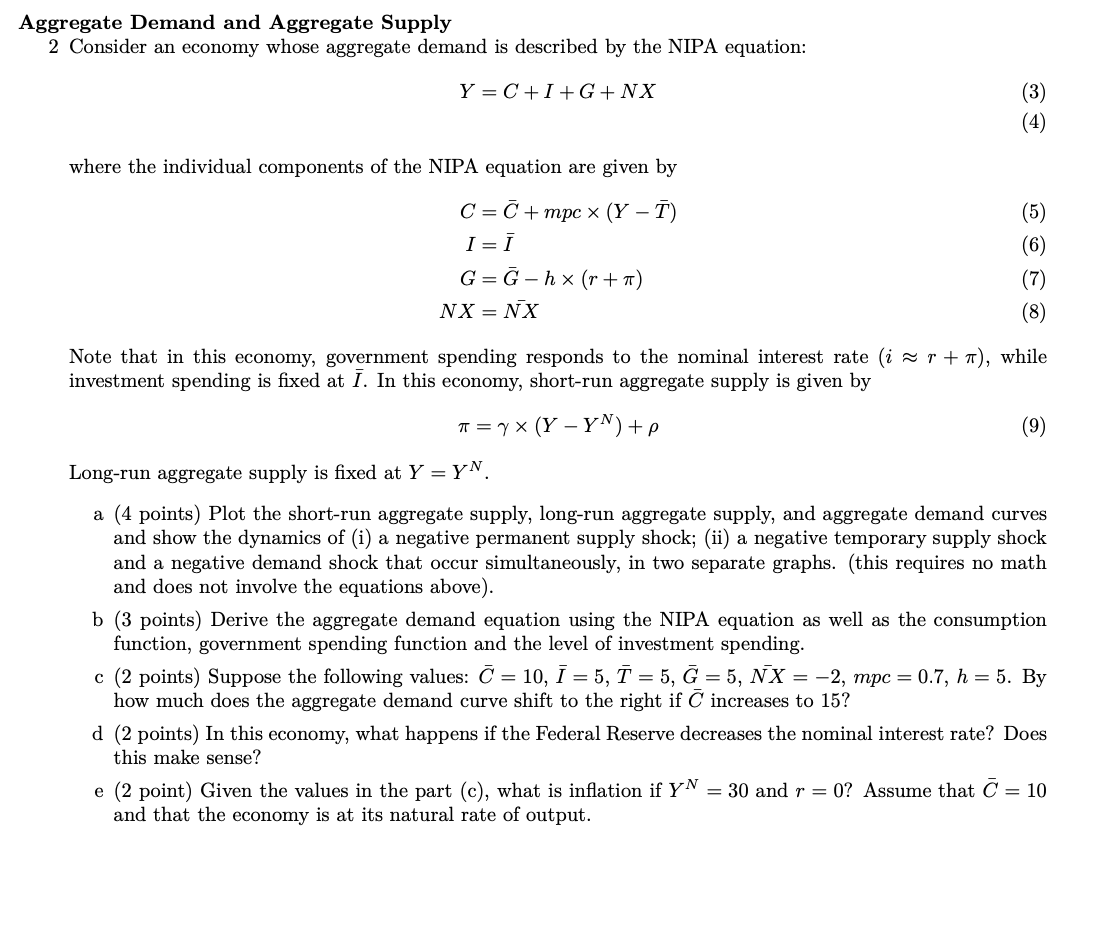
Aggregate Demand and Aggregate Supply 2 Consider an economy whose aggregate demand is described by the NIPA equation: Y=C+I+G+NX (3) where the individual components of the NIPA equation are given by C=+mpcx(YT) (5) I=f (6) G=hx(r+7r) (7) NX=N'X (8) Note that in this economy, government spending responds to the nominal interest rate (2' m r + 77), while investment spending is xed at I. In this economy, shortrrun aggregate supply is given by N=TX(Y-YN)+.0 (9) Longrun aggregate supply is xed at Y = YN. a (4 points) Plot the shortrun aggregate supply, longrun aggregate supply, and aggregate demand curves and show the dynamics of (i) a negative permanent supply shock; (ii) a negative temporary supply shock and a negative demand shock that occur simultaneously, in two separate graphs. (this requires no math and does not involve the equations above). b (3 points) Derive the aggregate demand equation using the NIPA equation as well as the consumption function, government spending function and the level of investment spending. c (2 points) Suppose the following values: 6' = 10, I = 5, T = 5, (:1: 5, N_X = 2, mpc = 0.7, h = 5. By how much does the aggregate demand curve shift to the right if C increases to 15? d (2 points) In this economy, what happens if the Federal Reserve decreases the nominal interest rate? Does this make sense? e (2 point) Given the values in the part (c), what is ination if YN = 30 and r = 0? Assume that (3 = 10 and that the economy is at its natural rate of output
Step by Step Solution
There are 3 Steps involved in it

Get step-by-step solutions from verified subject matter experts
 Study Help