







Question: Aggregate forecasts are usually more accurate than disaggregate forecasts, as they tend to have a smaller standard deviation of error relative to the mean. What
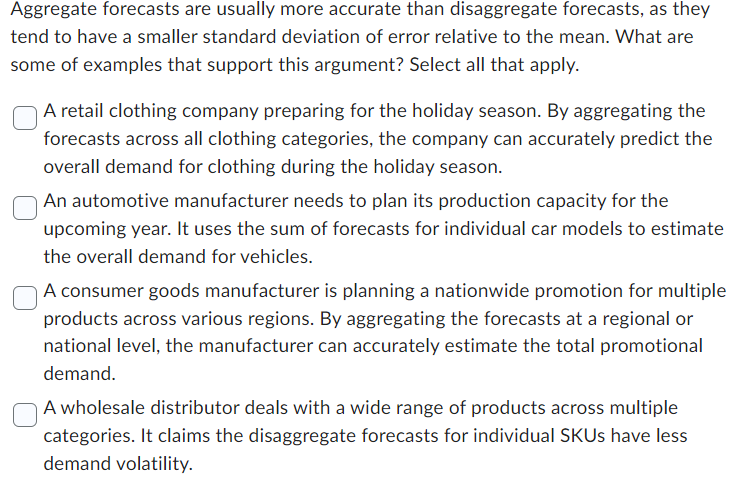
Aggregate forecasts are usually more accurate than disaggregate forecasts, as they tend to have a smaller standard deviation of error relative to the mean. What are some of examples that support this argument? Select all that apply. A retail clothing company preparing for the holiday season. By aggregating the forecasts across all clothing categories, the company can accurately predict the overall demand for clothing during the holiday season. An automotive manufacturer needs to plan its production capacity for the upcoming year. It uses the sum of forecasts for individual car models to estimate the overall demand for vehicles. A consumer goods manufacturer is planning a nationwide promotion for multiple products across various regions. By aggregating the forecasts at a regional or national level, the manufacturer can accurately estimate the total promotional demand. A wholesale distributor deals with a wide range of products across multiple categories. It claims the disaggregate forecasts for individual SKUs have less demand volatility
Step by Step Solution
There are 3 Steps involved in it

Get step-by-step solutions from verified subject matter experts
 Study Help