



Question: Ahmad is a developer who aims to design a new sorting algorithm as an alternative variant of the standard Quick Sort, as discussed in
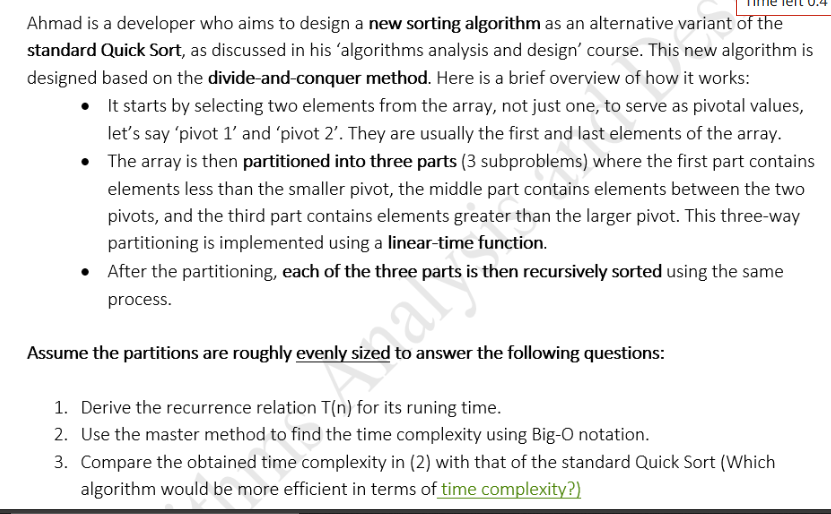
Ahmad is a developer who aims to design a new sorting algorithm as an alternative variant of the standard Quick Sort, as discussed in his 'algorithms analysis and design' course. This new algorithm is designed based on the divide-and-conquer method. Here is a brief overview of how it works: It starts by selecting two elements from the array, not just one, to serve as pivotal values, let's say 'pivot 1' and 'pivot 2'. They are usually the first and last elements of the array. The array is then partitioned into three parts (3 subproblems) where the first part contains elements less than the smaller pivot, the middle part contains elements between the two pivots, and the third part contains elements greater than the larger pivot. This three-way partitioning is implemented using a linear-time function. After the partitioning, each of the three parts is then recursively sorted using the same process. Assume the partitions are roughly evenly sized to answer the following questions: 1. Derive the recurrence relation T(n) for its runing time. 2. Use the master method to find the time complexity using Big-O notation. 3. Compare the obtained time complexity in (2) with that of the standard Quick Sort (Which algorithm would be more efficient in terms of time complexity?)
Step by Step Solution
There are 3 Steps involved in it
The image contains a description of a new sorting algorithm designed by a developer named Ahmad intended as an alternative to the standard Quick Sort ... View full answer

Get step-by-step solutions from verified subject matter experts