Question: Al-Driven Contextual Advertising: Toward Relevant Messaging Without Personal Data E. Haglund and J. Bjorklund Department of Computing Science, Umea University, Umed, Sweden ABSTRACT In programmatic
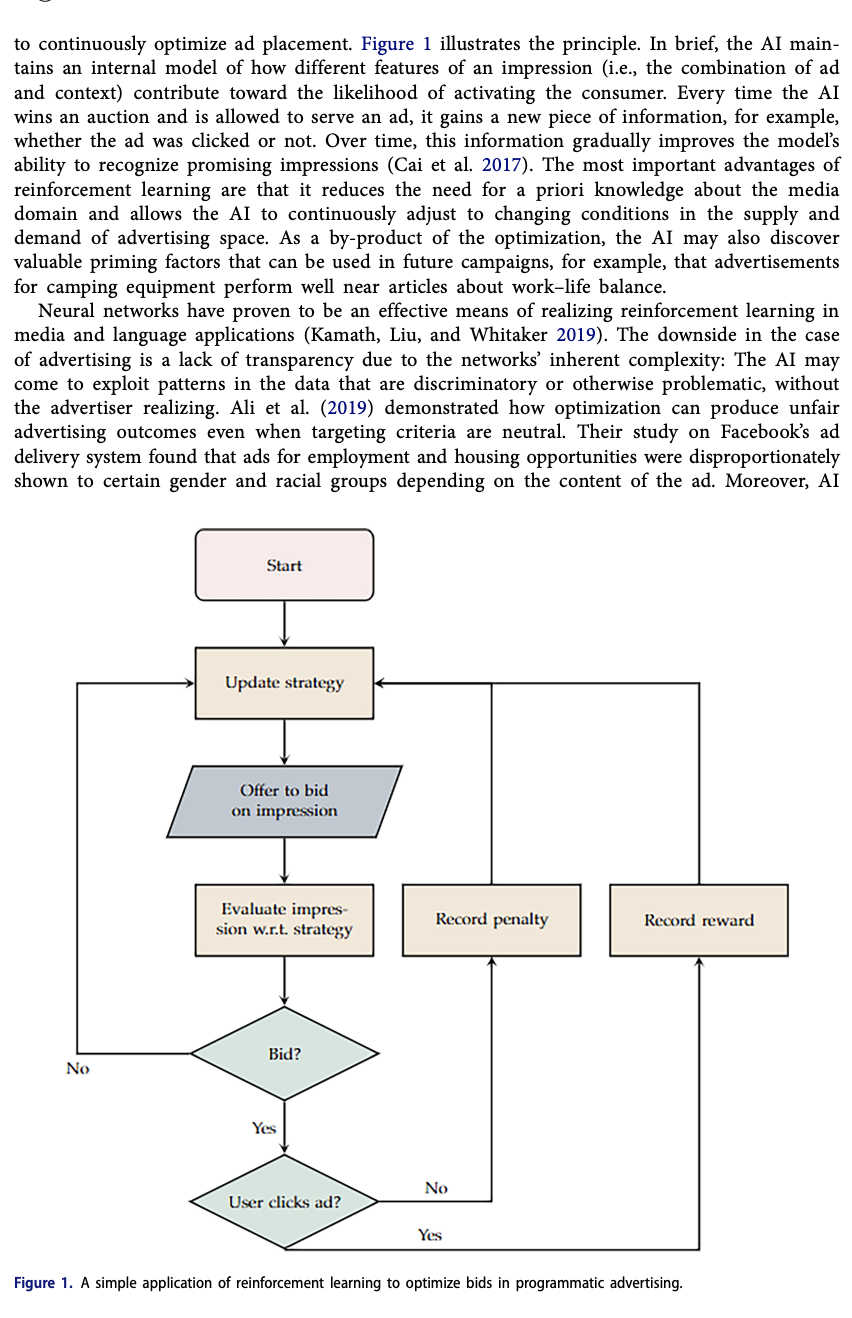
Al-Driven Contextual Advertising: Toward Relevant Messaging Without Personal Data E. Haglund and J. Bjorklund Department of Computing Science, Umea University, Umed, Sweden ABSTRACT In programmatic advertising, bids are increasingly based on knowledge of the surrounding media context. This shift toward contextual advertising is in part a counter-reaction to the current dependency on personal data, which is problematic from legal and ethical standpoints. The transition is acceler- ated by developments in artificial intelligence (Al), which allow for a deeper semantic analysis of the context and, by extension, more effective ad place- ment. We survey existing literature on the influence of context on the reception of an advertisement, focusing on three context factors: the appli- cability of the content and the ad, the affective tone of the content, and the involvement of the consumer. We then discuss how Al can leverage these priming effects to optimize ad placement through techniques such as rein- forcement learning, data clustering, and sentiment analysis. This helps close the gap between the state of the art in advertising technology and the Al-driven targeting methodologies described in prior academic research. Introduction In this work, we denote by contextual advertising (CA) the practice of optimizing advertising effectiveness by placing ads in favorable media contexts (Zhang and Katona 2012).! The world- wide market for CA was valued at about US $100 billion in 2017 and at US $200 billion in 2022 (Research and Markets 2023b). It is expected to continue to increase to around US $560 billion by 2030. This growth is predicted to happen at an average annual rate of 14 percent between 2022 and 2030 (Research and Markets 2023a). There is a substantial literature on the impact of context on advertising effectiveness (see, for example, Yi 1990; Norris and Colman 1992; Zhang and Katona 2012; Song 2014). However, the interplay between ad and context is complex, and empirical studies at times yield contra- dictory results.?> Despite this, CA is used for online media, where bidders in auctions of digital ad space use data about the media context to inform their decisions. The practice is already established in search advertising to include sponsored links among the answers to search queries. CA is now becoming a commodity also for display advertising, that is, the promotional third-party banners that finance a large part of the internet (Wood 2022). The increasing use of CA can be ascribed to two factors. First is the societal concern for consumer privacy and fairness that led to the General Data Protection Regulation and the California Consumer Privacy Act. Apple now requires iPhone users' consent before allowing tracking across apps and websites, and Google plans to remove third-party cookies from Chrome (Dave 2021). This motivates the industry to move away from personal data and behavioral tracking (Ipsos 2021), making CAwhich requires neitheran attractive alternative. Rather than looking at previously recorded data, CA assumes that consumers' content requests indicate their current state of mind and product preferences and places ads accordingly. A second driver of CA is the abundance of analyzable media content and ad performance data in online environments, which makes it possible to harness artificial intelligence (AI) for targeting purposes. Google alone serves 29.8 billion ad impressions every single day, spread over its own site and the 200 million websites in its advertising network (Venture Beat 2023). Given such volumes of traffic, automation is becoming a necessity to orchestrate global-scale campaigns. Moreover, in contrast to the case for autonomous vehicles and medical diagnostics, the conse- quences of misclassifications are generally acceptable. This fault tolerance encourages experi- mentation and lowers the barriers for Al applications in online advertising. In the case of CA, modern Al technology can analyze media content beyond the superficial level of keywords and provide a deeper and more refined profiling of contexts. It can detect signals like topic (Zhao et al. 2021), sentiment (Birjali, Kasri, and Beni-Hssane 2021), and visual complexity (Saraee, Jalal, and Betke 2020) and optimize bidding in programmatic real-time auctions for advertising space (Qin and Jiang 2019). While Al is already being applied to CA, it is still at an early stage of adoption. The purpose of this article is to explore the numerous ways in which AI can be applied to CA. For advertising researchers, an understanding of the implementation, benefits, and limitations of the technology is required to discern future research needs. Furthermore, our synthesis of advertising and technological research with regard to Al-driven CA provides a bridge between theory and practice. Many advertising platforms already offer services for CA that involve Al technology. We want to take you behind the curtain by describing the underlying methods that are used to classify content and optimize targeting, incorporating relevant academic work on AI within advertising. We begin by reviewing the advertising literature on media context effects and, in doing so, identify three context factors that have been shown to correspond to advertising effectiveness. We then explain how these context factors can be detected and quantified through Al-based methods, before moving on to (1) the optimization of ad delivery through reinforcement learn- ing, (2) the utilization of historical data through transfer learning, and (3) the attainment of deeper contextual understanding through large language models (LLMs). We conclude with a research agenda, in which we raise the need for research on the influence of context on ad evaluation in online media as well as studies on how Al and algorithms can meet the marketing goals of advertisers in a brand-safe, transparent, and computationally effective manner. The influence of context: A review of advertising literature CA predates the internet. Advertisers have long understood that context can be used to address groups of consumers with specific interests or shared challenges. Furthermore, a fitting context can increase the memorability of an ad or increase the persuasiveness of the ad message (Shen and Chen 2007; Yi 1990; Song 2014; Furnham, Bergland, and Gunter 2002). For example, by placing ads for public transport on a billboard next to a congested highway, the message reaches people facing a problem to which the ad provides a solution. To target customers with an interest in nature, a company selling tents may advertise their products in a magazine about trail run- ning. From here on, we take a favorable media context (with respect to a given ad) to be one whose features increase the likelihood that a specific advertising objective is achieved. It is thus not enough that the context and the ad contain have overlapping keyword sets, for example, if this has no impact on the target advertising metric. The notion of advertising effectiveness is multifaceted and can be measured in different ways. Previous studies have considered metrics such as ad and brand attitude, recall, and purchase intention (see, e.g., Cheong, de Gregorio, and Kim 2010). Three underlying context factors have received particular attention: (1) the applicability of the content and the ad, (2) the affective tone of the content, and (3) the involvement of the consumer. We briefly summarize previous literature on each of these in order. While early works mainly focused on print and TV media, attention has come to shift toward display advertising, the rectangular ads that pervade websites and social media. In the following sections, we discuss results from both offline and online media. Applicability A premise behind online CA is that the content a consumer chooses to engage with can be indicative of their interests and needs. Instead of relying on personal data, contextual advertisers indirectly target personal preference by pursuing article-ad applicability: placements where the content is relevant to the ad. Placing ads based on applicability has been shown to improve clickthrough rates (CTR) across several online content types, including third-party websites (Chakrabarti, Agarwal, and Josifovski 2008; Tagami et al. 2013), blog posts (Fan and Chang 2009), news sites (Oh, Lee, and Lee 2012), e-magazines (Zanjani, Diamond, and Chan 2011), and social media (Mao and Zhang 2015). Applicability has also been shown to improve con- sumers' attitude toward advertised brands and their recall of ads in numerous channels, including print media (Shen and Chen 2007; Yi 1990), TV (Furnham, Bergland, and Gunter 2002), and display advertising (Huang 2014; Song 2014). Applicability cannot only give an idea of the consumer's interests and needs but can also create a priming effect: a subconscious influence on the consumer's cognitive and behavioral reactions (Higgins 1996). By inducing feelings or emphasizing attributes, a media context can lead the consumer toward certain associations, which in turn affects how an ad is perceived. In a study by Yi (1990), subjects were shown an article together with a companion ad for a car, which emphasized the large size of the car. When the topic of the article was \"safety in air travel,\" the subjects tended to associate the size of the car with safety; when the topic was \"oil entrepreneurs,\" the subjects instead associated the size with poor fuel economy. Yi (1990) con- cluded that the theme of the priming article influenced the subjects' attitude toward the brand and advertisement as well as their purchase intention. Because of this priming effect, brands frequently advertise in high-status contexts, such as in luxury magazines and at exclusive events, in the hope of gaining prestige by association. There is support for the effectiveness of this approach (Fuchs 1964) and that these types of implicit contextual cues are moderated by the applicability in associations between a medium and the advertised brand (Dahln 2005). While the potential benefit of applicability is evident, it is important to bear in mind that different topics give rise to varying advertising effectiveness (Oh, Lee, and Lee 2012). Moreover, the fact that current CA systems have only a superficial understanding of context can lead to unfortunate placements that damage the advertised brand. For example, although articles con- taining the keyword \"family\" are as a rule favorable contexts for childcare products, they can also concern domestic abuse and other types of trauma. A number of factors mediating the priming effect induced by applicability further complicate the effective use of contextual ads. These factors include ad clutter (Oh, Lee, and Lee 2012), ad complexity (Song 2014), the level of arousal the ad produces (Belanche, Flavidn, and Prez-Rueda 2017), and the task orientation and product involvement of the consumer (Zanjani, Diamond, and Chan 2011). Affective tone The value of using emotions to engage with consumers is well known in marketing, and adver- tisers generally strive to evoke positive feelings through their messaging. Similarly, the affective tone of the surrounding media context can induce feelings that impact satisfaction, customers' loyalty, and decision-making. This idea is supported by Kwortnik and Ross (2007), who found that when consumers are exposed to ads for vacation trips, their rational evaluations are influ- enced by the emotional resonance of the ads. The conceptual basis is affective priming, that is, the observation that the affective tone of media content creates a cognitive response that shapes the perception of the ads. Several studies have confirmed that positive content improves attitudes and purchase intention in both print media and television (Pelsmacker, Geuens, and Anckaert 2002; Goldberg and Gorn 1987; Kamins, Marks, and Skinner 1991; Yi 1990; LaTour and Latour 2009). However, congruity in tone between ad and content (e.g., positive-positive or negative negative) leads to similar effects (Pelsmacker, Geuens, and Anckaert 2002; Kamins, Marks, and Skinner 1991). Meanwhile, negative emotions generated by media content can stimulate analytical processing of advertising messages. For instance, in a study by Shapiro, Macinnis, and Park (2013), consumers took a more critical stance to a restaurant advertisement if they had first been exposed to a radio segment that dampened their mood. Content involvement Priming theory suggests that when consumers appreciate and are engaged in media content, their perception of accompanying ads improves (Goldberg and Gorn 1987). However, if they are so deeply emerged that they fail to notice the ads, the effect of positive priming is lost. Advertisers employ a range of methods to shift the reader's attention away from the main content and toward their ads by, for example, the choice of colors (Fernandez and Rosen 2000) or positioning in the media (Huang 2018), but these may spoil the user experience. There is a tension between stakeholder interests: The consumers want the best possible user experience, which requires engagement and immersion, while the advertisers prioritize their marketing goals, not seldom at the cost of the user's immersion. The publishers need to strike a balance between the two objectives, where both consumers and advertisers are sufficiently satisfied to continue interacting with the publisher. The effects of content involvement on advertising effectiveness depend on the type of medium being consumed. Studies have found that TV viewers who are engaged in what they are watching show increased ad recall and more positive attitude toward the ad served (Pelsmacker, Geuens, and Anckaert 2002; Tavassoli, Shultz, and Fitzsimons 1995). Among readers of print media, on the other hand, a higher degree of involvement reduces ad recall (Norris and Colman 1992; Pelsmacker, Geuens, and Anckaert 2002). Norris and Colman (1992) conjecture that this differ- ence can be explained by the medium in which ads are presented. In TV, ads temporarily replace the media stream, forcing themselves upon the consumer's attention, whereas in print media, an absorbing article is more likely to keep the consumer's attention away from accompanying ads. If this conjecture is correct, then the effect of content involvement in flow-based social media such as TikTok and Instagram should bare greater similarity to the case for TV than for print, as the ads are spliced into the main media stream. Finally, in online display advertising, Tai and Chang (2005) found that higher levels of involvement improved CTR, ad attitudes, and conversion rates (i.e., purchases, roughly speaking). The effects were moderated by the type of web content and were more pronounced for entertainment and learning content than for news content. In summary, differences across media channels and the interplay of various context factors produce a complex environment. The promise of Al within CA lies in disentangling this com- plexity and identifying favorable ad placements using the richness of contextual data avail- able online. The application of Al to CA The volume and speed at which online advertising space is bought and sold, in combination with the economic values at stake, have motivated immense investments in process automation. This has made online advertising one of the early success stories for applied Al (Qin and Jiang 2019) and has contributed to the technological developments that have led to today's LLMs. Initial uses have focused on personalization, but Al is expected to also assume a significant role in context-centric advertising (Choi and Lim 2020). The same technologies that make it possible to automatically caption images with text, or realize visual-linguistic question answering, can help uncover the dynamics between ads and context (see, e.g., Chen et al. 2016; Hou et al 2017) and by doing so improve advertising effectiveness. Initial solutions have already been marketed by leading advertising platforms, and the technology is gradually becoming more sophisticated. In this article, when discussing Al applications, we are referring to systems that are trained on data rather than explicitly programmed.? In \"Identifying context factors using AL' we explore techniques through which Al learns to discern contextual factors. Additionally, in \"Optimizing ad targeting through reinforcement learning,\" we delve into how reinforcement learning can optimize ad placements toward an advertising goal over the course of an ad campaign. A brief introduction to programmatic advertising The vast majority of online advertisements are traded in programmatic auctions (Garnett 2018; Busch 2016), where advertising space is sold by digital publishers to advertisers. Because the auctions are conducted on the basis of individual viewings, they need to be completed within a matter of milliseconds, and the number of daily auctions is counted in tens of billions. Moreover, the value of a won auction is revealed immediately to the buyer: Either the ad is clicked or it is not. The combination of speed, scale, and direct feedback makes programmatic auctions a promising application area for AL Programmatic advertising takes off from the observation that every time a consumer requests some piece of content from an online publisher, there is an opportunity to display an ad. The consumer's exposure to the ad is called an impression. Before serving the requested content, the publisher solicits bids on the impression from advertisers through a digital ad exchange. The winning advertiser provides an ad, which is embedded in the content and sent to the consumer. The time for the whole transaction is approximately 300 ms (a blink of an eye takes 300-400ms). Two characteristic features are granularity and automation (Busch, 2016, 8). Granularity enables advertisers to make optimal use of their budget by inspecting each individual impression and bidding in proportion to its expected value in terms of, for example, consumer activation as measured in number of clicks. This detail-oriented view is only viable due to automation, which avoids expensive and time-consuming manual processing. For these reasons, one of the most common uses of Al in real-time bidding is to classify impressions into categories that have predictive value for advertising effectiveness. When such a classification is applied to consumer data, we talk about segmentation of audiences. When instead the classification is made with respect to the media content, we have Al-driven CA. Identifying context factors using Al Let us now discuss how AI can detect and quantify the context factors presented in \"The influence of context: a review of advertising literature\" The main approaches are detection of applicability through topic identification (Jelodar et al. 2019), recognition of affective tone through sentiment analysis (Yadav and Vishwakarma 2020), and estimation of the consumer's involvement through regression analysis (Bates and Watts 1988) and deep learning (Schulz and Behnke 2012) from correlating factors such as time spent on the website, scroll pace, or likeness to content previously consumed (Kwon et al. 2019). Among these, the majority of attention has been directed toward detecting applicability. However, there is a growing realization of the importance of also acknowledging sentiment and content involvement. Throughout this section, we complement the theoretical presentation with concrete examples from industry. Detecting applicability Recall that applicability refers to the topical relevance between an ad and its surrounding context. Media publishers are, to varying degrees, tagging their articles with categories such as \"sports, \"economy,\" and \"lifestyle\" These metadata are then provided as part of auctioned impressions, so that the buyers can make better-informed bids. However, manual categorization is time-consuming, and it is difficult to maintain consistency among annotators within a publica- tion, let alone among publications. The categories can therefore only provide a high-level and rather imprecise understanding of contexts. This can mean that ads appear on pages that are seemingly aligned with the target category but adopt a different perspective than that anticipated by the advertiser. For example, when events become newsworthy, it is often because something has gone wrong; this means that news content tagged with the label \"leadership,\" for example, often involves failed leadership, such as harassment cases or derailed negotiations. Topic detection, alternatively referred to as topic modeling or topic analysis, employs ML to assign labels or categories to content items (e.g., textual documents or websites) based on their respective topics or themes. A standard approach is latent Dirichlet allocation (LDA), a probabilistic model that tries to simultaneously represent each document as a distribution over topics and each topic as a distribution over words (Blei, Ng, and Jordan 2003). There are also methods that draw on deep learning, where different types of neural networkscommonly recurrent neural networks (Wang et al. 2019) or long short-term memory neural networks (Luan and Lin 2019)are trained on large sets of documents and then used for categorization tasks. These methods save human labor by automating the topic labeling and ensure a more coherent use of metadata tags (Xu et al. 2019). Topic identification can also be initiated by an advertising brand to detect media contexts relevant for them. For example, \"strong industrial leadership\" is too niched a category to be meaningful for many publishers to tag proactively, since it is not likely that they can reliably offer updated content in the category. However, a brand advertising through a range of publishers maywith the support of a contracted data providerbe able to identify a sufficient number of articles matching this description to run a successful campaign. Examples could be a company targeting positive reviews of their own brand or of articles mentioning their main competitor. In a broader context, this customized targeting allows brands to define and establish ownership over their own target categories. Topic identification realized through deep learning can also find abstract categories such as \"relaxation\" and \"self-fulfilment,\" which are difficult to reduce to individual keywords in article text (Liu et al. 2020), and help advertisers avoid negative reviews of their products or topics deemed brand-unsafe, such as content relating to war, vio- lence, pornography, and so on (Zhang et al. 2008). Topics can also be discovered by grouping articles by similarity and using the resulting clusters as pseudo topics (Aggarwal and Zhai 2012). It may, for example, be found that a certain cluster is particularly useful to promote household services, while another is better to promote bank loans. Analogously, we may find that some ads work better in positive contexts, while others benefit from emotionally charged media. In both cases, clustering can be a good alternative to direct topic identification, as it may be computationally less demanding to sort new articles into existing clusters than test for a vast set of fixed topics. A challenge with clustering is that the definition of similarity used to group media items must be carefully constructed, so that the resulting clusters form what we would see as natural categories (Harrando 2022). To conclude this section, we note that topic-based targeting is widely applied in commercial solutions. Examples abound, ranging from Google Ads offering categorizing of content across the web into niched topics like \"home improvement\" to Spotify allowing targeting of music associated with daily moments such as working out, cooking, or partying. Furthermore, a number of AdTech companies provide contextual targeting solutions by crawling the web, scanning URLs, and categorizing content (Seb 2023). Differentiation occurs in terms of, for example, categori- zation of multimodal data; breadth and nuance of topic targeting options; reach across websites and apps; and brand safetyavoiding content and publishers that could damage the advertiser's brand reputation. Detecting affective tone Data management platforms increasingly use sentiment analysis to offer contextual targeting based on emotion, assigning content labels such as \"happy\" \"serious,\" \"amusing,\" \"loving,\" and \"hopeful\" (Sobreanis 2021; IAS 2020). Academic research has studied the advertising effect of the affective tone of YouTube content and used computational approaches to select suitable ads and insertion points in videos (Wen et al. 2022; Yadati, Katti, and Kankanhalli 2014). There is evidence to support that such practices improve the user experience and lead to increased attention and recall of ads, when compared to contextual systems that do not account for content emotion (Yadati, Katti, and Kankanhalli 2014). A significant amount of research has also been devoted to sentiment targeting of user-generated content; see, for example, Nair and Shetty (2017), Fan and Chang (2009), Qiu et al. (2009), and Bushi and Zaiane (2019). This makes it possible for advertisers to target reviews or blog posts reporting positive experiences related to a product and to avoid posts that take a negative or neutral stance. Topic identification and semantic analysis are both instances of natural language processing (NLP) and usually focus on textual content, but the techniques are increasingly applied to mul- timodal content that also includes images, video, and sound (Chen et al. 2016; Hou et al. 2017). An industry example of sentiment targeting in the audio domain is YouTube Music, which offers targeting of moods such as \"feel good,\" \"chill,\" and \"romance;\" allowing advertisers to target music with an affective tone that resonates with their ad message or brand (Hsieh Nikolic 2020). Detecting content involvement In the online environment, attention-based metrics such as dwell time and viewport time, the time spent at a given position on a webpage, have been found to be robust metrics for content involvement (Lagun and Lalmas 2016; Bilenko and White 2008; Yi et al. 2014). Lagun and Lalmas (2016) relied on analysis of viewport time data to quantify user engagement in online news reading. The article identified four levels of reading engagement, ranging from bounce (leaving the page quickly) to complete engagement (consuming most of the article and reading or con- tributing comments, etc.). This allowed the researchers to determine how features such as the length and the presence of images and videos on the page correlated with reader engagement. Mappings between contextual features and user engagement allow publishers and advertisers to predict which articles and topics will attract user interest. The prediction does not require complex Al models; for example, LDA is used as a popular and relatively simple tool to chart content involvement (Lagun and Lalmas 2016). As discussed in \"Content involvement,\" the challenge lies rather in the effect between context factors possibly differing among content types, for example, between genres such as entertainment and political news (Yi et al. 2014) or between media types such as video and text (Pelsmacker, Geuens, and Anckaert 2002; Norris and Colman 1992). Therefore, a CA system designed for a particular domain is unlikely to perform optimally if directly transferred to a new setting. Turning to practical examples, TikTok's contextual targeting is limited to the top 4 percent of the apps content, a practice motivated by the assumption that, for contextual ads, content engagement correlates with brand engagement (TikTok 2022). In addition to classifications of topic and affective tone, The New York Times allows ad targeting based on different types of internal motivation that consumers experience after reading a story. These motivations include \"make a healthy change\" and \"donate to a cause\" The targeting approach thus aims to align high-involvement content with advertisements that resonate on a similar level. Optimizing ad targeting through reinforcement learning Reinforcement learning (Sutton and Barto 2018) adds an additional layer of automation by allow- ing the AI to actively explore the interplay between contextual features and advertisement effectiveness. It essentially uses trial and error to find patterns in the data and exploits these to continuously optimize ad placement. Figure 1 illustrates the principle. In brief, the AI main- tains an internal model of how different features of an impression (i.e., the combination of ad and context) contribute toward the likelihood of activating the consumer. Every time the Al wins an auction and is allowed to serve an ad, it gains a new piece of information, for example, whether the ad was clicked or not. Over time, this information gradually improves the model's ability to recognize promising impressions (Cai et al. 2017). The most important advantages of reinforcement learning are that it reduces the need for a priori knowledge about the media domain and allows the AI to continuously adjust to changing conditions in the supply and demand of advertising space. As a by-product of the optimization, the Al may also discover valuable priming factors that can be used in future campaigns, for example, that advertisements for camping equipment perform well near articles about work-life balance. Neural networks have proven to be an effective means of realizing reinforcement learning in media and language applications (Kamath, Liu, and Whitaker 2019). The downside in the case of advertising is a lack of transparency due to the networks' inherent complexity: The AI may come to exploit patterns in the data that are discriminatory or otherwise problematic, without the advertiser realizing. Ali et al. (2019) demonstrated how optimization can produce unfair advertising outcomes even when targeting criteria are neutral. Their study on Facebook's ad delivery system found that ads for employment and housing opportunities were disproportionately shown to certain gender and racial groups depending on the content of the ad. Moreover, Al Update strategy Offer to bid on impression Evaluate impres- sion W.rt strategy Record penalty Record reward No Figure 1. A simple application of reinforcement learning to optimize bids in programmatic advertising. systems based on reinforcement learning can be sensitive to noisy data in the early stages of the learning process, when it must base its decisions on relatively few observations. However, techniques such as filtering out accidental clicks that contribute to the noise have shown a strong positive impact on the performance of the trained model (Tolomei et al. 2019). Reinforcement learning has also been tried further down the sales tunnel. After the user has clicked an ad and been taken to a site, they are typically desired to take one or more target actions. Liberali and Ferecatu (2022) explore the use of reinforcement learning, more particularly the training of hidden Markov models, to adapt the site layout based on the user's actions to guide them toward these actions in the best possible way. This practice of adapting the char- acteristics of a marketing instrument on a page-view level is known as morphing. Banner mor- phing, adapting the layout or message of an ad to groups of consumers, has also been applied, with promising results (Urban et al. 2014). This encourages similar studies into how reinforcement learning can accommodate the layout and message of an ad to its surrounding context. If suc- cessful, morphing stands to provide a substantial lift in advertising effectiveness beyond that stemming from direct context matching of static ads. The agent starts by initiating its bidding strategy, possibly based on historical data. It then waits for an offer to bid on an impression. When this offer arrives, the agent evaluates the impression based on available information about, for example, personal data about the user, or context data, and decides whether to bid. If the agent decides to bid, it also decides on the amount to bid. If the agent does not bid, then it returns to update its strategy, now knowing more about what types of impressions it can expect. Assume then that the agent does bid. Now, if it loses the bid and the bid amount was lower than the agent's predicted value of the impres- sion, then it learns that it must be more aggressive in future bids. If, however, the bid was equal to the predicted value but the agent still lost, then it receives neither a punishment nor a reward. Finally, if the agent wins the bid, then it receives a punishment that is proportional to its bid but also a large positive reward if the user clicked. After this feedback has been received, the agent updates its strategy again to reflect the new knowledge. Optimization metrics for Al-driven advertising For an Al-driven advertising system to function, there needs to be precise metrics to optimize toward. Traditional metrics for display ads include impressions, clicks, and conversions (purchases, leads, and so forth). For video ads, average viewing time can be added to the list. Although the direct feedback of these metrics is well suited for Al optimization, it does not always reflect the diverse marketing objectives of advertisers. An advertiser aiming to prompt immediate sales could benefit from optimizing clicks or purchases per page view, while the success of a brand awareness campaign requires longer feedback loops. For example, a brand might advertise to stay top-of-mind in a target category or to reposition their brand to be perceived as more environmentally friendly or exclusive. Sometimes the individual viewing of an ad has small effect, and it is only through repeated exposure to the message that the consumer is affected (Campbell and Keller 2003). The dissonance between impression-based metrics and long-term advertising goals, along with other computational advertising challenges such as click fraud, is further discussed by Yun et al. (2020). To meet these challenges, the advertising industry has introduced a battery of novel metrics. This includes view-through conversion (VTC) rates, incremental measures, and survey-based metrics. VTC rates measure the percentage of users who do not click on an ad but later take a desired action, such as making a purchase. Incremental measures appraise the additional impact of an advertising campaign beyond organic outcomes (Yun et al. 2020). Survey-based metrics sample ad recall and psychological measures such as brand evaluations of both consumers who have been shown an ad and a control group who have not been shown the ad. Through the described metrics, we discern a trend of evaluating ad campaigns using experimental methods used in scientific experiments and A/B testing. This trend is contingent on the availability of data online and Al identifying patterns of data (Huh and Malthouse 2020). While these methods promise more insightful ad evaluation, they are not without drawbacks. Surveying consumers is costly, and the results can lack accuracy due to issues such as nonresponse bias and lack of sufficient sample size. Moreover, contextual advertisers who are concerned about data privacy should be aware that many of these metrics rely on the use of cookies to track consumers across platforms and over time. Leveraging existing knowledge with transfer learning When launching a new ad campaign, an ad targeting system faces a cold-start problem: how to effectively target ads when there are limited historical data available. Transfer learning is an ML technique in which knowledge from a related task is used to improve the performance of an ML model on a new task (Wang and Chen 2023). Transfer learning has proven effective for online behavioral targeting, using response data from other products to inform the targeting of a new ad campaign (Aggarwal, Yadav, and Keerthi 2019). In CA, historical ad campaigns a can speed up the training of a reinforcement learning system, allowing it to start from a point where it has already learned general relationships between context factors and ad performance. Historical advertising data thus become a strategic asset for an advertising systems provider, particularly as a dataset lacking representation of the new ad campaign will perform poorly. Unlocking deeper contextual comprehension with LLM Recent progress in language modeling has pushed the state of the art in almost every NLP task, including topic identification and sentiment analysis. Simply put, a language model is a proba- bility distribution over a vocabulary of words, conditioned on a sequence of preceding words. For example, given the sequence \"ladies and,\" the likelihood of the next word being \"gentlemen\" is high compared to that of \"men,\" although \"gentlemen\" is a less common word in general. In NLP, language models are used to generate sentences word-by-word, oftentimes from an initial starting prompt. To see how this can be used for topic identification, assume that we have a document D that we want to classify along with three candidate topics, a, b, and c. We may then query the model with a custom prompt: \"Out of the topics a, b, and , the topic of\" + D + \"is most likely;\" where the plus sign denotes concatenation. Language models have been realized over the years in countless ways, but in recent years LLMs based on transformers (Vaswani et al. 2017)a type of deep neural network with a mechanism called attentionhave become popular. The value of attention lies in that it allows the network to filter out irrelevant information when generating its output. Examples of transformer-based LLMs are GPT-3 (Brown et al. 2020), its instruction-tuned variant ChatGPT (OpenAl 2022), Bard (Google 2023), and Llama (Touvron et al. 2023). While unlikely to match human performance, LLMs can, in principle, recognize the relevance between an article and an advertisement as well as discern the affective tone of the former. Even in the absence of information about the reader, LLMs can provide some indication of the likelihood that an article will engage its audience. Two drawbacks of employing LLMs for ad targeting are the added computational cost and time spent in processing. As of now, the expense of categorizing a 750-word news article using a state-of-the-art LLM is in the magnitude of a few cents in USD (OpenAl 2023). Depending on server load, the processing time is around 60s (Menear 2023), which is magnitudes longer than the 400-ms time frame of a typical program- matic auction. However, each article is the focus of hundreds if not thousands of auctions, and a complete processing is only needed once. In subsequent requests, the article's associated cat- egories can simply be retrieved, which can be done within the strict time frame of programmatic auctions. Moreover, the processing of individual articles can be done in parallel, so the compu- tations involved scale well to large data sizes. Taken together, this means that even assuming a daily processing of some 100,000 articles, both cost and latency fall into the acceptable range for many companies operating in the advertising ecosystem. The main challenge with LLMs is instead the copyright associated with news articles, as uploading third-party articles to platforms such as OpenAl or Google is likely to infringe upon copyright law. There is also the sustain- ability aspect to consider, as LLMs areas previously mentionedresource-intensive. Combining contextual and personalized targeting Up to this point, we have mainly discussed CA in isolation, but many advertisers will likely combine the use of context with targeting based on personal data. Personalized advertising, due to its effectiveness, is unlikely to disappear completely; the decrease in ad revenue per webpage with disabled cookies has been reported as 50 to 80 percent (CMA 2020; Bleier 2021). At the same time, the trend away from consumer tracking is clear. Nearly 40 percent of advertisers have reduced their use of third-party cookies, a proportion that is expected to increase further as companies like Google, Apple, and Mozilla make tracking more difficult (Epsilon 2020). Interest-based targeting has been presented primarily by Google as a more privacy-friendly version of personalized targeting. The idea is that websites the user visits are categorized into a set of broader topics, for example, \"rock music\" and \"team sports\" (Goel 2022), without col- lecting URL-level data. We contend that advertisers can benefit from combining personalized and contextual methods, for example, using contextadapted messaging to consumers whose interest in a topic is con- firmed by more privacy-preserving tracking, such as interest-based targeting. The benefit of such an approach has been demonstrated by Lu, Zhao, and Xue (2016). The study found that con- sumers identified through browsing history as potential auto buyers were twice as likely to click on a car advertisement on an auto-related website than in an unrelated context. For advertisers, deciding which combinations of data to target can be difficult. Using the experience gained over an ad campaign, methods like transfer and reinforcement learning algorithms can assist in making these decisions, discerning the mix of personal and contextual variables that correlate to effective ad placement. Research agenda The literature on CA is substantial, but much of it focuses on offline media channels such as print and TV and many context effects in the online environment have not been explored. The complex interaction of context, advertisement, and user characteristics means that we have barely scratched the surface of the iceberg. The application of Al to CA is comparatively recent. Like in many applications of AI, there is a need for algorithms that can motivate their decisions. In advertising, this will mitigate the risk of unfair ad delivery and facilitate knowledge transfer between marketers and AI models. To this end, we outline a research agenda for future work. Contextual segmentation and clustering As Al enables us to create highly specific forms of targeting, we need to establish a set of best practices for defining and leveraging bespoke contextual segments, for instance, how to choose desirable media contexts for a given product category and practices for devising ads that exploit their placement in precisely defined contexts. This, in turn, requires a solid base of knowledge about brand-building and -positioning and insights into the distinctive characteristics of various media channels, publishers, and genres. As an area of research, the development of such guide- lines is situated within the intersection of AI, marketing, and consumer behavior. An alternative to working with predefined categories is to group articles based on similarity (see \"Detecting applicability\"). This approach has an advantage in that the resulting clusters
Step by Step Solution
There are 3 Steps involved in it
1 Expert Approved Answer
Step: 1 Unlock
Question Has Been Solved by an Expert!
Get step-by-step solutions from verified subject matter experts
Step: 2 Unlock
Step: 3 Unlock
Students Have Also Explored These Related Business Writing Questions!









 Study Help