







Question: Alg 2: Opt 3 -Performance Task: Bugs and Growth: Exponential and Logarithmic Equations M3 Topic 3: Exponential and Logarithmic Equations Sometimes insects native to
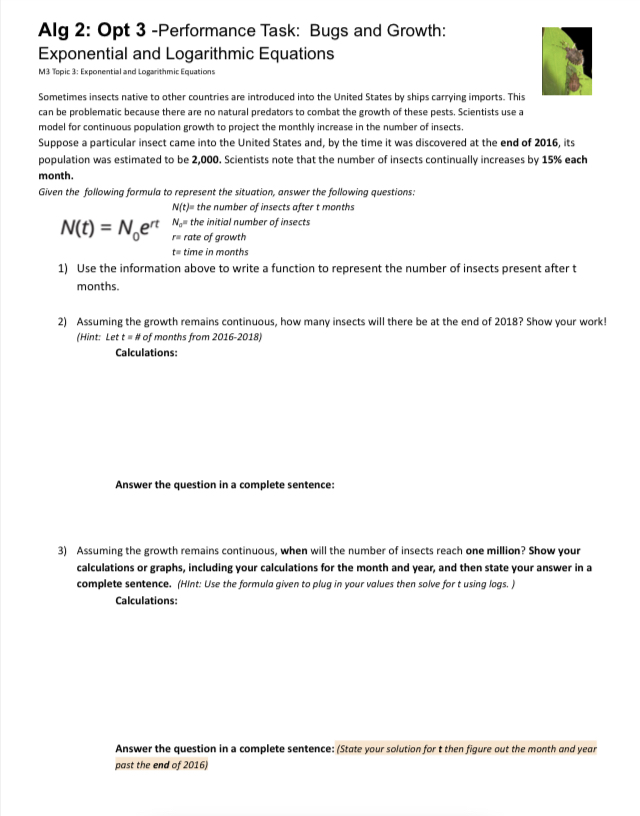
Alg 2: Opt 3 -Performance Task: Bugs and Growth: Exponential and Logarithmic Equations M3 Topic 3: Exponential and Logarithmic Equations Sometimes insects native to other countries are introduced into the United States by ships carrying imports. This can be problematic because there are no natural predators to combat the growth of these pests. Scientists use a model for continuous population growth to project the monthly increase in the number of insects. Suppose a particular insect came into the United States and, by the time it was discovered at the end of 2016, its population was estimated to be 2,000. Scientists note that the number of insects continually increases by 15% each month. Given the following formula to represent the situation, answer the following questions: N(t)= the number of insects after t months N(t) = Nert Now the initial number of insects r rate of growth t time in months 1) Use the information above to write a function to represent the number of insects present after t months. 2) Assuming the growth remains continuous, how many insects will there be at the end of 2018? Show your work! (Hint: Lett # of months from 2016-2018) Calculations: Answer the question in a complete sentence: 3) Assuming the growth remains continuous, when will the number of insects reach one million? Show your calculations or graphs, including your calculations for the month and year, and then state your answer in a complete sentence. (Hint: Use the formula given to plug in your values then solve for t using logs.) Calculations: Answer the question in a complete sentence: (State your solution for t then figure out the month and year past the end of 2016)
Step by Step Solution
There are 3 Steps involved in it

Get step-by-step solutions from verified subject matter experts
 Study Help