







Question: Algorithm A has worst time complexity TA(n) that satisfies recurrence relation: TA(n) = 26-TA(n/3) +200nIgn, Algorithm B has worst time complexity Tg(n) that satisfies recurrence
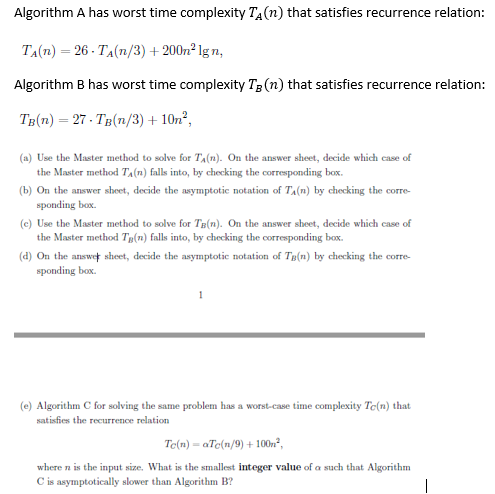
Algorithm A has worst time complexity TA(n) that satisfies recurrence relation: TA(n) = 26-TA(n/3) +200nIgn, Algorithm B has worst time complexity Tg(n) that satisfies recurrence relation: Tg(n) = 27. T}(n/3) +10n, (a) Use the Master method to solve for T.(n). On the answer sheet, decide which case of the Master method TA(n) falls into, by checking the corresponding box. (b) On the answer sheet, decide the asymptotic notation of T.(n) by checking the corre- sponding box (c) Use the Master method to solve for Te(n). On the answer sheet, decide which case of the Master method Ty(n) falls into, by checking the corresponding box (d) On the answet sheet, decide the asymptotic notation of Te(n) by checking the corre sponding box (e) Algorithm C for solving the same problem has a worst-case time complexity To(n) that satisfies the recurrence relation To(n) - aTo(n/9) +100m2, where n is the input size. What is the smallest integer value of a such that Algorithm C is asymptotically slower than Algorithm B
Step by Step Solution
There are 3 Steps involved in it

Get step-by-step solutions from verified subject matter experts
 Study Help