







Question: Algorithm A is a comparison - based sorting algorithm with best - case running time ( n ) , average - case running time (
Algorithm is a comparisonbased sorting algorithm with bestcase running time average
case running time and worstcase running time Which of the following is FALSE
regarding the decision tree of algorithm
A Some branch has height
B Some branch has height
C Most branches have height
D Some branch has a repeated comparison.
E There are at least leaves.
A
B
C
D
E Which of the following is NOT a common property of quicksort and quickselect?
A Making random choices makes both algorithms more robust.
B Both algorithms can be used to find the th statistic of the input.
C The recurrence relation representing the runtime is the same.
D The average runtime is asymptotically smaller than the worst case runtime.
E Both algorithms partition the input with respect to a pivot.
Consider an algorithm takes as input a digraph where and The
algorithm finds the indegree of all nodes and then removes the node with the smallest indegree.
After removing that node, the remaining node with the smallest indegree is removed, and so on until
all nodes have been removed. All nodes are listed in the order of removal. If the digraph is represented
using adjacency lists, and you can cache interim results, what is the most precise characterisation of
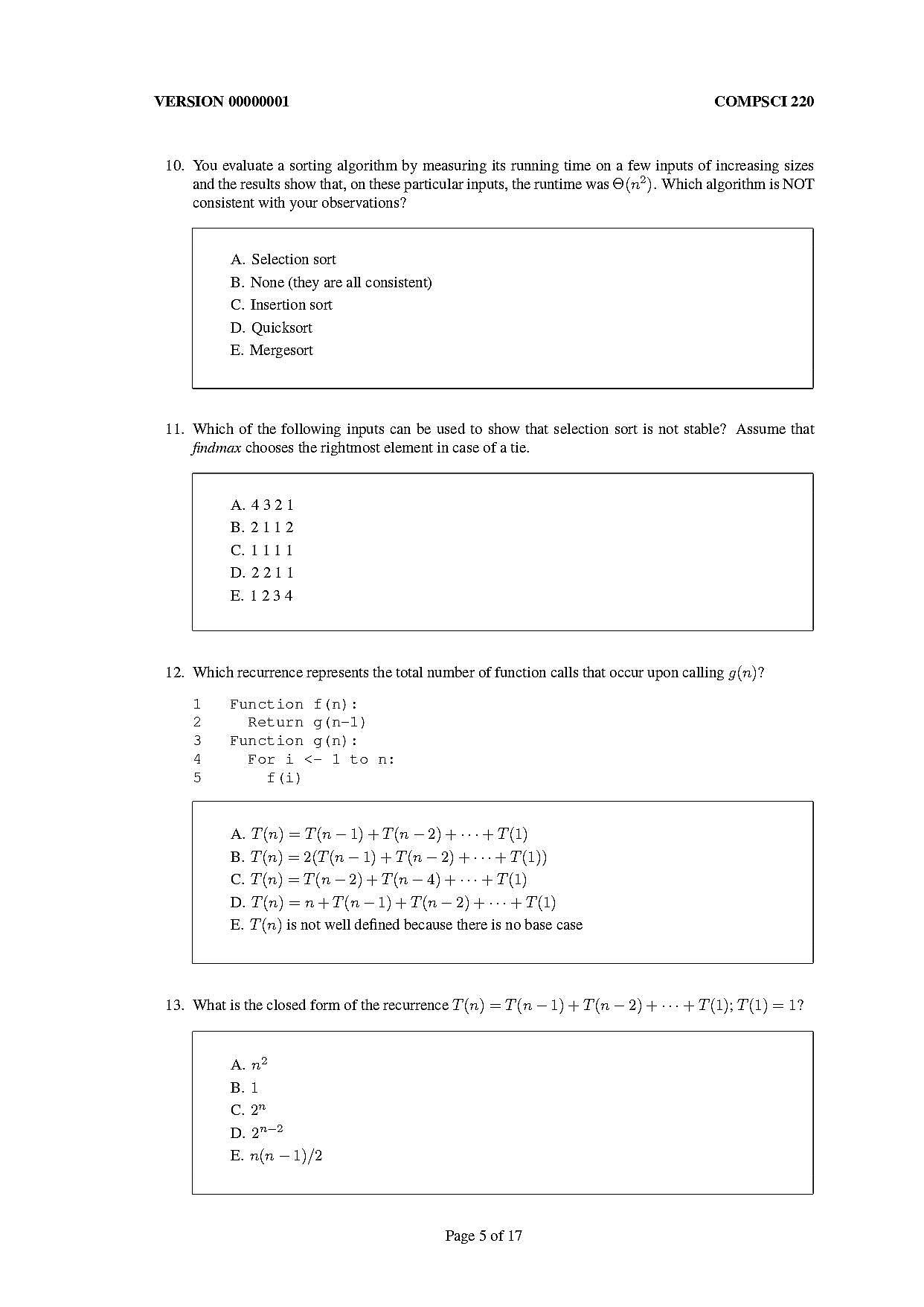
the running time of the algorithm?You evaluate a sorting algorithm by measuring its running time on a few inputs of increasing sizes
and the results show that, on these particular inputs, the runtime was Which algorithm is NOT
consistent with your observations?
A Selection sort
B None they are all consistent
C Insertion sort
D Quicksort
E Mergesort
Which of the following inputs can be used to show that selection sort is not stable? Assume that
findmax chooses the rightmost element in case of a tie.
Which recurrence represents the total number of function calls that occur upon calling
Acdots
Bcdots
Ccdots
Dcdots
E is not well defined because there is no base case
What is the closed form of the recurrence cdots;
Step by Step Solution
There are 3 Steps involved in it
1 Expert Approved Answer
Step: 1 Unlock

Question Has Been Solved by an Expert!
Get step-by-step solutions from verified subject matter experts
Step: 2 Unlock
Step: 3 Unlock
 Study Help