







Question: Algorithm question b. Computer networks should avoid single points of failure, that is, network nodes that can disconnect the network if they fail. A connected
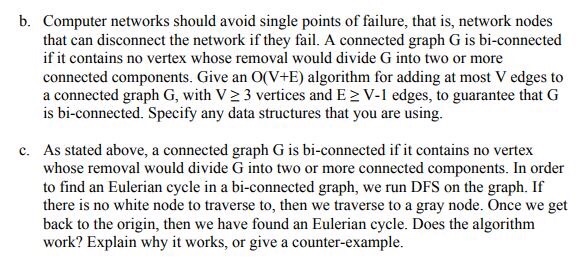
b. Computer networks should avoid single points of failure, that is, network nodes that can disconnect the network if they fail. A connected graph G is bi-connected if it contains no vertex whose removal would divide G into two or more connected components. Give an O(V+E) algorithm for adding at most V edges to a connected graph G, with V2 3 vertices and E 2 V-1 edges, to guarantee that G is bi-connected. Specify any data structures that you are using. As stated above, a connected graph G is bi-connected if it contains no vertex whose removal would divide G into two or more connected components. In order to find an Eulerian cycle in a bi-connected graph, we run DFS on the graph. If there is no white node to traverse to, then we traverse to a gray node. Once we get back to the origin, then we have found an Eulerian cycle. Does the algorithm work? Explain why it works, or give a counter-example c
Step by Step Solution
There are 3 Steps involved in it

Get step-by-step solutions from verified subject matter experts
 Study Help