







Question: algorithm source from : http://www.bioinfo.org.cn/~wangchao/maa/Numerical_Optimization.pdf at page 111 the answer need complete graph and datas thank you so much Implement Algorithm 5.2 and use to
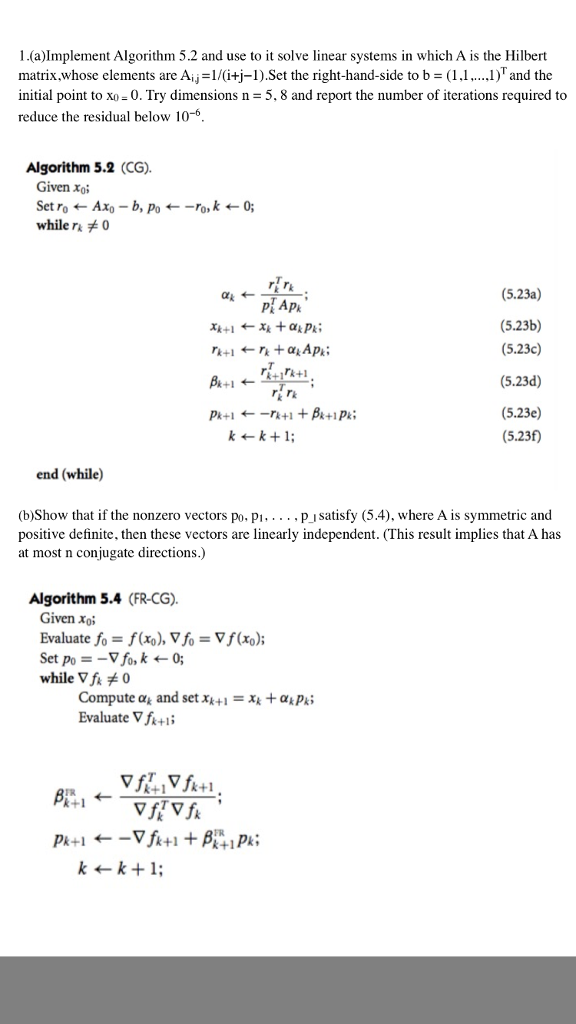
algorithm source from : http://www.bioinfo.org.cn/~wangchao/maa/Numerical_Optimization.pdf
at page 111
the answer need complete graph and datas thank you so much
Implement Algorithm 5.2 and use to it solve linear systems in which A is the Hilbert matrix, whose elements are A_i, j = 1/(i+j-1).Set the right-hand-side to b = (1, 1, ..., 1)^T and the initial point to x_0 = 0. Try dimensions n = 5, 8 and report the number of iterations required to reduce the residual below 10^-6. Given x_0: Set r_0 leftarrow Ax_0 - b, p_0 leftarrow r_0, k leftarrow 0: while r_k notequalto 0 alpha_k leftarrow r_k^T r_k/P_k^T Ap_k: x_k+1 leftarrow x_k + alpha_k P_k: r_k+1 leftarrow r_k + alpha_k Ap_k: beta_k+1 leftarrow r_k+1^T r_k+1/r_k^T r_k: P_k+1 leftarrow -r_k+1 + beta_k+1 p_k: k leftarrow k + 1: end (while) (b) Show that if the nonzero vectors p_0, p_1, ..., p_1 satisfy (5.4). where A is symmetric and positive definite, then these vectors are linearly independent. (This result implies that A has at most n conjugate directions.) Given x_0: Evaluate f_0 = f(x_0), nabla f_0 = nabla f(x_0): Set p_0 = - naba f_0, k leftarrow 0: while nabla f_k notequalto 0 Compute alpha_k and set x_k+1= x_k + alpha_k p_k: Evaluate nabla f_k+1: beta_k+1^TR leftarrow nabla f_k+1^T nabla f_k+1abla f_k^T nabla f_k: p_k+1 leftarrow -nabla f_k+1 + beta_k+1^TR p_k: k leftarrow k + 1
Step by Step Solution
There are 3 Steps involved in it

Get step-by-step solutions from verified subject matter experts
 Study Help