







Question: Algorithms: - Insertion sort - Shell sort - Mergesort - Quicksort - Radix sort - std::sort (on std::vector, it is already implemented in ) Input
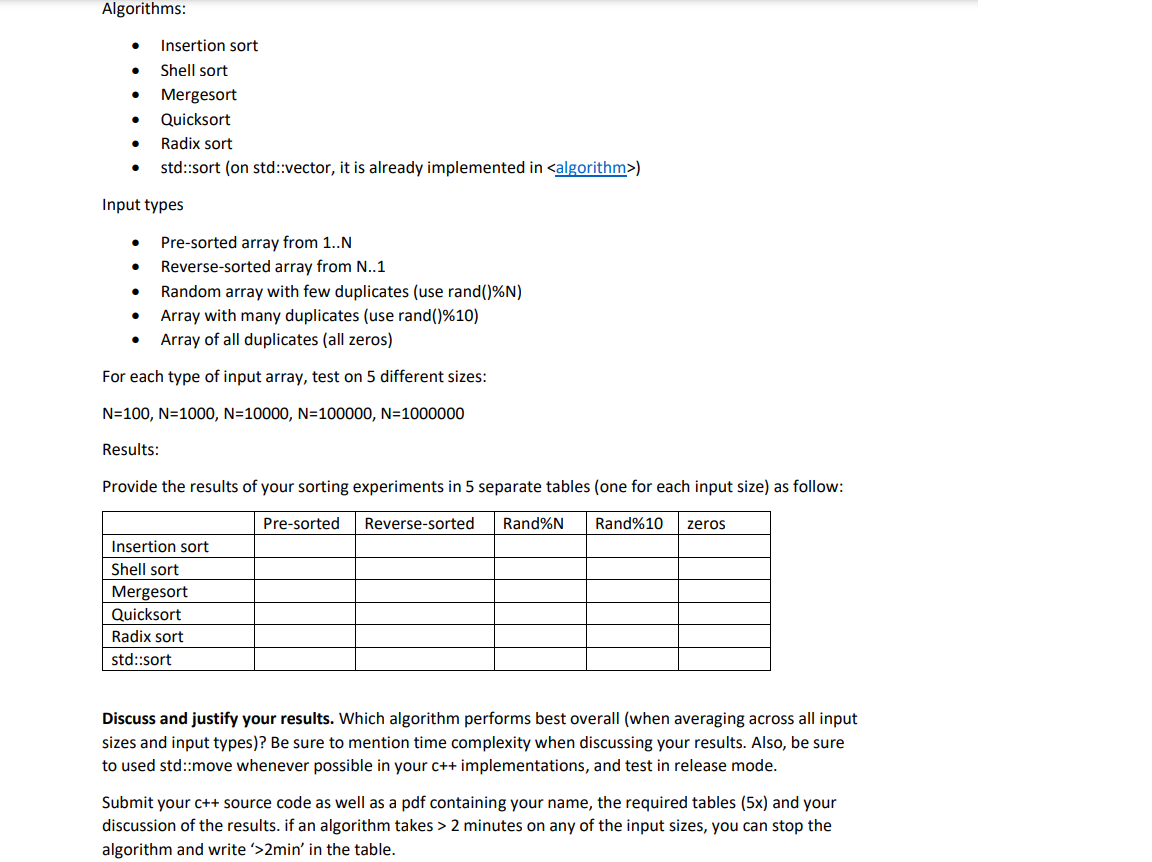
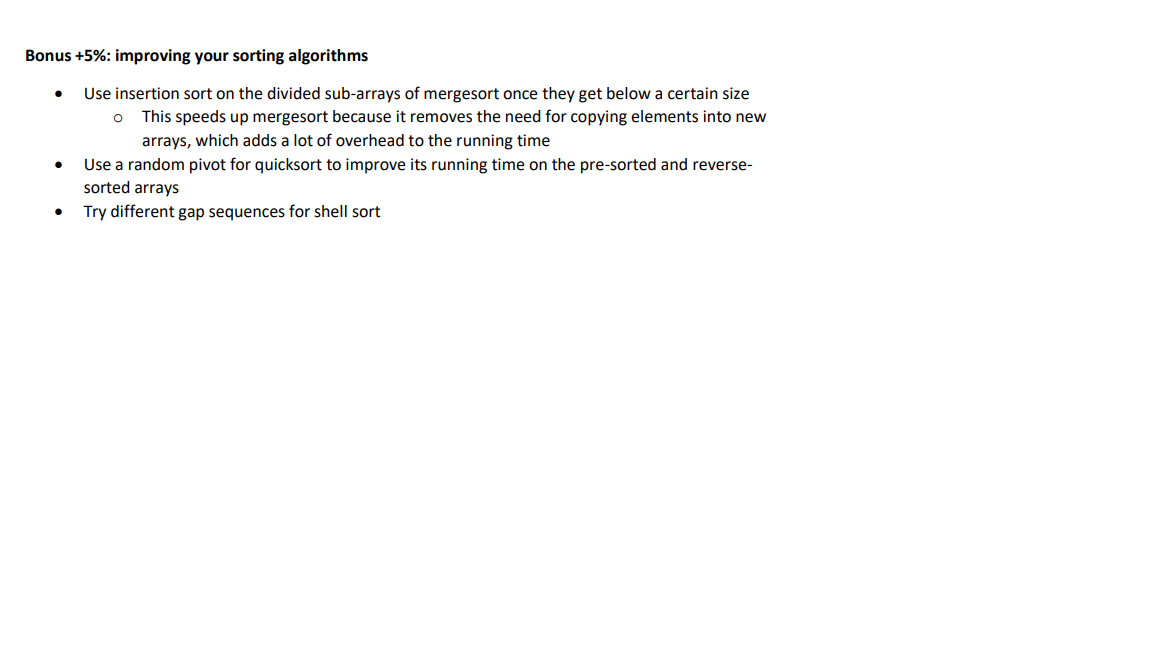
Algorithms: - Insertion sort - Shell sort - Mergesort - Quicksort - Radix sort - std::sort (on std::vector, it is already implemented in ) Input types - Pre-sorted array from 1.N - Reverse-sorted array from N..1 - Random array with few duplicates (use rand()\%N) - Array with many duplicates (use rand()\%10) - Array of all duplicates (all zeros) For each type of input array, test on 5 different sizes: N=100,N=1000,N=10000,N=100000,N=1000000 Results: Provide the results of your sorting experiments in 5 separate tables (one for each input size) as follow: Discuss and justify your results. Which algorithm performs best overall (when averaging across all input sizes and input types)? Be sure to mention time complexity when discussing your results. Also, be sure to used std::move whenever possible in your c++ implementations, and test in release mode. Submit your c++ source code as well as a pdf containing your name, the required tables (5x) and your discussion of the results. if an algorithm takes >2 minutes on any of the input sizes, you can stop the algorithm and write ' >2min in the table. Bonus +5% : improving your sorting algorithms - Use insertion sort on the divided sub-arrays of mergesort once they get below a certain size - This speeds up mergesort because it removes the need for copying elements into new arrays, which adds a lot of overhead to the running time - Use a random pivot for quicksort to improve its running time on the pre-sorted and reversesorted arrays - Try different gap sequences for shell sort
Step by Step Solution
There are 3 Steps involved in it

Get step-by-step solutions from verified subject matter experts
 Study Help