







Question: Algorithms Question! We are given a dictionary D, which is an array of n distinct strings, sorted in lexicographic order. We are also given a
Algorithms Question!
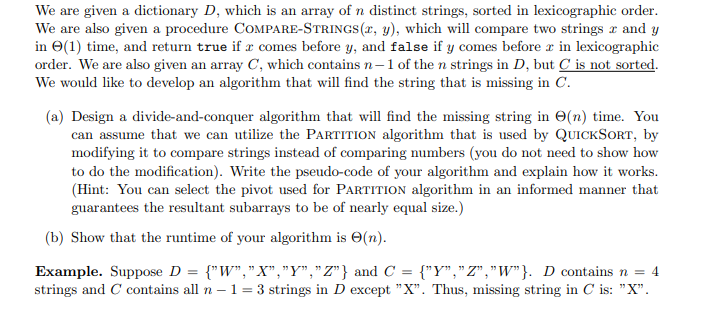
We are given a dictionary D, which is an array of n distinct strings, sorted in lexicographic order. We are also given a procedure Compare-Strings(x, y), which will compare two strings x and y in (1) time, and return true if x comes before y, and false if y comes before x in lexicographic order. We are also given an array C, which contains n1 of the n strings in D, but C is not sorted. We would like to develop an algorithm that will find the string that is missing in C.
Please note that it needs to be PSEUDOCODE and not real code.
We are given a dictionary D, which is an array of n distinct strings, sorted in lexicographic order. We are also given a procedure COMPARE-STRINGS (2, y), which will compare two strings x and y in (1) time, and return true if : comes before y, and false if y comes before r in lexicographic order. We are also given an array C, which contains n-1 of the n strings in D, but is not sorted. We would like to develop an algorithm that will find the string that is missing in C. (a) Design a divide-and-conquer algorithm that will find the missing string in O(n) time. You can assume that we can utilize the PARTITION algorithm that is used by QUICKSORT, by modifying it to compare strings instead of comparing numbers (you do not need to show how to do the modification). Write the pseudo-code of your algorithm and explain how it works. (Hint: You can select the pivot used for PARTITION algorithm in an informed manner that guarantees the resultant subarrays to be of nearly equal size.) (b) Show that the runtime of your algorithm is e(n). Example. Suppose D = {"W","X", "Y", "Z"} and C = {"Y","Z", "W"}. D contains n = 4 strings and contains all n - 1 = 3 strings in D except "X". Thus, missing string in C is: "X". We are given a dictionary D, which is an array of n distinct strings, sorted in lexicographic order. We are also given a procedure COMPARE-STRINGS (2, y), which will compare two strings x and y in (1) time, and return true if : comes before y, and false if y comes before r in lexicographic order. We are also given an array C, which contains n-1 of the n strings in D, but is not sorted. We would like to develop an algorithm that will find the string that is missing in C. (a) Design a divide-and-conquer algorithm that will find the missing string in O(n) time. You can assume that we can utilize the PARTITION algorithm that is used by QUICKSORT, by modifying it to compare strings instead of comparing numbers (you do not need to show how to do the modification). Write the pseudo-code of your algorithm and explain how it works. (Hint: You can select the pivot used for PARTITION algorithm in an informed manner that guarantees the resultant subarrays to be of nearly equal size.) (b) Show that the runtime of your algorithm is e(n). Example. Suppose D = {"W","X", "Y", "Z"} and C = {"Y","Z", "W"}. D contains n = 4 strings and contains all n - 1 = 3 strings in D except "X". Thus, missing string in C is: "X
Step by Step Solution
There are 3 Steps involved in it

Get step-by-step solutions from verified subject matter experts
 Study Help