







Question: Alice is trying to decide between two different block ciphers, FOO and BAR, for her application. Both FOO and BAR have the same block size
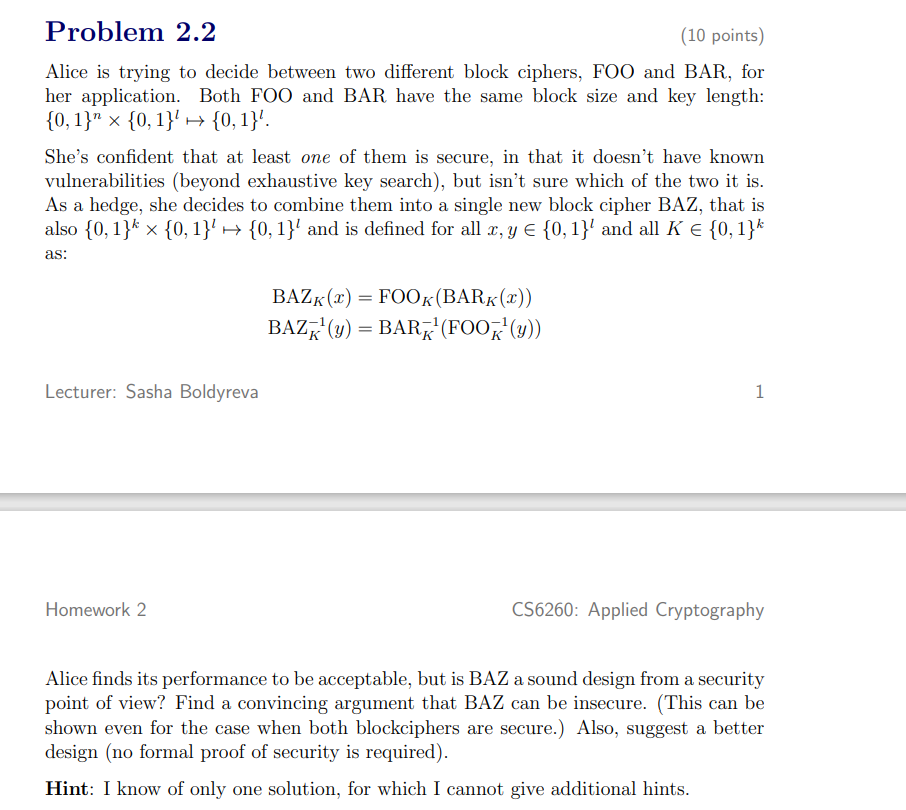
Alice is trying to decide between two different block ciphers, FOO and BAR, for her application. Both FOO and BAR have the same block size and key length: {0,1}n{0,1}l{0,1}l She's confident that at least one of them is secure, in that it doesn't have known vulnerabilities (beyond exhaustive key search), but isn't sure which of the two it is. As a hedge, she decides to combine them into a single new block cipher BAZ, that is also {0,1}k{0,1}l{0,1}l and is defined for all x,y{0,1}l and all K{0,1}k as: BAZK(x)BAZK1(y)=FOOK(BARK(x))=BARK1(FOOK1(y)) Lecturer: Sasha Boldyreva 1 Homework 2 CS6260: Applied Cryptography Alice finds its performance to be acceptable, but is BAZ a sound design from a security point of view? Find a convincing argument that BAZ can be insecure. (This can be shown even for the case when both blockciphers are secure.) Also, suggest a better design (no formal proof of security is required). Hint: I know of only one solution, for which I cannot give additional hints
Step by Step Solution
There are 3 Steps involved in it

Get step-by-step solutions from verified subject matter experts
 Study Help