







Question: = Alice's computer stores files using the following steps: 1. For each file F, the computer creates an encrypted version of the file S =
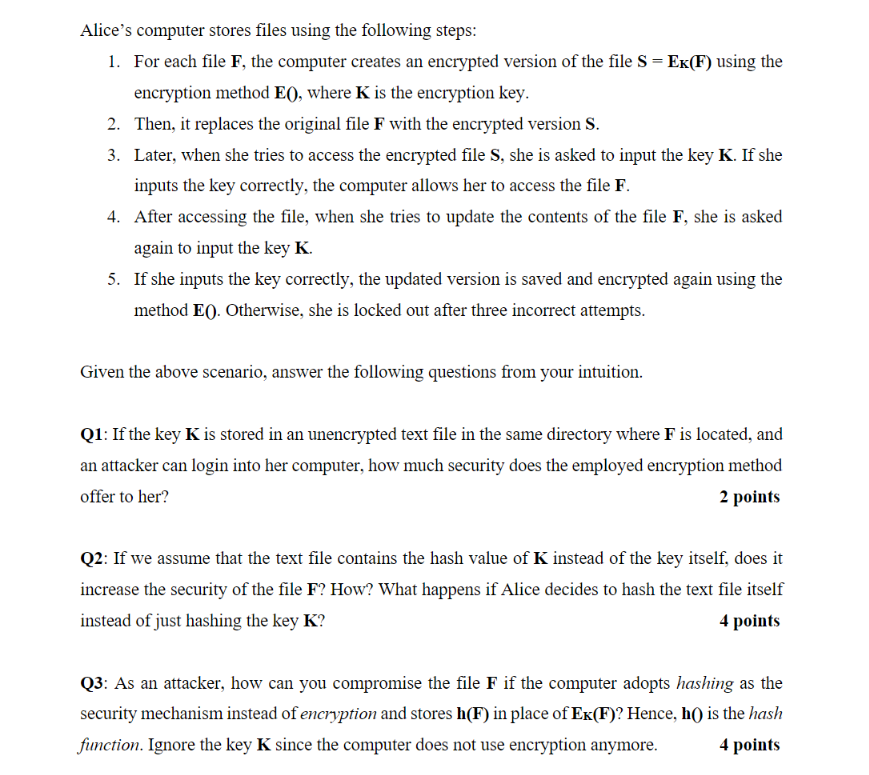
= Alice's computer stores files using the following steps: 1. For each file F, the computer creates an encrypted version of the file S = Ek(F) using the encryption method E(), where K is the encryption key. 2. Then, it replaces the original file F with the encrypted version S. 3. Later, when she tries to access the encrypted file S, she is asked to input the key K. If she inputs the key correctly, the computer allows her to access the file F. 4. After accessing the file, when she tries to update the contents of the file F, she is asked again to input the key K. 5. If she inputs the key correctly, the updated version is saved and encrypted again using the method E(). Otherwise, she is locked out after three incorrect attempts. Given the above scenario, answer the following questions from your intuition. Q1: If the key K is stored in an unencrypted text file in the same directory where F is located, and an attacker can login into her computer, how much security does the employed encryption method offer to her? 2 points Q2: If we assume that the text file contains the hash value of K instead of the key itself, does it increase the security of the file F? How? What happens if Alice decides to hash the text file itself instead of just hashing the key K? 4 points Q3: As an attacker, how can you compromise the file F if the computer adopts hashing as the security mechanism instead of encryption and stores h(F) in place of Ex(F)? Hence, h() is the hash function. Ignore the key K since the computer does not use encryption anymore. 4 points
Step by Step Solution
There are 3 Steps involved in it

Get step-by-step solutions from verified subject matter experts
 Study Help