



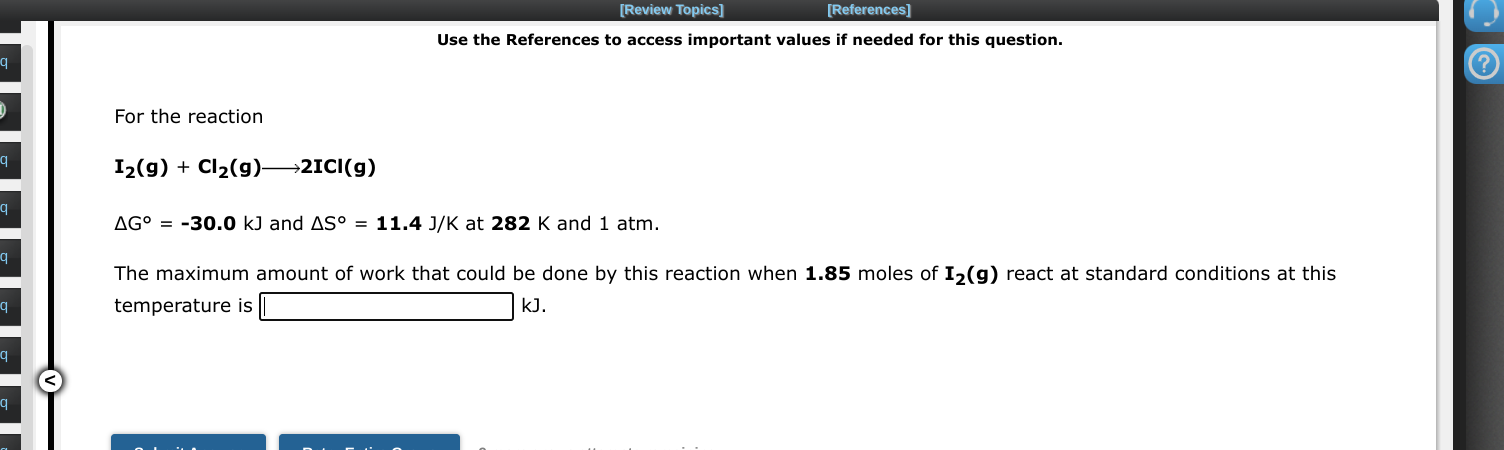
Question: all 4 plz plzz Use the References to access important values if needed for this question. For the reaction I2(g)+Cl2(g)2ICl(g) G=30.0kJ and S=11.4J/K at 282K
all 4 plz plzz
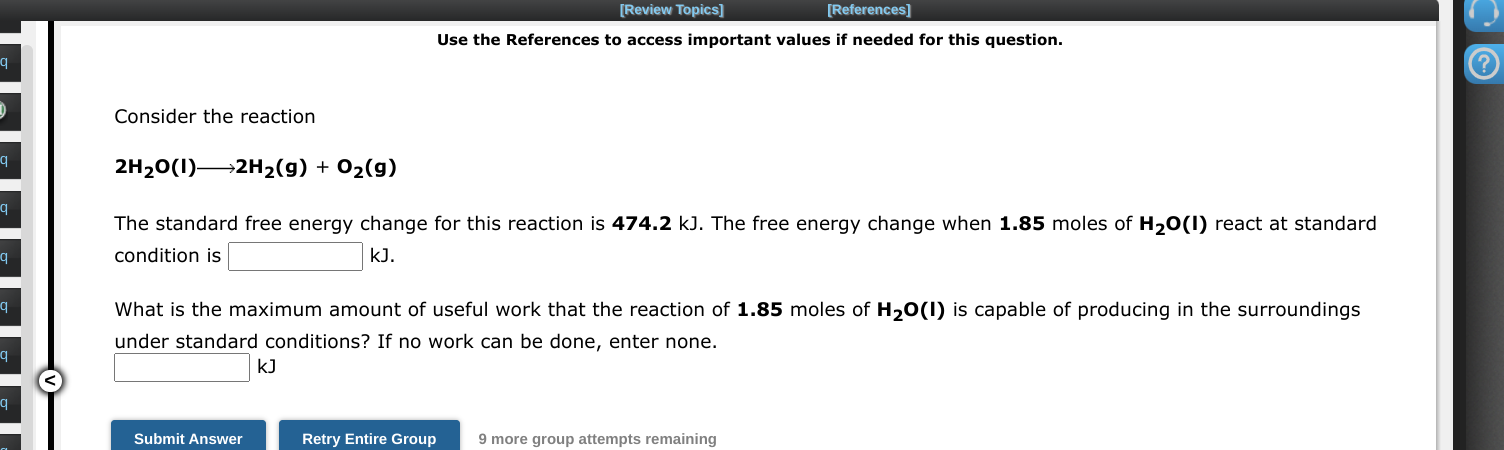
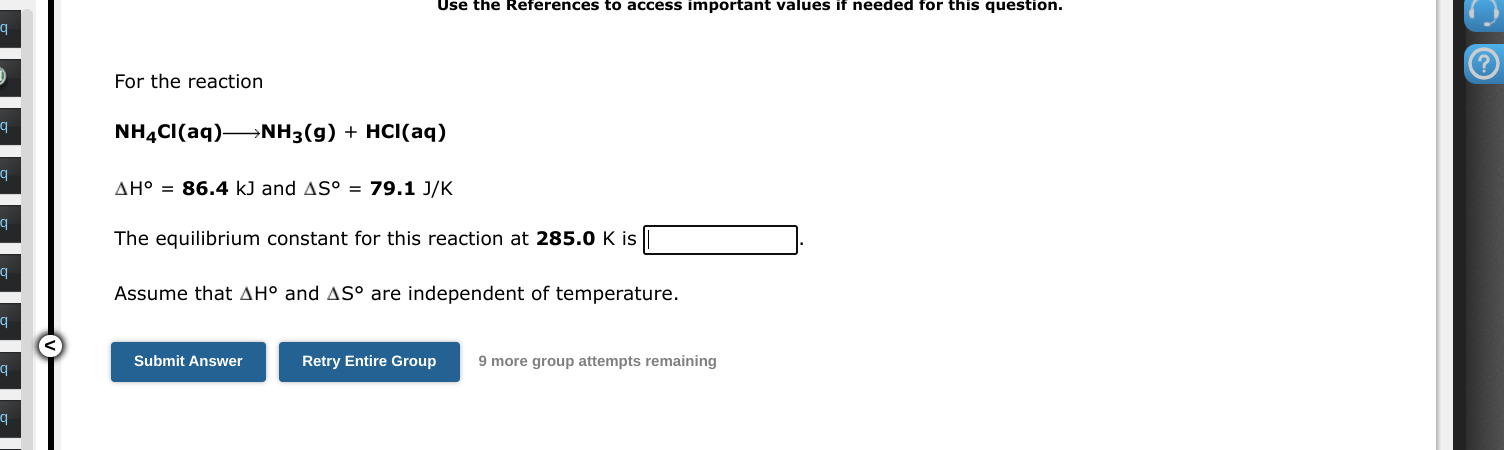
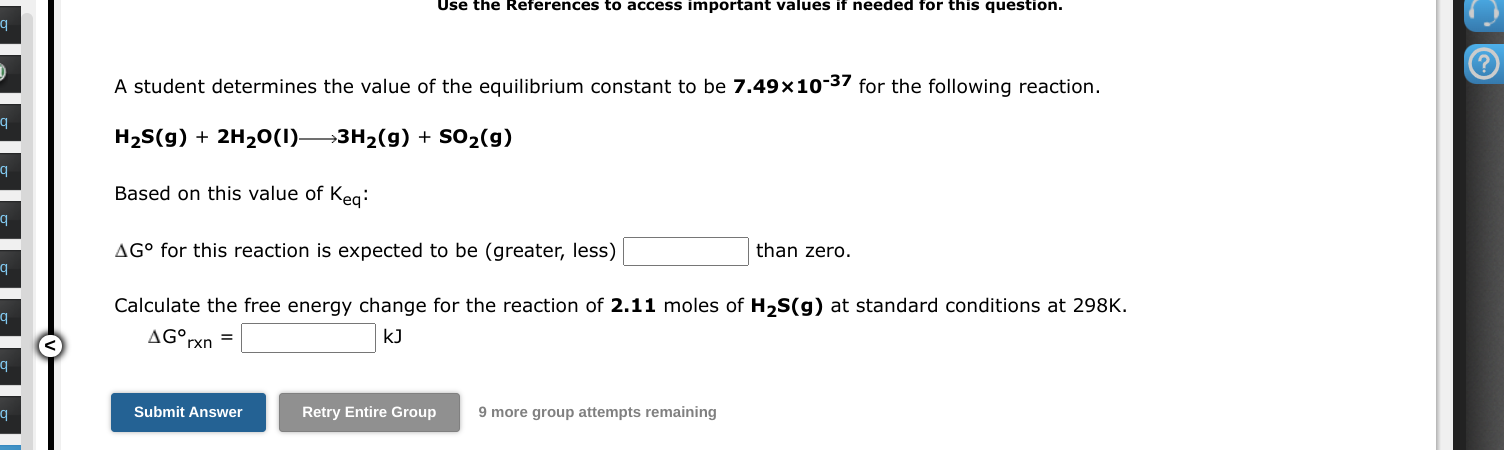
Use the References to access important values if needed for this question. For the reaction I2(g)+Cl2(g)2ICl(g) G=30.0kJ and S=11.4J/K at 282K and 1 atm. The maximum amount of work that could be done by this reaction when 1.85 moles of I2(g) react at standard conditions at this temperature is kJ. Use the References to access important values if needed for this question. Consider the reaction 2H2O(I)2H2(g)+O2(g) The standard free energy change for this reaction is 474.2kJ. The free energy change when 1.85 moles of H2O(I) react at standard condition is k. What is the maximum amount of useful work that the reaction of 1.85 moles of H2O(I) is capable of producing in the surroundings under standard conditions? If no work can be done, enter none. k] For the reaction NH4Cl(aq)NH3(g)+HCl(aq) H=86.4kJ and S=79.1J/K The equilibrium constant for this reaction at 285.0K is Assume that H and S are independent of temperature. 9 more group attempts remaining A student determines the value of the equilibrium constant to be 7.491037 for the following reaction. H2S(g)+2H2O(l)3H2(g)+SO2(g) Based on this value of Keq : G for this reaction is expected to be (greater, less) than zero. Calculate the free energy change for the reaction of 2.11 moles of H2S(g) at standard conditions at 298K. Grxn=kJ 9 more group attempts remaining
Step by Step Solution
There are 3 Steps involved in it

Get step-by-step solutions from verified subject matter experts