



Question: All answers have to be exact, not using decimals. Bare answers will count as no answer: you have to show all your work, including intermediate
All answers have to be exact, not using decimals. Bare answers will count as "no answer": you have to show all your work, including intermediate steps, and explain how you reached your conclusion. Please write the words clearly
1. Consider the function f(x) =x3+x+ 1 You can see from its graph that it is invertible. Prove it by computing the derivative and explain why the result proves that f is invertible (it actually proves more: not only does f1 exist, it is also differentiable). |
2. A problem of considerable importance in astronomy, arising in the study of planetary motion, is the determination of the "eccentric anomaly" E of the planet. It satisfies the equation: E c sin(E) = T2t, where t is time in years, T is the period of the orbit and c is a constant called the eccentricity. Suppose c= 0.9, and T= 10 years. a. Find E(t) when E=3 b. When is E=3? |
3. During an adiabatic process in chemistry, the pressure P and volume V of a certain element in a container are always related by the equation PV3/2=32, where V is measured in m3(cubic meters) and P is measured in N/m2(Newtons per square meter). a. Use differentials (or a linear approximation) to estimate the pressure when the volume is 1.1m3. Notice that when the volume is 1m, you can compute the pressure exactly. b. Suppose that your measurement of the volume is not exact, but is off by a relative error of 2%. Find the corresponding relative error (as a percentage) for the pressure. Give the correct units. !!!! Note If we denote the uncertainty in a measure of quantity x as x, the relative error is xx, which we approximate by linear approximation with xdx, which involves applying differentiation rules, as needed, when x is expressed as a function of another quantity, to find an expression for dx. |
4.
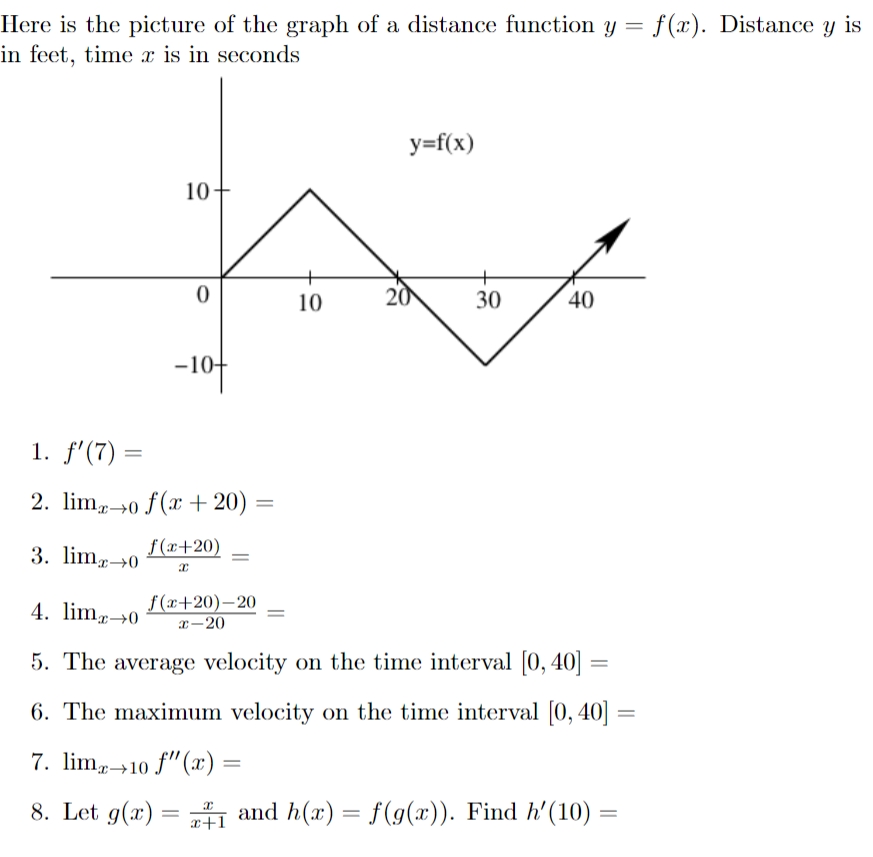
Here is the picture of the graph of a distance function y = f (3") Distance 3; is in feet1 time :1: is in seconds 1. f'(7) = 2. Imam.m m: + 20) = f m+2n _ 3.1imm_,n m _ 4. liming fgm+2n)2n _ m2 _ 5. The average velocity on the time interval [0, 40] = . The maximum velocity on the time interval [0, 40] = 6 7. 11mm_,m f"(;r;) = 8- Let 90v) = T and Mm) = me. Find mm =
Step by Step Solution
There are 3 Steps involved in it

Get step-by-step solutions from verified subject matter experts