







Question: All information is given, if you cannot construct a decision table, then you can leave that part out You are a physician trying to decide
All information is given, if you cannot construct a decision table, then you can leave that part out
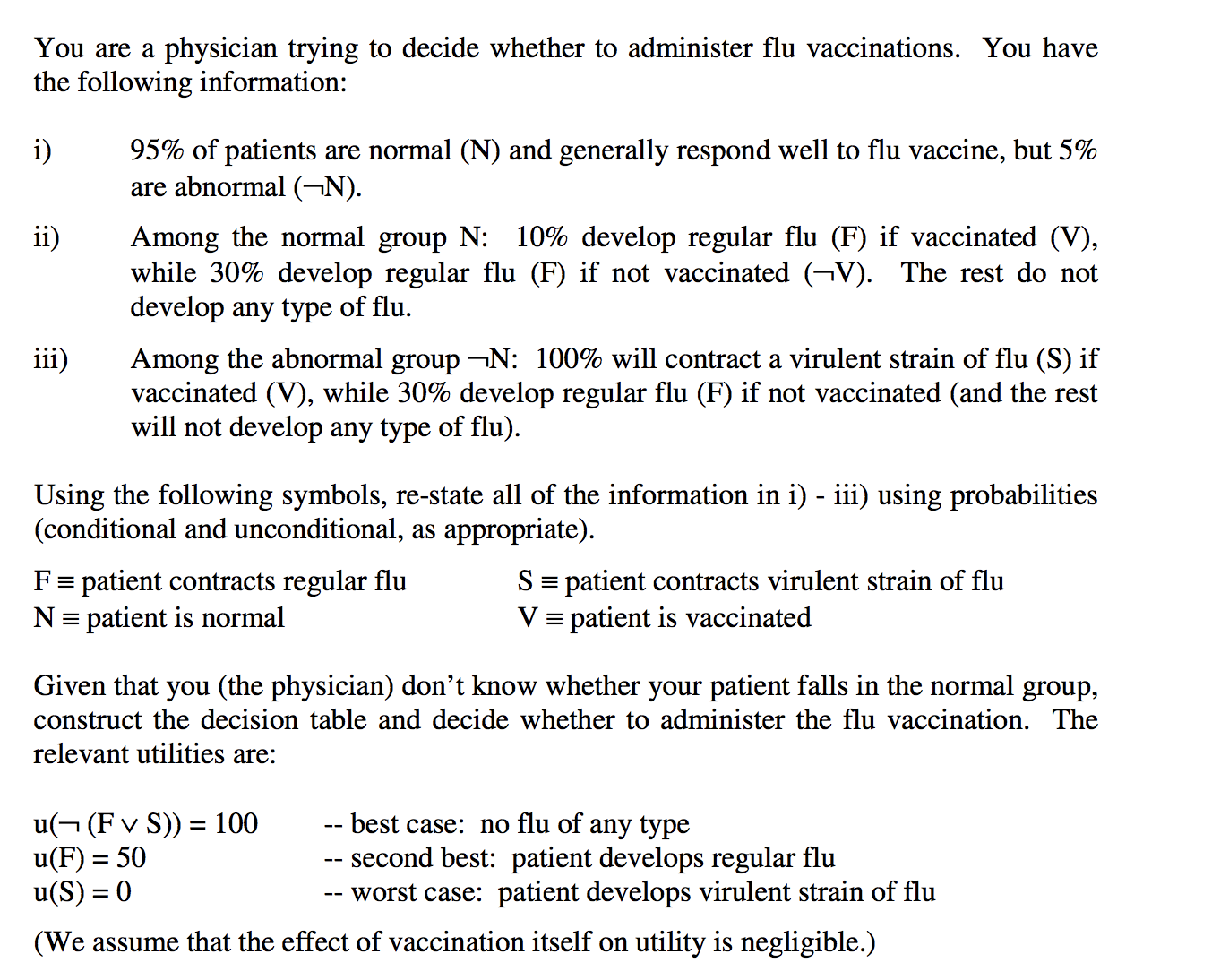
You are a physician trying to decide whether to administer u vaccinations. You have the following information: i) 95% of patients are normal (N) and generally respond well to u vaccine, but 5% are abnormal (_IN). ii) Among the normal group N: 10% develop regular u (F) if vaccinated (V), while 30% develop regular u (P) if not vaccinated (_IV). The rest do not develop any type of u. iii) Among the abnormal group _IN: 100% will contract a virulent strain of u (S) if vaccinated (V), while 30% develop regular u (F) if not vaccinated (and the rest will not develop any type of u). Using the following symbols, re-state all of the information in i) - iii) using probabilities (conditional and unconditional, as appropriate). F E patient contracts regular u S 2 patient contracts virulent strain of u N 2 patient is normal V 2 patient is vaccinated Given that you (the physician) don't know whether your patient falls in the normal group, construct the decision table and decide whether to administer the u vaccination. The relevant utilities are: u(u (F v 3)) = 100 -- best case: no u of any type u(F) = 50 -- second best: patient develops regular u u(S) = 0 -- worst case: patient develops virulent strain of u (We assume that the effect of vaccination itself on utility is negligible.)
Step by Step Solution
There are 3 Steps involved in it

Get step-by-step solutions from verified subject matter experts
 Study Help