







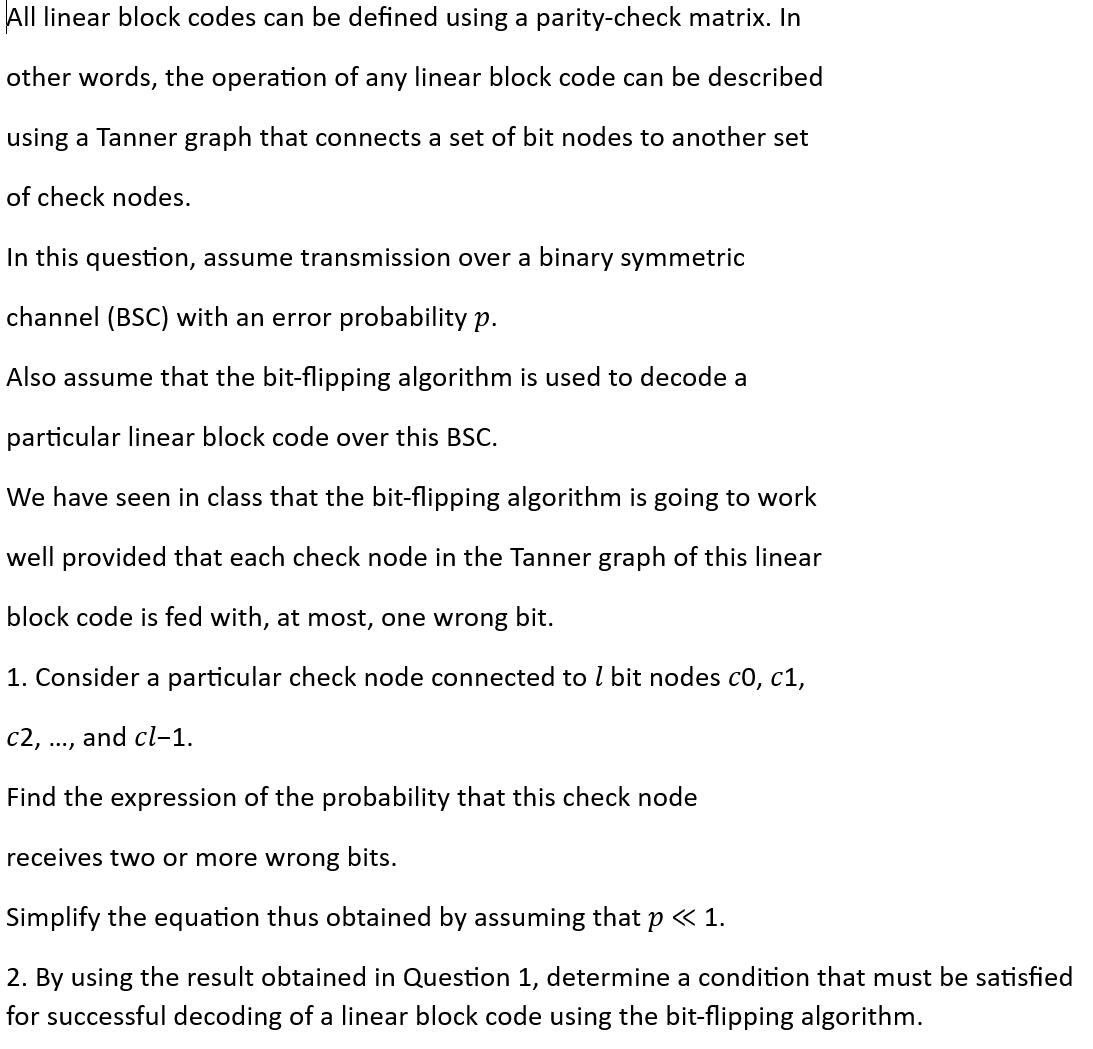
Question: All linear block codes can be defined using a parity - check matrix. In other words, the operation of any linear block code can be
All linear block codes can be defined using a paritycheck matrix. In
other words, the operation of any linear block code can be described
using a Tanner graph that connects a set of bit nodes to another set
of check nodes.
In this question, assume transmission over a binary symmetric
channel BSC with an error probability
Also assume that the bitflipping algorithm is used to decode a
particular linear block code over this BSC
We have seen in class that the bitflipping algorithm is going to work
well provided that each check node in the Tanner graph of this linear
block code is fed with, at most, one wrong bit.
Consider a particular check node connected to bit nodes
dots, and
Find the expression of the probability that this check node
receives two or more wrong bits.
Simplify the equation thus obtained by assuming that
By using the result obtained in Question determine a condition that must be satisfied
for successful decoding of a linear block code using the bitflipping algorithm.
Step by Step Solution
There are 3 Steps involved in it
1 Expert Approved Answer
Step: 1 Unlock

Question Find io in the circuit of figure 1 using superpositio... View full answer
Question Has Been Solved by an Expert!
Get step-by-step solutions from verified subject matter experts
Step: 2 Unlock
Step: 3 Unlock
 Study Help