







Question: all parts pleas Question Help Determine whether (a) through (c) are true, and give an explanation or counterexample. a. For linear functions, the slope of
all parts pleas
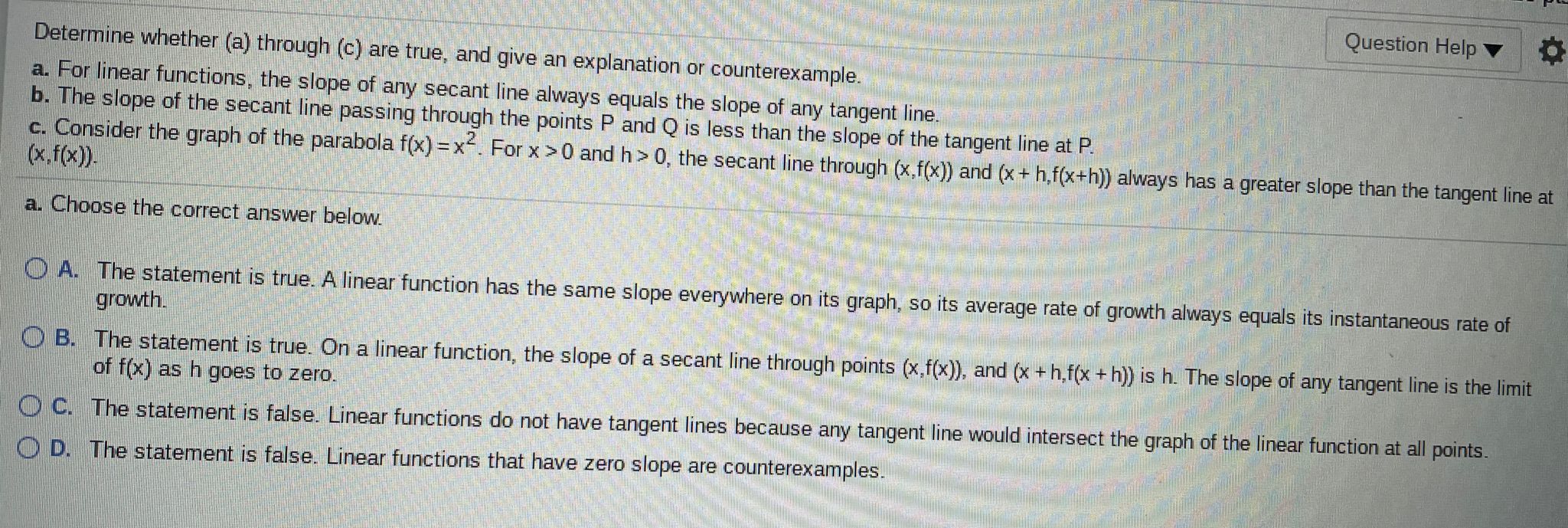 Question Help Determine whether (a) through (c) are true, and give an explanation or counterexample. a. For linear functions, the slope of any secant line always equals the slope of any tangent line. b. The slope of the secant line passing through the points P and Q is less than the slope of the tangent line at P. c. Consider the graph of the parabola f(x) = x-. For x >0 and h > 0, the secant line through (x,f(x)) and (x + h,f(x+h)) always has a greater slope than the tangent line at (x. f(x))_ a. Choose the correct answer below. A. The statement is true. A linear function has the same slope everywhere on its graph, so its average rate of growth always equals its instantaneous rate of growth. () B. The statement is true. On a linear function, the slope of a secant line through points (x,f(x)), and (x + h,f(x + h)) is h. The slope of any tangent line is the limit of f(x) as h goes to zero. O C. The statement is false. Linear functions do not have tangent lines because any tangent line would intersect the graph of the linear function at all points. D. The statement is false. Linear functions that have zero slope are counterexamples
Step by Step Solution
There are 3 Steps involved in it
1 Expert Approved Answer
Step: 1 Unlock

Question Has Been Solved by an Expert!
Get step-by-step solutions from verified subject matter experts
Step: 2 Unlock
Step: 3 Unlock
 Study Help