







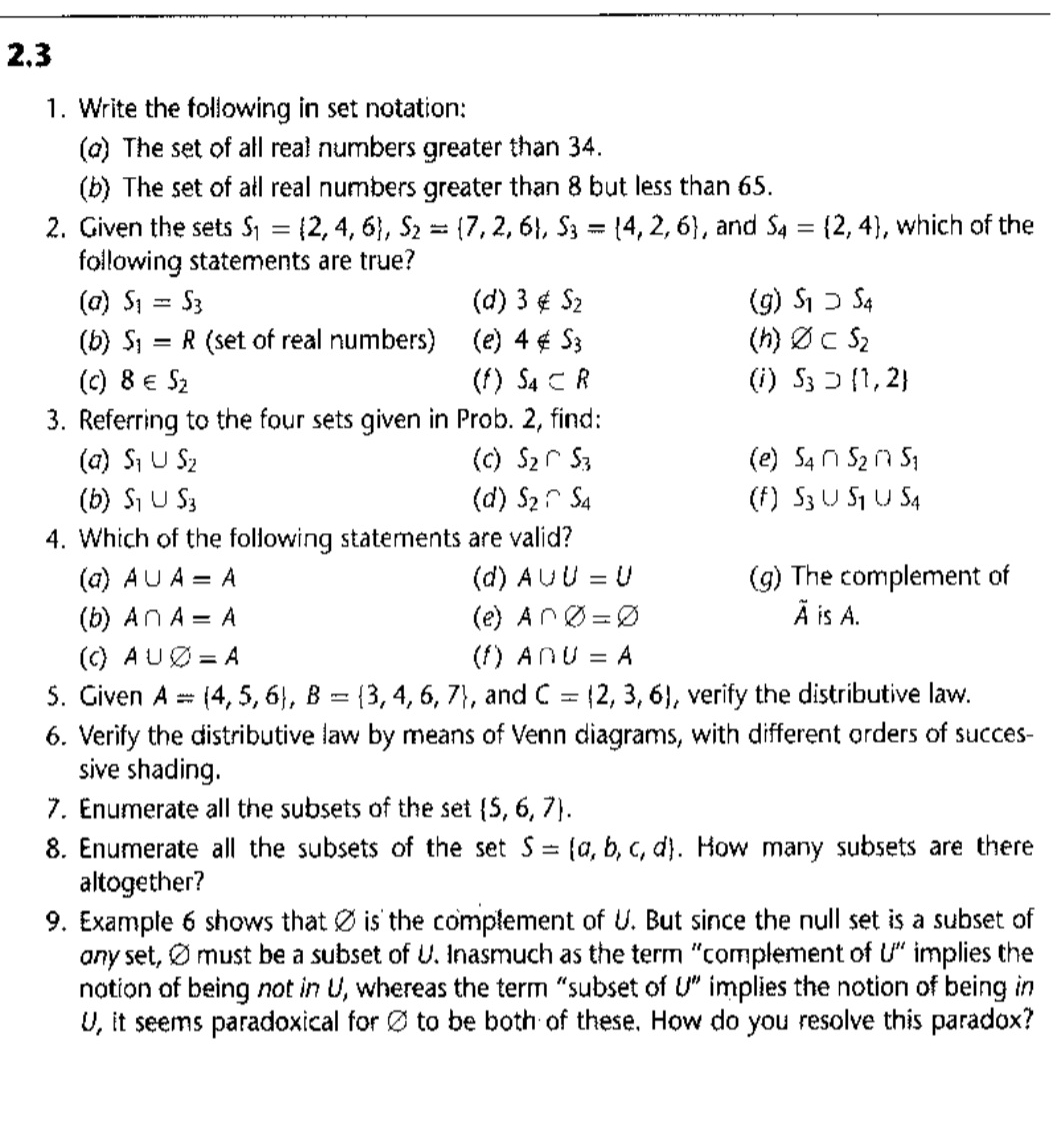
Question: all questions from 1 to 9 13 . Write the following In set notation: (a) The set of all real numbers greater than 34. (b)
all questions from 1 to 9
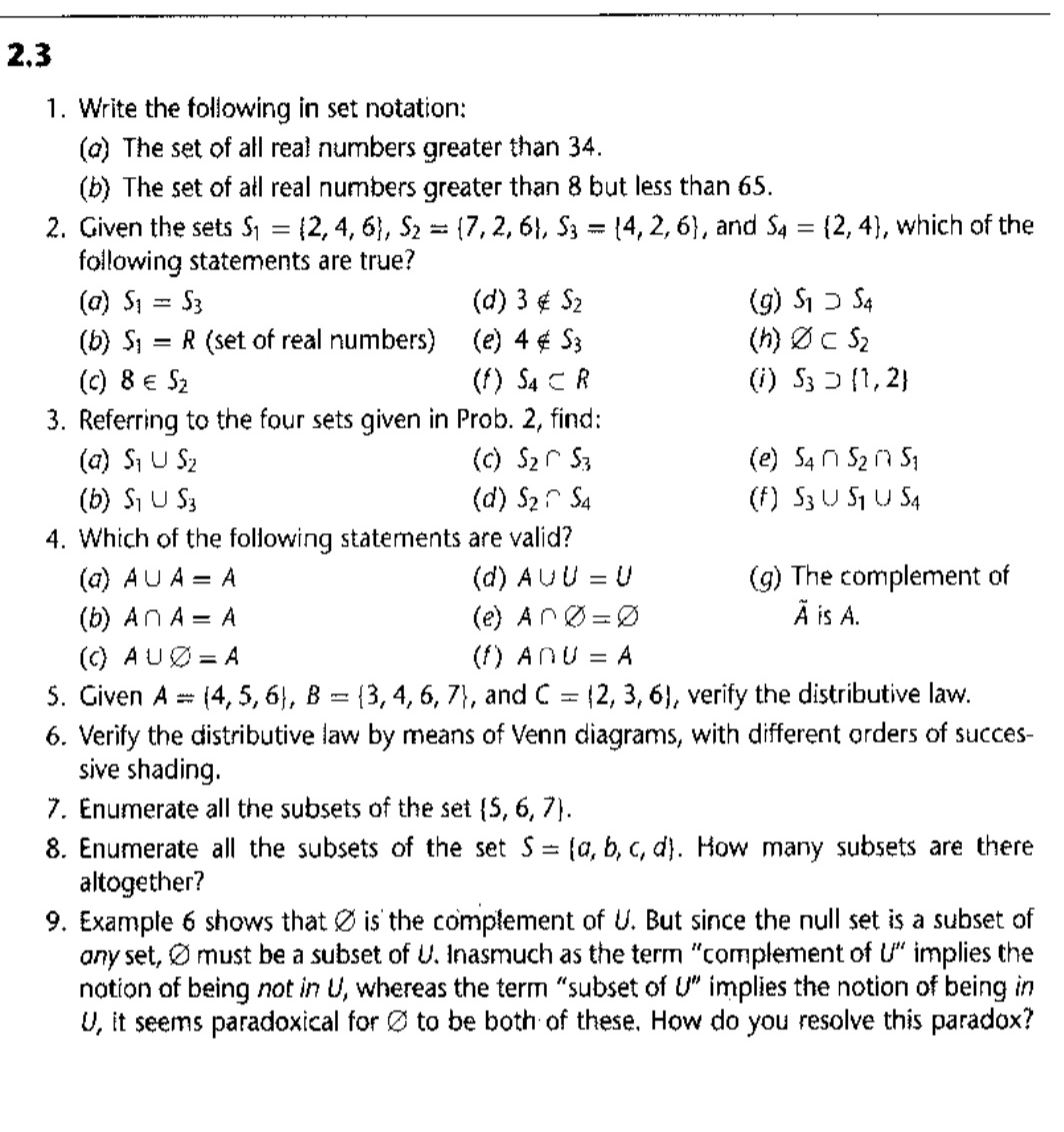
13 . Write the following In set notation: (a) The set of all real numbers greater than 34. (b) The set of all real numbers greater than B but less than 65. . Given the sets 51 =12, 4, 6}, $2 = [7. 2. 6|, 5; = [4, 2, 6}, and $4 = [2, 4}, which of the following statements are true? (a) s; = 53 (d) 3 e 52 (g) 51 a 54 (b) S; = R (set of real numbers} (9) 4 e 53 (h) E C 52 (c) 8 e 32 (f) 54 c R (i) 53 :J [1,2] . Referring to the four sets given in Prob. 2, find: (0) 31 U 32 (C) 52 IH 53 (E) 54 Fl 52 l1 5! (b) 31 U S; (d) 52 r\" 54 (f) 53 U 51 u 54 Which of the following statements are valid? (0) A U A = A (d) A U U = U (9) The complement of (b)AnA=A (e}An= isA. (C)AU=A (f)AnU=A . Given A = [4, 5, 6], B = [3, 4, 6, 7i, and C = [2, 3, 6], verify the distributive law. Verify the distributive law by means of Venn diagrams, with different orders of succes- sive shading. . Enumerate all the subsets of the set {5, 6, 7]. Enumerate all the subsets of the set 5 = [o,b, ad}. How many subsets are there altogether? . Example 6 shows that 13 is' the co'niplement of U. But sinCe the null set is a subset of any set, Q! must be a subset of U. Inasmuch as the term "corn plernent of U" implies the notion of being not in U, whereas the term \"subset oi U" implies the notion of being in U, it seems paradoxical for 2] to be both of these. How do you resolve this paradox
Step by Step Solution
There are 3 Steps involved in it

Get step-by-step solutions from verified subject matter experts
 Study Help