







Question: ALL SECTIONS HIGHLIGHTED IN RED MUST BE COMPLETED BY EACH STUDENT BEFORE ENTERING LAB. SECTIONS IN BLUE MUST COMPLETED DURING LAB. Student Name: Lab Partner(s):
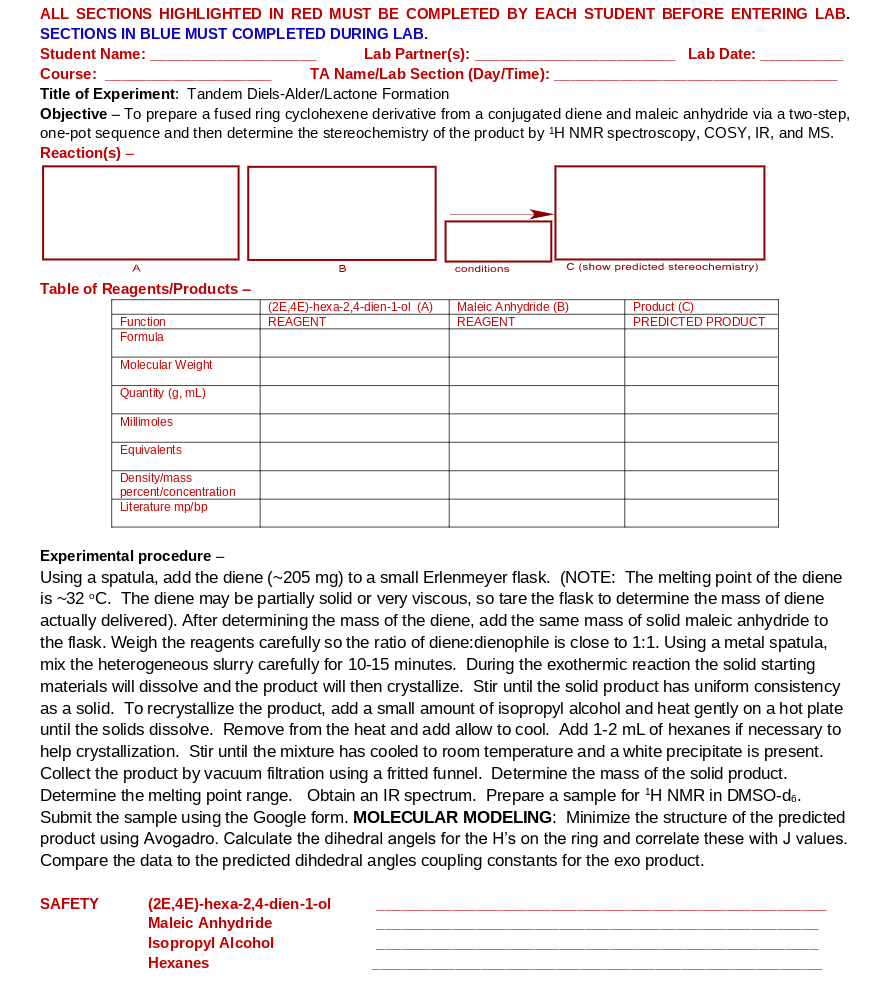
ALL SECTIONS HIGHLIGHTED IN RED MUST BE COMPLETED BY EACH STUDENT BEFORE ENTERING LAB. SECTIONS IN BLUE MUST COMPLETED DURING LAB. Student Name: Lab Partner(s): Lab Date: Course: TA Name/Lab Section (Day/Time): Title of Experiment: Tandem Diels-Alder/Lactone Formation Objective - To prepare a fused ring cyclohexene derivative from a conjugated diene and maleic anhydride via a two-step, one-pot sequence and then determine the stereochemistry of the product by 1H NMR spectroscopy, COSY, IR, and MS. Reaction(s) - Table of Reacdents/Products - Experimental procedure - Using a spatula, add the diene ( 205mg ) to a small Erlenmeyer flask. (NOTE: The melting point of the diene is 32C. The diene may be partially solid or very viscous, so tare the flask to determine the mass of diene actually delivered). After determining the mass of the diene, add the same mass of solid maleic anhydride to the flask. Weigh the reagents carefully so the ratio of diene:dienophile is close to 1:1. Using a metal spatula, mix the heterogeneous slurry carefully for 10-15 minutes. During the exothermic reaction the solid starting materials will dissolve and the product will then crystallize. Stir until the solid product has uniform consistency as a solid. To recrystallize the product, add a small amount of isopropyl alcohol and heat gently on a hot plate until the solids dissolve. Remove from the heat and add allow to cool. Add 1-2 mL of hexanes if necessary to help crystallization. Stir until the mixture has cooled to room temperature and a white precipitate is present. Collect the product by vacuum filtration using a fritted funnel. Determine the mass of the solid product. Determine the melting point range. Obtain an IR spectrum. Prepare a sample for 1H NMR in DMSO- d6. Submit the sample using the Google form. MOLECULAR MODELING: Minimize the structure of the predicted product using Avogadro. Calculate the dihedral angels for the H's on the ring and correlate these with J values. Compare the data to the predicted dihdedral angles coupling constants for the exo product. ALL SECTIONS HIGHLIGHTED IN RED MUST BE COMPLETED BY EACH STUDENT BEFORE ENTERING LAB. SECTIONS IN BLUE MUST COMPLETED DURING LAB. Student Name: Lab Partner(s): Lab Date: Course: TA Name/Lab Section (Day/Time): Title of Experiment: Tandem Diels-Alder/Lactone Formation Objective - To prepare a fused ring cyclohexene derivative from a conjugated diene and maleic anhydride via a two-step, one-pot sequence and then determine the stereochemistry of the product by 1H NMR spectroscopy, COSY, IR, and MS. Reaction(s) - Table of Reacdents/Products - Experimental procedure - Using a spatula, add the diene ( 205mg ) to a small Erlenmeyer flask. (NOTE: The melting point of the diene is 32C. The diene may be partially solid or very viscous, so tare the flask to determine the mass of diene actually delivered). After determining the mass of the diene, add the same mass of solid maleic anhydride to the flask. Weigh the reagents carefully so the ratio of diene:dienophile is close to 1:1. Using a metal spatula, mix the heterogeneous slurry carefully for 10-15 minutes. During the exothermic reaction the solid starting materials will dissolve and the product will then crystallize. Stir until the solid product has uniform consistency as a solid. To recrystallize the product, add a small amount of isopropyl alcohol and heat gently on a hot plate until the solids dissolve. Remove from the heat and add allow to cool. Add 1-2 mL of hexanes if necessary to help crystallization. Stir until the mixture has cooled to room temperature and a white precipitate is present. Collect the product by vacuum filtration using a fritted funnel. Determine the mass of the solid product. Determine the melting point range. Obtain an IR spectrum. Prepare a sample for 1H NMR in DMSO- d6. Submit the sample using the Google form. MOLECULAR MODELING: Minimize the structure of the predicted product using Avogadro. Calculate the dihedral angels for the H's on the ring and correlate these with J values. Compare the data to the predicted dihdedral angles coupling constants for the exo product
Step by Step Solution
There are 3 Steps involved in it

Get step-by-step solutions from verified subject matter experts
 Study Help