







Question: Allied Components Company Case Study & Analysis You recently went to work for Allied Components Company, a supplier of auto repair parts used in the
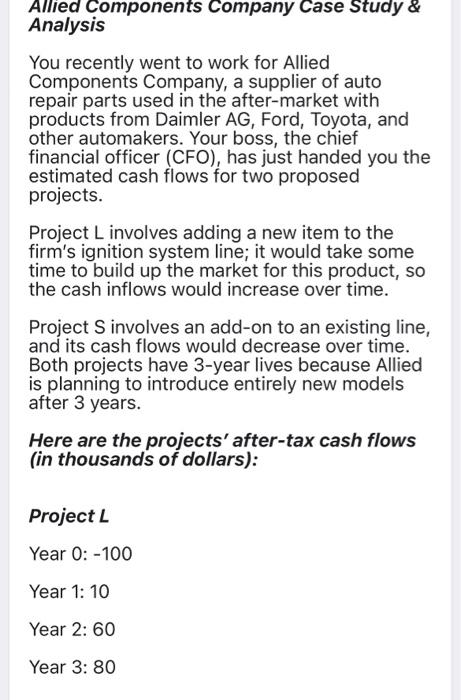
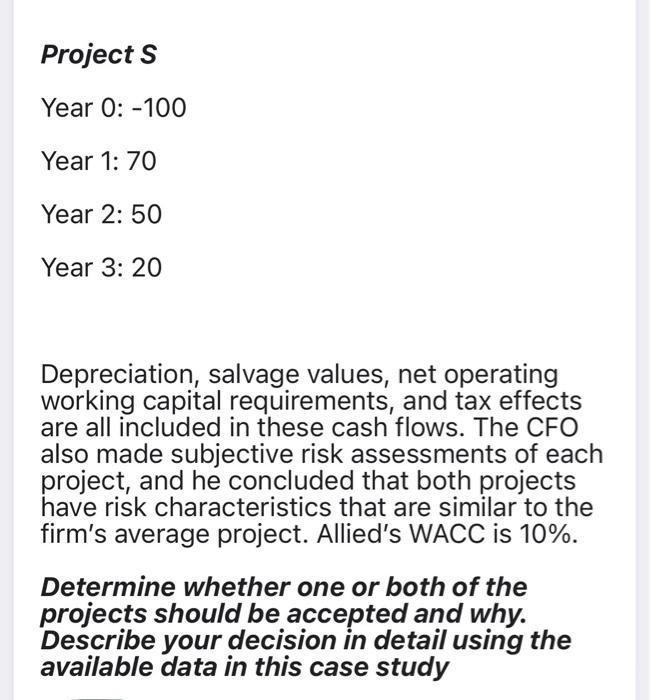
Allied Components Company Case Study & Analysis You recently went to work for Allied Components Company, a supplier of auto repair parts used in the after-market with products from Daimler AG, Ford, Toyota, and other automakers. Your boss, the chief financial officer (CFO), has just handed you the estimated cash flows for two proposed projects. Project L involves adding a new item to the firm's ignition system line; it would take some time to build up the market for this product, so the cash inflows would increase over time. Project S involves an add-on to an existing line, and its cash flows would decrease over time. Both projects have 3-year lives because Allied is planning to introduce entirely new models after 3 years. Here are the projects' after-tax cash flows (in thousands of dollars): Project L Year O: -100 Year 1: 10 Year 2: 60 Year 3: 80 Project S Year 0: -100 Year 1: 70 Year 2: 50 Year 3: 20 Depreciation, salvage values, net operating working capital requirements, and tax effects are all included in these cash flows. The CFO also made subjective risk assessments of each project, and he concluded that both projects have risk characteristics that are similar to the firm's average project. Allied's WACC is 10%. Determine whether one or both of the projects should be accepted and why. Describe your decision in detail using the available data in this case study
Step by Step Solution
There are 3 Steps involved in it

Get step-by-step solutions from verified subject matter experts
 Study Help